
Diaeretiella
Starý, 1960
Diaeretiella is a of in the Braconidae, Aphidiinae. The sole , Diaeretiella rapae, is a koinobiont endoparasitoid of aphids with documented occurrence in 87 countries. It has been recorded parasitizing approximately 98 species across more than 180 plant species in 43 plant families, with particular association to cabbage aphid (Brevicoryne brassicae) on cruciferous crops. The genus is recognized as an important agent in systems.
Pronunciation
How to pronounce Diaeretiella: //daɪəˌrɛtiˈɛlə//
These audio files are automatically generated. While they are not always 100% accurate, they are a good starting point.
Identification
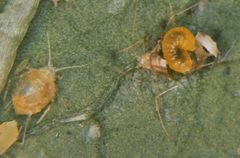
The Diaeretiella is distinguished from other aphidiine genera by being , containing only D. rapae. Identification to level requires examination of morphological characters of D. rapae, including wing venation patterns and body proportions typical of the Aphidiinae. Field identification is complicated by the small size of and similarity to other aphidiine ; confirmed identification typically requires rearing from mummified or microscopic examination. Presence is often inferred from the occurrence of mummified aphids with characteristic hardened, discolored on host plants.
Images
Habitat
Agricultural and natural environments supporting , particularly cruciferous crop systems (Brassica spp., including cabbage, cauliflower, Brussels sprouts, broccoli, mustard, kale) and cereal crops. Associated with weedy vegetation including Sinapis arvensis that can harbor aphid populations when crops are absent. Laboratory studies indicate successful development at 25°C and 70% relative humidity on plants such as cauliflower seedlings.
Distribution
; recorded in 87 countries worldwide. Specific documented occurrences include Europe (native range of aphids), North America, South America, Asia (including India, China), Africa (including Upper Egypt), and Australia. Distribution records from GBIF include Denmark, Norway, and Sweden.
Host Associations
- Brevicoryne brassicae - primary cabbage aphid; most extensively studied with highest rates on third instar nymphs (42%)
- Lipaphis erysimi - turnip aphid
- Myzus persicae - green peach aphid
- Aphis gossypii - cotton aphid
- Macrosiphum euphorbiae - potato aphid
- Schizaphis graminum - ; cereal
- Diuraphis noxius - ; cereal
- Rhopalosiphum padi - bird cherry-oat aphid; cereal
- Rhopalosiphum maidis - corn leaf aphid; cereal
- Aphis fabae - black bean aphid
- Aphis craccivora - cowpea aphid
- Hayhurstia atriplicis -
- Hyadaphis foeniculi -
- Brachycaudus helichrysi -
- approximately 98 aphid species total - documented from literature across 180+ plant in 43
Life Cycle
Koinobiont endoparasitoid development: single laid per . Egg to host mummification: approximately 9–11 days depending on host instar. Mummification to : 3–5 days. Total development from egg to adult emergence: 12.5–15.6 days (shorter on third instar hosts, longer on fourth instar). Parasitized hosts develop hardened, discolored mummies; larva pupates internally before adult emergence through exit hole in mummy. Pre-oviposition period approximately 1 day; oviposition period 6–7 days. Adult lifespan in laboratory conditions: mortality begins day 14–17, all individuals dead by day 25–26.
Behavior
Koinobiont strategy allows to continue feeding and development while feeds internally. Strong host instar preference: third instar nymphs most preferred (42% ), followed by fourth (31%), second (22%), and first instar (13%). Oriented upwind responses to host plant volatiles (Brassica napus, Sinapis arvensis) and aphid (E-β-farnesene). Increased oviposition attempts in response to aphid honeydew and host plant-aphid complex volatiles. Antennal olfactory show electrophysiological responses to . Reproductive strategy adjusts when competing for hosts.
Ecological Role
agent suppressing in agricultural systems, particularly on cruciferous and cereal crops. Natural enemy contributing to regulation of aphid pest populations; potential component in programmes to reduce chemical use. Documented as important natural enemy of cabbage aphid by University of California program.
Human Relevance
Used as agent in of pests on cole crops and cereals. Susceptible to , with documented effects of acetamiprid, imidacloprid, and other compounds on survival; this susceptibility influences recommendations for compatible pest management strategies. performance enhanced by extrafloral nectar provisioning. Subject of extensive research on tritrophic interactions and - chemical .
Similar Taxa
- other Aphidiinae genera (e.g., Aphidius, Lysiphlebus, Binodoxys)similar koinobiont and mummy formation; distinguished by -level morphological characters and range patterns
- Diaeretussimilar name and aphidiine classification; Diaeretiella is while Diaeretus contains multiple , with different associations and geographic patterns
Sources and further reading
- BugGuide
- Wikipedia
- GBIF taxonomy match
- iNaturalist taxon
- NCBI Taxonomy
- Catalogue of Life
- Cabbage Aphids Do Not Social-Distance | Bug Squad
- Behavioral and physiological responses of Diaeretiella rapae to semiochemicals
- Host selection behavior of Diaeretiella rapae McIntosh (Hymenoptera: Braconidae) attacking cereal aphids in Upper Egypt سلوک الأختيار العوائلي للطفيلMcIntosh Diaeretiella rapae لحشرات من النجيليات في صعيد مصر
- Biology and Demographic Parameters of Diaeretiella rapae (McIntosh) against Brevicoryne brassicae (L.)
- Parasitoid Diaeretiella rapae (Hymenoptera: Braconidae) Adjusts Reproductive Strategy When Competing for Hosts
- Influence of host quality and temperature on the biology ofDiaeretiella rapae(Hymenoptera: Braconidae)
- Resistência a acetamiprido de Lipaphis pseudobrassicae ( Davis) (Hemipetra: Aphididae) resistentes e suscetíveis ao parasitoide Diaeretiella rapae (McIntosh) (Hymenoptera: Braconidae, Aphidiinae)
- Kairomonal effect of aphid alarm pheromones and analogues on the parasitoid Diaeretiella rapae
- Causa da resistência de Lipaphis pseudobrassicae (DAVIS, 1914) ao parasitoide Diaeretiella rapae (McINTOSH, 1855) e sua influência sobre o parasitismo de Myzus persicae (SULZER, 1776)
- Custo adaptativo e resistência à alta temperatura de Lipaphis pseudobrassicae (Davis, 1914) (Hemiptera: Aphididae) resistente ao parasitoide Diaeretiella rapae (McIntosh, 1855) (Hymenoptera: Braconidae, Aphidiinae)
- Seasonal Incidence of Aphids and the Aphid Parasitoid Diaeretiella rapae (M'Intosh) (Hymenoptera: Aphidiidae) on Rapeseed in Tennessee
- Laboratory evaluation of different insecticides against Brevicoryne brassicae and its parasitoid, Diaeretiella rapae (Hymenoptera: Braconidae: Aphidiinae)
- Effect of fungal isolates and imidacloprid on cabbage aphid Brevicoryne brassicae and its parasitoid Diaeretiella rapae
- The effect of insecticides on the distribution of foracing parasitoids,Diaeretiella rapae [Hym.: Braconidae] on plants
- Effects of Synergists on Toxicity of Six Insecticides in Parasitoid Diaeretiella rapae (Hymenoptera: Aphidiidae)
- Effect of extrafloral nectar provisioning on the performance of the adult parasitoid Diaeretiella rapae