
Lipaphis pseudobrassicae
(Davis, 1914)
Turnip Aphid
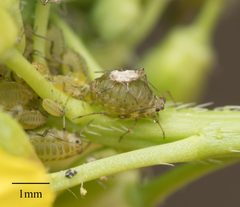
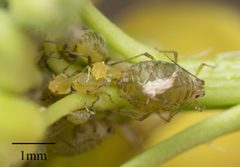
Lipaphis pseudobrassicae, commonly known as the , is a Brassicaceae- and significant agricultural pest. It exhibits high with rapid growth rates on plants. The shows better to high temperatures than some , suggesting increasing relevance in warmer growing seasons and regions. It is a target for strategies and programs.
Pronunciation
How to pronounce Lipaphis pseudobrassicae: //lɪˈpæfɪs ˌsuːdoʊˈbræsɪˌkiː//
These audio files are automatically generated. While they are not always 100% accurate, they are a good starting point.
Identification
Lipaphis pseudobrassicae is a Brassicaceae distinguished from the Myzus persicae by association. It can be separated from Brevicoryne brassicae by shorter reproductive period but higher net rate. Wingless forms may be identified by morphological features including cornicle length and cauda shape, though these require microscopic examination. Molecular tools may be needed for definitive identification where morphological overlap occurs with related .
Images
Habitat
Agricultural environments on Brassicaceae crop plants. Laboratory studies indicate successful development at 25 ± 2°C, 60% relative humidity, and 12-hour photophase. Shows better performance on some varieties than others, with growth parameters varying by host plant cultivar.
Distribution
Brazil (potential to become main pest of Brassicaceae crops, established in multiple agricultural regions); India (Gujarat, first reported on knol-khol in 2025); Ghana (first formal report on cabbage); United States (Alaska, Hawaii, conterminous 48 states); Turkey; China; South Africa; Benin; Mali.
Diet
Phloem sap from Brassicaceae plants. Documented hosts include Brassica oleracea var. acephala (kale), Brassica oleracea var. capitata (cabbage), Brassica oleracea var. gongylodes (knol-khol), Brassica juncea (mustard), Brassica campestris, and wild host Rorippa indica. Performance varies by host and cultivar.
Host Associations
- Brassica oleracea var. acephala - primary kale, high documented
- Brassica oleracea var. capitata - primary cabbage
- Brassica oleracea var. gongylodes - primary knol-khol, first reported in Gujarat, India 2025
- Brassica juncea - primary mustard
- Brassica campestris -
- Rorippa indica - wild
Life Cycle
Development from 24-hour-old nymph to : approximately 5.3–6.6 days depending on plant and conditions. mortality low (<16%) on suitable hosts. Net reproductive rate (Ro) ranges from 17.62 to 92.61 depending on host and study conditions. Mean time (T) approximately 11.3 days. (rm) around 0.39 with finite rate of increase (λ) of 1.49 on optimal hosts. doubling time approximately 3.6 days. parthenogenetic via females.
Behavior
Forms dense colonies on plants. Wingless, parthenogenetic females produce the majority of field . Shows ability to develop on different host within Brassicaceae with similar biological performance across some hosts, though population parameters vary significantly by host cultivar. Exhibits resistance to Diaeretiella rapae in some populations.
Ecological Role
Major pest of Brassicaceae crops with potential to become the primary pest in some regions. High growth rate enables rapid development. Serves as for aphid Diaeretiella rapae, though rates are often low due to host resistance mechanisms. Population outbreaks associated with viral transmission in cabbage in Ghana.
Human Relevance
Significant economic pest of cruciferous vegetable crops including kale, cabbage, mustard, and knol-khol. Damage includes leaf curling, yellowing, stunted growth, and reduced marketable yield. Target for applications and programs. Subject of research using and -based insecticides. Some show resistance to acetamiprid and to parasitoid Diaeretiella rapae.
Similar Taxa
- Brevicoryne brassicaeBoth are Brassicaceae aphids; L. pseudobrassicae has shorter reproductive period but higher net rate and better high-temperature
- Myzus persicaeCo-occurs on brassica crops; M. persicae is a pest while L. pseudobrassicae is Brassicaceae-; molecular and morphological tools may be needed for separation
- Lipaphis erysimiClosely related congeneric ; L. pseudobrassicae has been treated as L. erysimi pseudobrassicae in some literature, requiring careful taxonomic verification
More Details
Temperature Adaptation
Shows better to high temperatures than Brevicoryne brassicae, suggesting potential for increased pest status in warmer seasons and under climate change scenarios.
Parasitoid Resistance
Some exhibit resistance to the Diaeretiella rapae, which is widely used for of brassica aphids. This resistance has been characterized as both pre-ovipositional and post-ovipositional mechanisms.
Host Varietal Effects
growth parameters vary significantly across plant varieties. On cabbage, variety Oxylus supports highest population growth while Leadercross is less suitable. This has implications for breeding and variety selection in pest management.
Sources and further reading
- BugGuide
- Wikipedia
- GBIF taxonomy match
- iNaturalist taxon
- NCBI Taxonomy
- Biologia de Lipaphis pseudobrassicae (Hemiptera: Aphididae) em couve (Brassica oleracea var. acephala) e mostarda (Brassica juncea (L.) Czern) Biology of Lipaphis pseudobrassicae (Hemiptera: Aphididae) on kale (Brassica oleracea var. acephala) and mustard (Brassica juncea (L.) Czern) Biología de Lipaphis pseudobrassicae (Hemiptera: Aphididae) en col (Brassica oleracea var. acephala) y mostaza (Brassica juncea (L.) Czern)
- Biology and life table of Brevicoryne brassicae and Lipaphis pseudobrassicae (Hemiptera: Aphididae) on Brassica oleracea var. acephala
- Morphological, ecological and biological variations in the mustard aphid, Lipaphis pseudobrassicae (Kaltenbach) (Hemiptera: Aphididae) from different host plants
- Biological Parameters and Life Table of Lipaphis pseudobrassicae (Hemiptera: Aphididae) (Davis, 1914) on Kale (Brassica oleracea L. var. acephala)
- Biological parameters and life table of Lipaphis pseudobrassicae (Hemiptera: Aphididae) (Davis, 1914) on kale (Brassica oleracea L. var. acephala)
- Insecticidal activity of 23 essential oils and their major compounds against adult Lipaphis pseudobrassicae (Davis) (Aphididae: Homoptera)
- Resistência a acetamiprido de Lipaphis pseudobrassicae ( Davis) (Hemipetra: Aphididae) resistentes e suscetíveis ao parasitoide Diaeretiella rapae (McIntosh) (Hymenoptera: Braconidae, Aphidiinae)
- Causa da resistência de Lipaphis pseudobrassicae (DAVIS, 1914) ao parasitoide Diaeretiella rapae (McINTOSH, 1855) e sua influência sobre o parasitismo de Myzus persicae (SULZER, 1776)
- Custo adaptativo e resistência à alta temperatura de Lipaphis pseudobrassicae (Davis, 1914) (Hemiptera: Aphididae) resistente ao parasitoide Diaeretiella rapae (McIntosh, 1855) (Hymenoptera: Braconidae, Aphidiinae)
- FIRST REPORT OF TURNIP APHID, LIPAPHIS PSEUDOBRASSICAE (DAVIS) (APHIDIDAE: HEMIPTERA) INFESTING KNOL-KHOL (BRASSICA OLERACEA VAR. GONGYLODES) IN GUJARAT, INDIA
- Low parasitism byDiaeretiella rapae(Hym.: Braconidae) ofLipaphis pseudobrassicae(Hemip.: Aphididae): pre- or post-ovipositional host resistance?
- Host stage preference and performance of the aphid parasitoid Diaeretiella rapae (Hymenoptera: Braconidae) on Brevicoryne brassicae and Lipaphis pseudobrassicae (Hemiptera: Aphididae)
- Effects of acetamiprid on Lipaphis pseudobrassicae (Hemiptera: Aphididae) resistant and susceptible to the parasitoid Diaeretiella rapae (Hymenoptera: Braconidae, Aphidiinae)
- Comparative bionomics and life table studies ofLipaphis erysimi pseudobrassicae(Davis) andMyzus persicae(Sulzer) (Hemiptera: Aphididae) on three cabbage varieties
- First Report and Distribution of the Indian Mustard Aphid, Lipaphis erysimi pseudobrassicae (Hemiptera: Aphididae) on Cabbage (Brassica oleracea var capitata) in Ghana