
Lipaphis
Mordvilko, 1928
Crucifer Aphids
Species Guides
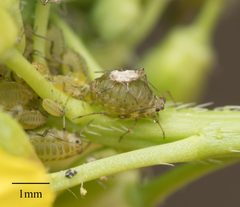
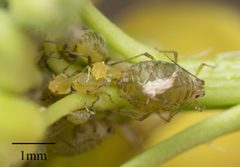
1- Lipaphis pseudobrassicae(Turnip Aphid)
Lipaphis is a of aphids in the Aphididae, commonly known as crucifer aphids. in this genus are specialized feeders on plants in the family Brassicaceae, with some species showing broader ranges within dicotyledons. The genus includes economically significant pests such as Lipaphis erysimi (mustard ) and Lipaphis pseudobrassicae, which cause substantial yield losses in rapeseed, mustard, kale, and other cruciferous crops across multiple continents.
Pronunciation
How to pronounce Lipaphis: /lɪˈpeɪfɪs/
These audio files are automatically generated. While they are not always 100% accurate, they are a good starting point.
Images
Habitat
Agricultural and natural environments dominated by herbaceous dicotyledons, particularly Brassicaceae. occur on cultivated cruciferous crops including rapeseed, mustard, kale, and canola, as well as wild crucifers.
Distribution
Widely distributed across Europe (Austria, Belgium, Britain, Bulgaria, Denmark, France, Germany, Ireland, Netherlands, Norway, Poland, Sweden, Yugoslavia), Asia (China, India, Indonesia, Iran, Iraq, Israel, Japan, Korea, Pakistan, Thailand, Turkey, USSR), Africa (Cameroun, Egypt, Ethiopia, Kenya, Libya, Madagascar, Morocco, Nigeria, South Africa, Sudan, Tanzania, Uganda), Australasia and Pacific Islands (Australia, Fiji, Hawaii, New Zealand, Papua New Guinea), North America (Canada, Mexico, USA), Central America and West Indies ( Rica, Nicaragua, West Indies), and South America (Argentina, Peru, Surinam, Venezuela). Distribution records also confirmed from Denmark, Norway, and Sweden.
Diet
Phloem sap from dicotyledonous plants. The shows strong affinity for Brassicaceae; most feed exclusively on Brassica hosts, though L. erysimi and L. pseudobrassicae have broader host ranges within dicotyledons while still predominantly consuming Brassicaceae (79-86% of host plants from this ).
Host Associations
- Brassicaceae - primary Strong affinity; 95.83% of from herbaceae
- Brassica oleracea var. acephala - kale/couve
- Brassica juncea - mustard/mostarda
- dicotyledons - broader classexclusive feeding on dicots; less than 5% from lignosae
Life Cycle
Holocyclic or anholocyclic depending on and climate. For L. pseudobrassicae: nymphal stage lasts approximately 5.3-5.6 days on kale and mustard with low mortality (<16%). time (T) approximately 11 days; net reproductive rate (Ro) of 92.61; (rm) of 0.39; finite rate of increase (λ) of 1.49; doubling time (DT) rapid. Total duration and longevity similar across Brassicaceae hosts. primarily parthenogenetic with females producing live young.
Ecological Role
Herbivore and agricultural pest with high . Serves as prey for aphidophagous natural enemies including predatory syrphid flies (Ischiodon scutellaris, Episyrphus balteatus, Eupeodes frequens, Metasyrphus confrater) and (Diaeretiella rapae). Syrphid oviposition is -dependent, with -laying increasing with density up to an upper asymptote.
Human Relevance
Major economic pest of Brassicaceae oilseed and vegetable crops. L. erysimi is a primary constraint for mustard production in Pakistan and India, causing substantial yield losses. L. pseudobrassicae has potential to become the main pest of Brassicaceae in Brazil. Management strategies include (cultivar selection such as KS-75 and PM 25 showing resistance), adjusted sowing dates, extracts (neem), synthetic (Fipronil, acetamiprid), and through natural enemy conservation. Resistance to and insecticides has been documented in some .
Similar Taxa
- Brevicoryne brassicaeAlso a major pest of Brassicaceae; co-occurs on same and is prey for the same natural enemy complex; distinguished by morphological features and specific host preferences
- Myzus persicaeOccurs on Brassicaceae crops including kale; broader diet; differs in range and body
Sources and further reading
- BugGuide
- Wikipedia
- GBIF taxonomy match
- iNaturalist taxon
- NCBI Taxonomy
- Catalogue of Life
- Lipaphis erysimi . [Distribution map].
- Aphids and their Host Affinity- IV: Lipaphis spp.
- Biologia de Lipaphis pseudobrassicae (Hemiptera: Aphididae) em couve (Brassica oleracea var. acephala) e mostarda (Brassica juncea (L.) Czern) Biology of Lipaphis pseudobrassicae (Hemiptera: Aphididae) on kale (Brassica oleracea var. acephala) and mustard (Brassica juncea (L.) Czern) Biología de Lipaphis pseudobrassicae (Hemiptera: Aphididae) en col (Brassica oleracea var. acephala) y mostaza (Brassica juncea (L.) Czern)
- Resistência a acetamiprido de Lipaphis pseudobrassicae ( Davis) (Hemipetra: Aphididae) resistentes e suscetíveis ao parasitoide Diaeretiella rapae (McIntosh) (Hymenoptera: Braconidae, Aphidiinae)
- Causa da resistência de Lipaphis pseudobrassicae (DAVIS, 1914) ao parasitoide Diaeretiella rapae (McINTOSH, 1855) e sua influência sobre o parasitismo de Myzus persicae (SULZER, 1776)
- Management Of Canola Aphid (Lipaphis Erysimi (Kalt); Hemiptera: Aphididae) Through Different Control Tactics.
- Ovipositional/Numerical response of aphidophagous syrphids (Diptera:Syrphidae) at varying prey densities of Lipaphis erysimi and Brevicoryne brassicae (Homoptera:Aphididae)
- Physical basis of host plant resistance in rapeseed and mustard against mustard aphid, Lipaphis erysimi (Kaltenbach)
- Custo adaptativo e resistência à alta temperatura de Lipaphis pseudobrassicae (Davis, 1914) (Hemiptera: Aphididae) resistente ao parasitoide Diaeretiella rapae (McIntosh, 1855) (Hymenoptera: Braconidae, Aphidiinae)
- Biological Parameters and Life Table of Lipaphis pseudobrassicae (Hemiptera: Aphididae) (Davis, 1914) on Kale (Brassica oleracea L. var. acephala)
- Growth and developmental behavior of Lipaphis erysimi (Kalt.) at leaf stage and flowering stages on different mustard genotypes
- Biology of the Mustard Aphid, Lipaphis erysimi,1 in India2