
Episyrphus balteatus
(De Geer, 1776)
marmalade hoverfly, marmalade hover fly
Episyrphus balteatus, commonly known as the marmalade hoverfly, is a small (9–12 mm) syrphid fly native to the Palaearctic region. It is considered the most abundant native hoverfly in Central Europe. are significant of flowering plants, while larvae are voracious of aphids, consuming up to approximately 400 aphids before . The exhibits partial migratory , with some individuals moving southward in autumn while others overwinter locally.
Pronunciation
How to pronounce Episyrphus balteatus: //ˌɛpɪˈsɪrfəs bɔːlˈtiːətəs//
These audio files are automatically generated. While they are not always 100% accurate, they are a good starting point.
Identification
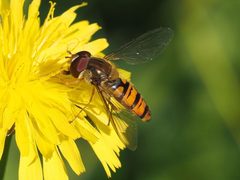
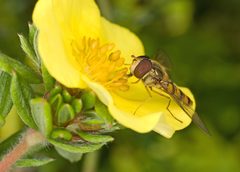
are distinguished by orange and black banding on the , with secondary black bands on the third and fourth dorsal plates and faint greyish longitudinal stripes on the . Coloration varies individually and is influenced by pupal temperature and duration; females are typically darker than males. Males possess ( touching at the top of the ), a characteristic of most hoverflies. The -like coloration represents .
Images
Habitat
Found in diverse including urban gardens, agricultural fields, and natural landscapes. Seasonal microhabitat preferences vary: occupy sheltered south-facing forest edges; summer activity concentrates on north-facing edges where flowers are abundant. Shrub fallows within 2 km positively influence abundance. trap studies in southern France indicate overwintering can also occur in larval or puparial stages within forest edges.
Distribution
Widespread throughout the Palaearctic region, encompassing Europe, North Asia, and North Africa. Documented from the Azores (Faial, Flores, Pico, São Jorge, São Miguel). Abundance and distribution patterns are strongly influenced by landscape structure, forest edge orientation and length, and proximity to shrub .
Seasonality
Active throughout the year in favorable conditions. Reproductive induced during larval instars by below 11.8–11.9 hours (mid- to late September day lengths in central Europe), with temperature modulating the critical photoperiod. Spring and northward occur May–June; autumn southward migration peaks August–September. females found in sheltered locations; summer movement toward north-facing forest edges.
Diet
feed on pollen and nectar, with demonstrated preference for smaller yellow flowers with high nectar concentrations. Larvae are exclusively aphidophagous, predating soft-bodied aphids; consumption rates vary with plant and , with up to 558 aphids consumed per larva under optimal conditions.
Life Cycle
Complete . laid near colonies; larvae pass through three instars, consuming aphids throughout. occurs in soil. Developmental time from oviposition to averages 21.5 days (range 18–25 days) under greenhouse conditions. time approximately 50 days; net reproductive rate (R₀) of 101.3 with of 0.0925 per day. Adults can live up to 80–105 days; females begin oviposition at 8 days post-emergence and may lay fertile eggs at 100+ days of age. Mean approximately 780 eggs per female.
Behavior
Exhibits partial migratory with facultative strategies. Some individuals migrate southward to southern Europe and North Africa in autumn; others overwinter locally as in reproductive or as larvae/pupae. Migrating individuals fly below 300 m altitude, with some reaching 750–1000 m; they select favorable winds and maintain southward orientation using a solar compass. Forms dense migratory swarms that may alarm humans due to -like appearance. Oviposition site selection is influenced by colony size, honeydew concentration, and presence of (which deter additional oviposition via olfactory cues).
Ecological Role
Important of wild and cultivated flowering plants, though less efficient than honey bees on a per-visit basis; abundance compensates for individual . Major agent of cereal aphids and other pests in agroecosystems. by larvae can significantly suppress aphid . Contributes to services in agricultural landscapes through combined pollination and pest predation functions.
Human Relevance
Valued as a natural agent in , particularly for cereal and horticultural crops. contribute to pollination services in agricultural and urban environments. Dense migratory swarms occasionally cause public concern due to -mimicry, though the is harmless. Used in research on insect , , and gene regulatory networks; sequenced in 2022–2023.
Similar Taxa
- Eupeodes corollaeCo-occurring migratory hoverfly with similar seasonal movement patterns and use, though differing in abdominal patterning and coloration.
- Syrphus ribesiiCommon sympatric syrphine hoverfly; distinguished by abdominal banding pattern and lack of secondary black bands on tergites 3–4.
- Scaeva pyrastriSimilar size and general appearance; distinguished by presence of spots (ocellar spots) on rather than transverse bands.
Sources and further reading
- BugGuide
- Wikipedia
- GBIF taxonomy match
- iNaturalist taxon
- NCBI Taxonomy
- The great potential of citizen science - an opportunity to work together more in the name of preserving insects in 2021 - Buglife Blog - Buglife
- Aphid peril – Aphids, flower flies, lady beetles (MISSING VIDEO AND LINKS) — Bug of the Week
- The Legend of the Pantaloon Bee - Buglife Blog - Buglife
- Meet six unsung heroes of the pollination world - Buglife Blog - Buglife
- Argentina | Beetles In The Bush | Page 8
- Diptera | Beetles In The Bush | Page 6
- Oviposition site selection of Episyrphus balteatus
- Diapause and overwintering of the hoverflyEpisyrphus balteatus
- Landscape parameters explain the distribution and abundance of Episyrphus balteatus (Diptera: Syrphidae)
- Oviposition behaviour and host colony size discrimination in Episyrphus balteatus (Diptera: Syrphidae)
- Effect of host plants on the feeding potential of Episyrphus balteatus (De Geer) preying on two different aphid species
- Combination of morphometric and isotopic tools for studying spring migration dynamics in Episyrphus balteatus
- Untersuchungen zur Biologie und zum Reproduktionsvermögen von Episyrphus balteatus Deg. (Dipt., Syrphidae) unter Gewächshausbedingungen
- Influence of prey host plant on a generalist aphidophagous predator: Episyrphus balteatus (Diptera: Syrphidae)
- EFFECT OF HOST PLANTS ON THE GROWTH AND DEVELOPMENT OF EPISYRPHUS BALTEATUS (DE GEER) (DIPTERA: SYRPHIDAE) PREDATING APHIS CRACCIVORA (HEMIPTERA: APHIDIDAE)
- Effect of size, extraguild prey and habitat complexity on intraguild interactions: a case study with the invasive ladybird Harmonia axyridis and the hoverfly Episyrphus balteatus
- Expanding the fly eye gene regulatory network: From Drosophila to the hoverfly Episyrphus balteatus.