
Syrphus ribesii
(Linnaeus, 1758)
Common Banded Hoverfly
Syrphus ribesii is a common Holarctic hoverfly and an effective in both agricultural and natural . are frequent flower visitors, feeding on nectar and pollen while providing pollination services. The is highly migratory and shows remarkable adaptability to diverse from farmland to forest. Two distinct races exist across much of Europe.

Pronunciation
How to pronounce Syrphus ribesii: /ˈsɪrfəs rɪˈbiːsi.aɪ/
These audio files are automatically generated. While they are not always 100% accurate, they are a good starting point.
Identification
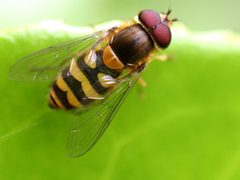
Females distinguished from similar Syrphus by entirely yellow hind (females of S. vitripennis and S. torvus have dark markings) and absence of hairs (S. torvus females have hairy eyes). Males have bare eyes unlike S. torvus, but closely resemble S. vitripennis; reliable separation requires examination of hind femur (S. ribesii has some black hairs) and second basal of wing (entirely covered by microtrichia in S. ribesii). Male genitalia provide definitive identification. shiny black, to lunulae. Sternites with lateral and black marks. Male hind femora black on basal two-thirds; female hind femora completely yellow. Lateral margins of abdominal tergites black except at ends of yellow bands.
Images
Habitat
; occurs in farmland, orchards, horticultural land, suburban gardens, and parks. Also found in deciduous and coniferous forests.
Distribution
Palearctic: Fennoscandia south to Iberia and Mediterranean basin; Ireland eastward through Europe into Turkey, European Russia, and Afghanistan; Urals through Siberia and Russian Far East to Pacific coast (Kuril Isles) and Japan. Nearctic: Alaska southward to central United States. Highly migratory.
Seasonality
active March to mid-November.
Diet
Larvae are obligate , feeding on various aphid including Aphis fabae. feed on nectar and pollen.
Life Cycle
Female lays in or near colonies. Larvae pass through three instars before ; pupa is convex and pear-shaped, attached to leaves or stems. Final produces fly. Two races occur in Europe: 2n=8 and 2n=10.
Behavior
Larvae exhibit modified searching based on starvation state: satiated individuals remain near aphids with reduced locomotion and thigmokinesis; 24-hour starved larvae show concentrated searching with higher casting rates and elevated forward speed; 48-hour starved larvae display highest casting rates and speed with grouped projections along path, resulting in greater . are capable of sustained hovering .
Ecological Role
Important agent of in agricultural and horticultural systems. contribute to pollination of flowering plants.
Human Relevance
Valued as natural pest control agent in gardens, orchards, and agricultural settings; larvae reduce without chemical intervention. are common in managed and wild landscapes. Frequently mistaken for bees or due to protective mimicry.
Similar Taxa
- Syrphus vitripennisVery similar appearance; males especially difficult to distinguish, requiring examination of hind setation and wing microtrichia
- Syrphus torvusFemales distinguished by hairy and dark-marked hind ; males distinguished by hairy eyes
Sources and further reading
- BugGuide
- Wikipedia
- GBIF taxonomy match
- NCBI Taxonomy
- Catalogue of Life
- Just Hovering | Bug Squad
- Hello, Friday Fly Day! | Bug Squad
- Bug Squad
- Syrphus-opinator - Entomology Today
- Bug Eric: The Maggot on the Rosebush: Aphid-eating Flower Fly Larvae
- New Website Features Insects of the Greater Yellowstone Ecosystem
- Searching behaviour in relation to starvation of Syrphus ribesii
- Size and shape variation in Syrphus ribesii L. (Diptera, Syrphidae)
- FEEDING BEHAVIOUR OF SYRPHUS RIBESII AND MELANOSTOMA SCALARE ON APHIS FABAE