
Syrphus vitripennis
Meigen, 1822
Black-thighed Flower Fly
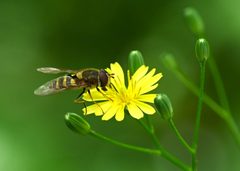
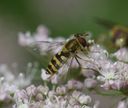
Syrphus vitripennis is a common Holarctic hoverfly (Syrphidae) with distinctive yellow and black -mimicking coloration. are medium-sized (8–11 mm body length, wing length 7.25–10.25 mm) and frequent flowers from March to October, peaking in July–August. Larvae are , making this economically significant for . The species is highly migratory, with documented seasonal movements between latitudes. It is one of five Syrphus species in Britain and can be difficult to distinguish from , particularly S. rectus in males.

Pronunciation
How to pronounce Syrphus vitripennis: //ˈsɪrfəs ˌvɪtrɪˈpɛnɪs//
These audio files are automatically generated. While they are not always 100% accurate, they are a good starting point.
Identification
Males are indistinguishable from S. rectus; females separable by hind coloration (black on basal two-thirds in S. vitripennis versus yellow on basal half in S. rectus). Tergites 3 and 4 have entire yellow bands with black lateral margins. Second basal of wing only partially covered in microtrichia (versus complete coverage in S. ribesii and S. torvus). above lunulae black. Male: femora 3 black for basal three-quarters. Wing length 7.25–10.25 mm.
Images
Habitat
Deciduous and coniferous woodland, woodland clearings, field hedgerows, suburban gardens, and parks. Wide range of lowland .
Distribution
Holarctic. Palearctic: throughout Europe, common and widely distributed in Britain and Ireland. Nearctic: Alaska to California. Highly migratory; observed moving northwards from Isles of Scilly and Cornwall in June, with seasonal latitudinal movements to higher latitudes in spring and lower latitudes in autumn.
Seasonality
on wing March to October (March to November in some regions), peaking July–August. Overwinters as larva.
Diet
feed on nectar and pollen from flowers. Larvae are predatory, feeding on aphids.
Life Cycle
Overwinters as larva. emerge in spring and are active through autumn.
Behavior
Highly migratory with documented seasonal latitudinal movements. frequently hover near flowers.
Ecological Role
Larval stage functions as an , contributing to natural of aphid in agricultural and natural .
Human Relevance
Important agent; larvae prey on aphids that are agricultural pests. are . Frequently mistaken for honey bees or due to mimicry.
Similar Taxa
- Syrphus rectusMales are morphologically indistinguishable; females separable by hind coloration pattern.
- Syrphus ribesiiDistinguished by complete microtrichia coverage of second basal (versus partial in S. vitripennis).
- Syrphus torvusDistinguished by complete microtrichia coverage of second basal (versus partial in S. vitripennis).
Sources and further reading
- BugGuide
- Wikipedia
- GBIF taxonomy match
- iNaturalist taxon
- NCBI Taxonomy
- Catalogue of Life
- How Jeff Smith’s 'Neighborly' Project Will Benefit the Bohart Museum of Entomology | Bug Squad
- Publications | Entomology Research Museum
- Just Hovering | Bug Squad
- Hello, Friday Fly Day! | Bug Squad
- Bug Squad
- A New Guide for Understanding Insect Vectors of Plant Pathogen Xylella fastidiosa
- The genome sequence of a hoverfly, Syrphus vitripennis (Meigen, 1822).