
Syrphus torvus
Osten Sacken, 1875
Hairy-eyed Flower Fly
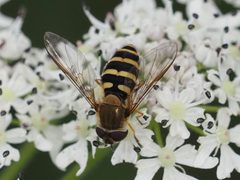
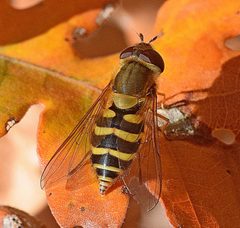
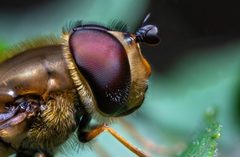
Syrphus torvus is a Holarctic hoverfly commonly known as the Hairy-eyed Flower Fly. feed on pollen and nectar from diverse flowering plants, while larvae are specialized of aphids. The is notable for having conspicuously hairy , particularly in males where the hairs are long and dense. It occupies forested and urban green spaces across a broad geographic range and exhibits migratory .
Pronunciation
How to pronounce Syrphus torvus: //ˈsɪrfəs ˈtɔrvəs//
These audio files are automatically generated. While they are not always 100% accurate, they are a good starting point.
Identification
The hairy are diagnostic for this within the Syrphus. Males can be distinguished from other Syrphus species by the dense, long hairs on the eyes combined with the black basal three-fourths of hind . Females have shorter eye hairs but share the same leg coloration. Separation from similar species requires examination of male genitalia or larval characters.
Images
Appearance
have covered with numerous hairs; in males these are long and dense, in females shorter and sparser. of the hind leg (femora 3) is black on the basal three-fourths. Body markings follow typical Syrphus patterning with yellow and black bands on the . Male genitalia and larval have been illustrated by Dusek and Laska (1964).
Habitat
Abies, Picea and Pinus forest; Betula, Fagus, Quercus forest; dwarf-shrub tundra. in suburban gardens with mature trees and urban parks.
Distribution
Holarctic. Palearctic: Greenland and Fennoscandia south to Iberia and Mediterranean basin, through Europe into Turkey and European Russia; eastward from Urals through Siberia and Russian Far East to Pacific coast (Kuril Isles) and Japan; Indomalaya in Formosa, Northern India, Nepal, and Thailand. Nearctic: Alaska south to New Mexico. Migratory; observed at altitudes up to 5,000 meters in the Rocky Mountains.
Seasonality
fly from March to October. Overwinters as larvae.
Diet
feed on pollen and nectar. Larvae are obligate of aphids on trees, bushes, and shrubs.
Life Cycle
Female lays in or near colonies. Larva passes through three instars before . Final produces a convex pear-shaped pupa attached to leaf, stem, or other substrate. emerges from pupal capsule. Overwinters as larva.
Behavior
are particularly attracted to yellow and white flowers. Exhibits migratory with large numbers observed moving through high-altitude mountain passes. Hovering typical of Syrphidae.
Ecological Role
Larvae function as agents of . contribute to pollination of diverse flowering plants.
Human Relevance
Beneficial insect in gardens and agricultural systems due to larval on pests. are . Frequently mistaken for bees or due to mimicry.
Similar Taxa
- Syrphus opinatorSimilar abdominal banding pattern and overall appearance; distinguished by differences in and leg coloration
- Syrphus ribesiiOverlapping distribution and use; S. torvus distinguished by hairy and black hind base
Misconceptions
are frequently mistaken for honey bees or due to yellow-black coloration and hovering . This mimicry is protective but leads to misidentification by observers.
More Details
Flower visitation
have been documented visiting: umbellifers, Allium ursinum, Aster, Bellis perennis, Brassica rapa, Buxus, Caltha, Cirsium arvense, Crataegus, Euphorbia, Frangula alnus, Glaux maritima, Hedera, Hieracium, Oxalis, Prunus spinosa, Ranunculus, Rosa, Rubus, Salix, Senecio jacobaea, Sorbus, Taraxacum, Tussilago
Sources and further reading
- BugGuide
- Wikipedia
- GBIF taxonomy match
- iNaturalist taxon
- NCBI Taxonomy
- Catalogue of Life
- Just Hovering | Bug Squad
- Hello, Friday Fly Day! | Bug Squad
- Bug Squad
- Syrphus-opinator - Entomology Today
- Bug Eric: The Maggot on the Rosebush: Aphid-eating Flower Fly Larvae
- New Website Features Insects of the Greater Yellowstone Ecosystem