
Hayhurstia atriplicis
(Linnaeus, 1761)
Chenopodium aphid, Saltbush Leaf-Fold Aphid
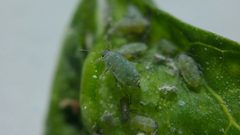
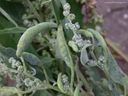
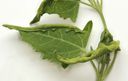
Hayhurstia atriplicis is a holocyclic, associated with Chenopodium plants. It is considered economically indifferent but serves as a for species, particularly Diaretiella rapae and Ephedrus nacheri. These parasitoids have been utilized in programs targeting other pest aphids, including and Schizaphis graminum.
Pronunciation
How to pronounce Hayhurstia atriplicis: /haɪˈhɜːrstiə əˈtrɪplɪs/
These audio files are automatically generated. While they are not always 100% accurate, they are a good starting point.
Identification
Distinguished from other aphids by its specific association with Chenopodium (goosefoot/saltbush) plants; further diagnostic features require examination of morphological characters not detailed in available sources.
Images
Habitat
Associated with Chenopodium groves in farmland and urban environments; these plant stands provide stable conditions.
Distribution
Recorded from Belgium (Brussels-Capital Region, Flemish Region, Walloon Region) and Czechoslovakia (now Czech Republic and Slovakia).
Diet
Phloem sap from Chenopodium plants.
Host Associations
- Chenopodium - primary Specific plant ; 'Chenopodium ' reflects this association
Life Cycle
Holocyclic and , completing its entire on a single plant without host alternation.
Ecological Role
Serves as a for ; supports natural enemies that can be deployed for of economically important pest aphids.
Human Relevance
Source of biocontrol agents; from this have been collected and shipped to U.S. insectary facilities for use in () control projects. The itself is economically indifferent and not considered a pest.
Similar Taxa
- Other Aphis species on ChenopodiumMay co-occur on same plants; requires morphological examination for definitive identification.
- Hayhurstia spp.Congeneric may share associations; specific identification requires detailed morphological study.
More Details
Parasitoid associations
Two primary are consistently associated with H. atriplicis in Czechoslovakia: Diaretiella rapae (a with broad range among pests) and Ephedrus nacheri. This aphid-parasitoid association has been exploited for biocontrol purposes.
Biocontrol applications
from H. atriplicis were laboratory and field tested against and Schizaphis graminum, despite these target pests not occurring naturally in Czechoslovakia due to climatic constraints. This represents an example of using parasitoid from alternative for pest management.