
Bicyrtes ventralis
(Say, 1824)
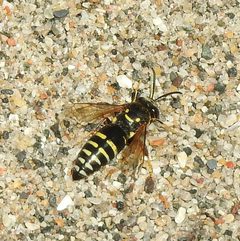
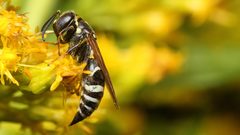
Bicyrtes ventralis is a sand wasp in the Crabronidae, distributed across Central America and North America. Like other members of the Bicyrtes, it is a solitary, that nests in soil. Females provision underground burrows with paralyzed true bugs as food for their larval offspring. The is one of approximately eight North American species in the genus Bicyrtes.

Pronunciation
How to pronounce Bicyrtes ventralis: /bɪˈsaɪrtiːz vɛnˈtrælɪs/
These audio files are automatically generated. While they are not always 100% accurate, they are a good starting point.
Identification
Bicyrtes ventralis can be distinguished from other sand wasps by the boxy, angular appearance of the hind , with white markings often present on the angular hind corners. The Bicyrtes is characterized by a more sedate and approachable demeanor compared to the rapid, flighty of similar sand wasps such as Bembix and Steniolia. -level identification within Bicyrtes requires examination of specific morphological characters not detailed in available sources.
Images
Habitat
Sandy soils, including coarse or rocky substrates. Unlike many sand wasps that require fine sand, Bicyrtes can nest in soil with pebbles and pavement fragments. Nesting occurs in open, sparsely vegetated areas with exposed ground.
Distribution
Central America and North America. Specific range boundaries within this region are not well documented in available sources.
Diet
Predatory. Females hunt true bugs (Hemiptera: Heteroptera) including stink bugs (Pentatomidae), leaf-footed bugs (Coreidae), and shield bugs (Scutelleridae). Assassin bugs (Reduviidae) have also been recorded as prey for the .
Life Cycle
Solitary nesting with . Females excavate burrows 15–20 cm deep at a shallow angle using tarsal rakes on the front legs. Burrows terminate in single or multiple . Prey is paralyzed and stockpiled in cells; an is laid on the first victim. The female closes the burrow while hunting and uses landmarks to relocate the hidden entrance. Multiple nests may be initiated, though not all are completed.
Behavior
Females are , spending considerable time excavating and provisioning nests. Both sexes visit flowers frequently for nectar, becoming distracted enough to allow close approach. Males patrol for mates and may aggregate in sleeping clusters. The tends toward solitary nesting rather than dense typical of some sand wasps.
Ecological Role
of true bugs, potentially providing of pest such as stink bugs. Documented as a predator of the Harlequin Bug (Murgantia histrionica) and implicated in control of the Brown Marmorated Stink Bug (Halyomorpha halys).
Human Relevance
Considered beneficial for agriculture and gardening due to on pest stink bugs. Non-aggressive toward humans; stings are possible but unlikely without handling. No active management protocols exist, though preserving sandy nesting and avoiding use in nesting areas supports .
Similar Taxa
- Bicyrtes quadrifasciatusSimilar size, coloration, and preferences; both widespread in North America. B. quadrifasciatus has four pale bands on the , while B. ventralis has different abdominal markings (specific pattern not detailed in sources).
- Stictia carolinaBoth are large, black-and-white sand wasps that can appear similar in . Stictia carolina is substantially larger, specializes on horse flies as prey, and has more extensive white markings on the .
- Bembix speciesSimilar nesting and general appearance, but Bembix are extremely rapid and flighty, rarely allowing close approach, and have a more rounded profile compared to the angular, boxy thorax of Bicyrtes.
More Details
Nesting Substrate Flexibility
Unlike many sand wasps that require fine, loose sand, Bicyrtes including B. ventralis can successfully nest in coarse, rocky soils containing pebbles and pavement fragments. This ecological flexibility may expand their potential range into anthropogenic .
Taxonomic Note
assignment has varied historically; Bicyrtes has been placed in Bembicidae, Crabronidae, and Sphecidae in different classifications. Current sources list Crabronidae as the accepted family.
Sources and further reading
- BugGuide
- Wikipedia
- GBIF taxonomy match
- iNaturalist taxon
- NCBI Taxonomy
- Catalogue of Life
- Bembicid Holdings | Entomology Research Museum
- Bug Eric: Wasp Wednesday: Bicyrtes
- Bug Eric: Wasp Wednesday: Wasp vs. Bug
- Bug Eric: Wasp Wednesday: The "Horse Guard"
- Bug Eric: Harlequin Bug
- Bug Eric: Wasp Wednesday: Bembecinus