
Steniolia
Say, 1837
sand wasps
Species Guides
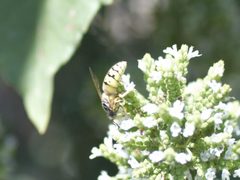
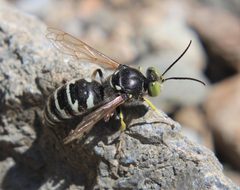
4Steniolia is a of solitary sand wasps in the Crabronidae, containing approximately 15 described . All North American species are western in distribution, with four species extending only as far north as Mexico. Females are , constructing single-celled burrows in dry, powdery soil to provision with paralyzed flies. The genus is notable for coloration, elongated mouthparts adapted for nectar feeding, and distinctive nightly sleeping clusters formed by both sexes.
Pronunciation
How to pronounce Steniolia: /stɛ.niˈoʊ.li.ə/
These audio files are automatically generated. While they are not always 100% accurate, they are a good starting point.
Identification
Steniolia can be distinguished from other sand wasps by their coloration patterns and elongated, tongue-like mouthparts ( and ) that are not retractable and are tucked between the legs when not in use. Males are larger than females, a reversal of typical in . The lacks the boxy shape with angular white hind corners seen in Bicyrtes, and is generally more vigilant and quicker to than Bicyrtes species.
Images
Habitat
Dry, powdery soils in arid and semi-arid environments including sandy areas, trails, and open ground. Nesting occurs in soil rather than true sand, with females often digging in close proximity to one another.
Distribution
Western North America from southeast Washington, Idaho, and Wyoming south through Arizona, California, and into Mexico. All 14 North American are western; four species occur only as far north as Mexico.
Seasonality
active from March through August, with peak activity varying by and locality.
Diet
feed on nectar from deep flowers such as thistles, Palafoxia, Petalonyx, Melilotus, and Chilopsis, using elongated mouthparts to access nectar. Females hunt flies (Diptera) as larval provisions, including bee flies (Bombyliidae), flower flies (Syrphidae), and potentially robber flies (Asilidae).
Life Cycle
Females excavate burrows 7–17 cm deep terminating in a single . They practice : laying one on an initial paralyzed fly, then repeatedly hunting to bring additional flies to the developing larva. The female covers the burrow entrance while away and uses subtle landmarks to relocate it. Once larval feeding ceases, the female permanently seals the burrow and departs. The larva pupates, with emerging weeks later or to emerge the following season.
Behavior
Females exhibit parental care through of larvae. Both sexes participate in dense, spherical sleeping clusters at night, from which they disperse at daybreak; mating apparently occurs at these . Females are highly vigilant and easily startled into during activity.
Ecological Role
of Diptera, potentially providing of fly . Serves as for including velvet ants (Mutillidae) and cuckoo wasps (Parnopes edwardsii). contribute to pollination through nectar feeding.
Similar Taxa
- BembixAlso in tribe Bembicini with similar sand wasp habits, but Bembix typically have different coloration patterns and lack the elongated mouthparts of Steniolia; Bembix are generally more approachable and less vigilant.
- BicyrtesSimilar size and general appearance, but Bicyrtes has a distinctly boxy with angular, often white-marked hind corners; Bicyrtes is more sedate and easier to approach, and provisions with true bugs (Hemiptera) rather than flies.
- StictiaRelated in subtribe Stictiellina with similar nesting , but differs in morphological details of mouthpart structure and coloration patterns.
Sources and further reading
- BugGuide
- Wikipedia
- GBIF taxonomy match
- iNaturalist taxon
- NCBI Taxonomy
- Catalogue of Life
- Bembicid Holdings | Entomology Research Museum
- Bug Eric: Wasp Wednesday: Steniolia elegans
- Bug Eric: May 2011
- Bug Eric: August 2010
- Bug Eric: Results of the Red Rock Canyon Open Space Bioblitz
- Bug Eric: Wasp Wednesday: Bicyrtes