
Steniolia eremica
Gillaspy, 1964
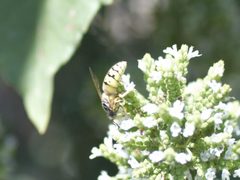
Steniolia eremica is a of sand wasp in the Crabronidae, described by James E. Gillaspy in 1964. It is one of approximately fifteen species in the Steniolia, all of which are restricted to western North America. Males are larger than females and have been observed visiting thistle flowers and other nectar sources. The species is considered less abundant than that share its range.
Pronunciation
How to pronounce Steniolia eremica: /stɛ.niˈoʊ.li.ə ɛˈrɛ.mɪ.kə/
These audio files are automatically generated. While they are not always 100% accurate, they are a good starting point.
Identification
Males are notably larger than females, reaching approximately 22 mm in length. The exhibits the markings characteristic of the Steniolia. Males possess elongated, non-retractable mouthparts ( and ) adapted for reaching nectar in deep flowers. The species can be distinguished from the more widespread Steniolia elegans by its more restricted distribution and apparent lower abundance.
Images
Habitat
Occurs in arid and semi-arid regions including desert and dry grassland environments. Males have been observed at blooming thistles (Cirsium sp.) and other flowering plants in canyon .
Distribution
Western North America from central Nevada south through Arizona, southeast California, and into Mexico. Also recorded from Central America.
Seasonality
have been collected from March through August.
Diet
feed on nectar from flowers including thistles (Cirsium), Palafoxia (Spanish Needles), Petalonyx (sandpaper plant), Melilotus (sweetclover), and Chilopsis (desert-willow). Females are presumed to hunt flies as prey for their larvae, as is typical for the , though direct observation of prey capture in this has not been documented.
Life Cycle
Presumed similar to : females dig burrows in dry soil to depths of 7-17 cm, provision with paralyzed flies, and exhibit by bringing multiple prey items to the developing larva. Larvae pupate and emerge as weeks later, or overwinter if seasonal timing requires.
Behavior
Males are highly vigilant and easily startled, though may become approachable when concentrated at nectar sources. Both sexes of Steniolia engage in communal sleeping clusters at night, with mating apparently occurring at these .
Ecological Role
of flies; potential of deep-throated flowers through male nectar-feeding activity.
Similar Taxa
- Steniolia elegansWidespread western with similar and appearance, but more abundant and ranging farther north to Washington, Idaho, and Wyoming
More Details
Etymology
The specific epithet 'eremica' derives from Greek 'eremos' meaning solitary or desert, reflecting the arid of this .
Research History
Described by James E. Gillaspy in 1964, who conducted the definitive revisionary study of the Steniolia. The remains poorly known biologically compared to better-studied .
Sources and further reading
- BugGuide
- Wikipedia
- GBIF taxonomy match
- iNaturalist taxon
- Catalogue of Life
- Bembicid Holdings | Entomology Research Museum
- Primary Type List | Entomology Research Museum
- Bug Eric: Wasp Wednesday: Steniolia eremica
- Bug Eric: Wasp Wednesday: Steniolia elegans
- Bug Eric: August 2010
- Bug Eric: Results of the Red Rock Canyon Open Space Bioblitz