
Stictiellina
R. Bohart & Horning, 1971
Genus Guides
3- Glenostictia(sand wasps)
- Steniolia(sand wasps)
- Stictiella(Butterfly-wolf Wasps)
Stictiellina is a subtribe of sand wasps in the Crabronidae, containing at least 60 described distributed across six . These are solitary, ground-nesting that provision their burrows with paralyzed flies for their larval offspring. Members are known for their elongated mouthparts adapted for nectar feeding and are often observed visiting flowers. The subtribe was established by Bohart and Horning in 1971.
Pronunciation
How to pronounce Stictiellina: //stɪk.tɪˈɛl.ɪ.na//
These audio files are automatically generated. While they are not always 100% accurate, they are a good starting point.
Identification
Stictiellina can be distinguished from other Bembicini by the combination of elongated, non-retractable mouthparts ( and ) adapted for nectar feeding, and their association with ground-nesting provisioning flies. Within the subtribe, are separated by morphological characters: Chilostictia, Glenostictia, Microstictia, and Xerostictia are small genera with restricted distributions, while Steniolia and Stictiella are more diverse. Steniolia are noted for their appearance and large male size relative to females.
Images
Appearance
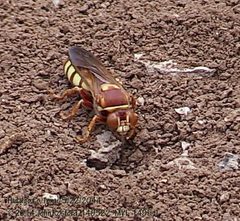
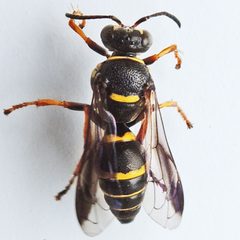
Members of Stictiellina are medium-sized with slender bodies. Steniolia , a representative , reach approximately 22 mm in length. A distinctive feature is the elongated, non-retractable and (tongue-like mouthparts), which form straw-like structures used for nectar probing; these are tucked between the legs when not in use. Many species exhibit coloration and patterning.
Habitat
Arid and semi-arid environments including deserts and dry grasslands. characterized by sandy or loose soils suitable for burrow excavation. Associated with flowering plants that serve as nectar sources.
Distribution
Primarily North American, with range extending from central Nevada south through Arizona, southeastern California, and into Mexico. Some have more restricted distributions.
Seasonality
active from March to August, with peak activity varying by and locality. Activity patterns tied to flowering periods of nectar sources and prey availability.
Diet
feed on nectar from flowers including thistles (Cirsium), Palafoxia, Petalonyx, Melilotus, and Chilopsis. Females hunt flies (Diptera) as larval provisions; Steniolia females have been observed provisioning with robber flies (Asilidae), though this relationship requires confirmation.
Life Cycle
Solitary ground-nesting . Females excavate burrows, hunt and paralyze flies with a sting, and transport prey to the burrow where larvae feed on the provisioned food. Developmental stages include , larva, pupa, and ; specific timing undocumented for most .
Behavior
Highly vigilant and easily startled into when not feeding. Males observed to be less wary when concentrated at nectar sources. Females demonstrate industrious hunting , capturing and transporting prey to nest burrows. Extra-long mouthparts used for nectar probing.
Ecological Role
of flies, potentially contributing to regulation of dipteran . of desert and semi-arid flowering plants through nectar feeding.
Human Relevance
Beneficial insects due to on flies, including potential pest . Subject of entomological study, particularly revisions by J.E. Gillaspy. Observed by naturalists and photographed at flowers in southwestern North America.
Similar Taxa
- Other Bembicini subtribesStictiellina distinguished by elongated non-retractable mouthparts; other subtribes lack this specialized nectar-feeding
- Bembix and related sand waspsSimilar ground-nesting and prey type, but Stictiellina have distinct morphological characters including mouthpart structure and male genitalia
More Details
Taxonomic History
Originally treated as part of 'traditional Sphecidae', now classified in Crabronidae () or Bembicidae (family) depending on classification system used. The subtribe was formally established by R. Bohart and D.S. Horning in 1971.
Research History
James E. Gillaspy was the leading authority on Steniolia, publishing major revisions in 1964 and 1985 (with R.M. Bohart). Much basic remains undocumented for most .