
Bicyrtes quadrifasciatus
(Say, 1824)
Four-banded Stink Bug Wasp, four-banded stink bug hunter wasp
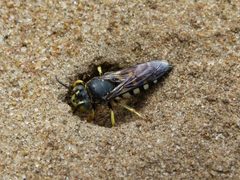
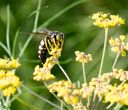
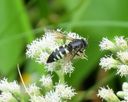
Bicyrtes quadrifasciatus is a sand wasp native to North America, east of the Rocky Mountains. Females construct solitary burrows in sandy soil to provision with paralyzed true bugs, primarily stink bugs (Pentatomidae), as food for their larvae. The has gained attention for its role as a native agent of the Brown Marmorated Stink Bug (Halyomorpha halys). are nectar-feeders and can be readily observed at flowers.
Pronunciation
How to pronounce Bicyrtes quadrifasciatus: /bɪˈsaɪrtiːz kwɒdrɪfæsɪˈeɪtəs/
These audio files are automatically generated. While they are not always 100% accurate, they are a good starting point.
Identification
Easily distinguished from similar sand wasps (Bembix, Steniolia) by the boxy, angular appearance of the , with white-marked hind corners. More sedate and approachable in than most other Bembicinae. Distinguished from other Bicyrtes by specific banding patterns and geographic range.
Images
Habitat
Sandy soils including riverbanks, lakeshores, sand volleyball courts, and children's sandboxes. Tolerates coarser, rockier soil textures than most other sand wasps. Nests in open, sandy areas often near water sources.
Distribution
North America, east of the Rocky Mountains. Recorded from Canada (Ontario) throughout the eastern and central United States.
Seasonality
Active during summer months. frequent flowers throughout the season; nesting activity peaks during warm periods.
Diet
feed on nectar from flowers including dogbane (Apocynum), Indian hemp, milkweeds, white sweet clover, and wild carrot ( Anne's Lace). Larvae are provisioned with paralyzed true bugs, primarily stink bugs (Pentatomidae), with leaf-footed bugs (Coreidae), shield bugs (Scutellaridae), and assassin bugs (Reduviidae) also recorded as prey.
Host Associations
- Halyomorpha halys - -preyBrown Marmorated Stink Bug; pest in North America, now a major prey item for B. quadrifasciatus
- Pentatomidae - -preyPrimary prey ; nymphs hunted as larval provisions
- Coreidae - -preyLeaf-footed bugs accepted as prey
- Scutellaridae - -preyShield bugs recorded as prey
- Reduviidae - -preyAssassin bugs recorded as prey
Life Cycle
Females dig burrows 15–20 cm deep at a shallow angle using a tarsal rake on modified forelegs. Burrows terminate in single or multiple . Females practice : each cell is stocked with multiple paralyzed prey items, an is laid on the first victim, and the burrow is sealed. The female does not remain to feed the larva progressively. Larvae develop on the cached prey and emerge as the following season.
Behavior
Solitary nesting; females tend to nest alone rather than in dense . When returning from hunting, females use subtle landmarks to relocate hidden nest entrances. Both sexes are sedate at flowers and can be closely approached. During nest excavation, other may fly up to investigate the digging individual, though the function of this (mate-seeking or nest usurpation) is unclear. When disturbed while carrying prey, females retain their prey and fly off rather than dropping it.
Ecological Role
of true bugs, with documented importance in suppressing of the Brown Marmorated Stink Bug. As a native agent, it may reduce the need for introduced . contribute to pollination through nectar feeding.
Human Relevance
Recognized as a beneficial insect for of agricultural pests. Subject of citizen science projects to document nest provisioning rates and prey composition. Non-aggressive; poses minimal sting risk to humans. Presence in sandboxes and recreational areas may cause minor nuisance.
Similar Taxa
- Bembix spp.Similar size and coloration, but Bembix has rounded and is far more flighty and difficult to approach
- Steniolia spp.Similar sand wasp , but lacks the angular, boxy with white hind corners characteristic of Bicyrtes
- Other Bicyrtes speciesSeven other North American exist; distinguished by banding patterns, geographic distribution, and subtle morphological differences
More Details
Biological Control Significance
Research by Alex Surcică and others has documented that B. quadrifasciatus has rapidly adopted the Brown Marmorated Stink Bug as a major prey item, with females provisioning nests almost exclusively with this pest in some areas. This native -prey relationship may provide sustainable, regionally adapted pest suppression without risks associated with introduced biocontrol agents.
Nesting Biology
Unlike the related Cerceris fumipennis, which drops its prey (jewel beetles) when disturbed, B. quadrifasciatus retains its prey and escapes when handled. This behavioral difference was noted by observers attempting to confirm prey identity through disturbance.
Taxonomic History
Originally described as Monedula quadrifasciata by Say in 1824. The Bicyrtes was established later, with this transferred to it. The -level classification has varied, with treatments placing it in Bembicidae, Nyssonidae, or Crabronidae depending on taxonomic scheme.
Sources and further reading
- BugGuide
- Wikipedia
- GBIF taxonomy match
- iNaturalist taxon
- NCBI Taxonomy
- Catalogue of Life
- Bembicid Holdings | Entomology Research Museum
- Bug Eric: Wasp Wednesday: Wasp vs. Bug
- Missouri | Beetles In The Bush | Page 9
- Hymenoptera | Beetles In The Bush | Page 4
- behavior | Beetles In The Bush | Page 2
- Bug Eric: Wasp Wednesday: Bicyrtes