
Ixodiphagus hookeri
(Howard, 1908)
tick wasp
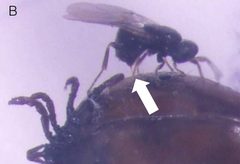
Ixodiphagus hookeri, commonly known as the , is a minute wasp in the Encyrtidae that specializes in attacking hard ticks (Ixodidae). Females oviposit into unfed tick nymphs, with development proceeding only after the engorges on vertebrate blood. The wasp harbors the symbiotic bacterium pipientis, which appears to suppress the tick's immune response and facilitate successful . This has been recorded from numerous tick worldwide and is considered a promising candidate for of tick of human and animal .
Pronunciation
How to pronounce Ixodiphagus hookeri: /ɪkˈsɒdɪfæɡəs ˈhʊkəri/
These audio files are automatically generated. While they are not always 100% accurate, they are a good starting point.
Identification
Distinguished from other Encyrtidae by its extremely small size, association with , and the characteristic flattened with large . Molecular detection via qPCR targeting I. hookeri-specific sequences is increasingly used for identification, as morphological identification of minute specimens is challenging. The presence of DNA in ticks can serve as an indicator of I. hookeri .
Images
Appearance
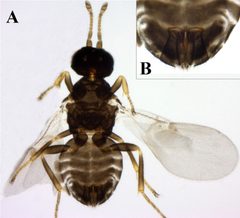
Small measuring 0.8–0.9 mm in body length with a wing span of approximately 1.5 mm. Coloration is blackish overall. is dorsally flattened with very large . show : females possess 11-segmented, club-shaped antennae, while males have 10-segmented, thread-like antennae. Wings are typical of Encyrtidae with reduced venation.
Habitat
Occurs in supporting , particularly areas with suitable vertebrate for tick feeding. In Europe, strongly associated with woodland and forest edge habitats where Ixodes ricinus occurs. Favors situations near water sources in some regions. Specific microhabitat preferences relate to host tick questing rather than direct environmental requirements.
Distribution
distribution excluding Antarctica. Documented from North America (including British Columbia and California), Europe (widespread including Finland, Netherlands, Germany, Hungary), South America (Brazil), Africa (Kenya), and Asia. Within Europe, shows geographic variation in preferences and rates.
Seasonality
Short period during summer months in temperate regions (Europe). activity coincides with availability of unfed nymphs suitable for oviposition. In northern Europe, peak activity appears to occur from May through mid-July, with some extension into early autumn.
Host Associations
- Ixodes ricinus - primary Preferred in Europe; nymphal stages primarily targeted
- Ixodes scapularis - North American ; embryonic development studied in this association
- Rhipicephalus sanguineus - stages recorded as ; dog-associated studied
- Amblyomma nodosum - First record from Brazil, 2022
- Amblyomma sculptum - Investigated in Brazil but detection unsuccessful in some studies
- Haemaphysalis concinna - Documented in Balkan Peninsula
- Dermacentor reticulatus - non-Explicitly not used as in Europe despite sympatry
- Ornithodoros spp. - recorded as
- Amblyomma spp. - Multiple in recorded
- Dermacentor spp. - Multiple in recorded, with noted exceptions
- Hyalomma spp. - recorded as
Life Cycle
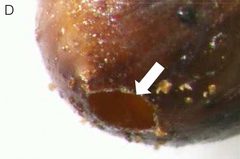
Females oviposit single into the body of unfed nymphs (primarily) or . Eggs enter until the tick engorges on vertebrate blood, at which point embryonic development initiates. Larvae develop as koinobiont endoparasitoids within the tick for 28–70 days before emerging as adult . Some eggs fail to develop due to and melanization by the tick immune system. appear to suppress host and increase success. Adult wasps are short-lived, with females immediately beginning oviposition and expiring within approximately seven days.
Behavior
Females exhibit -seeking mediated by olfactory cues. Attracted to volatiles from dog hair, particularly from -infested individuals, suggesting use of host animal cues to locate tick prey. A synthetic blend of hexanal, heptanal, and isovaleric acid elicits attraction. Visual host evaluation occurs prior to oviposition. Females show higher acceptance of live tick nymphs than dead or solvent-washed specimens. Males not directly involved in host location.
Ecological Role
Natural enemy of hard ticks, with potential to reduce and associated transmission. rates in natural populations range from 0% to 38% depending on location and year. May differentially affect transmission cycles of tick-borne : positive association with deer-associated Anaplasma phagocytophilum, negative association with rodent-associated Borrelia afzelii and Neoehrlichia mikurensis. Considered a candidate agent for tick of and other tick-borne diseases.
Human Relevance
Investigated extensively as a agent for ticks of medical and veterinary importance. Potential application in integrated management programs, particularly for control of Ixodes ricinus ( of ) and Rhipicephalus sanguineus (dog tick). detection in ticks has been used as a molecular indicator of I. hookeri presence, though this relationship requires careful interpretation. Climate change appears to be increasing rates in northern Europe, suggesting expanding suitability for biological control applications.
Similar Taxa
- Other Ixodiphagus speciesIxodiphagus brunneus, I. texanus, I. theilerae, and I. mysorensis are congeneric of ticks; morphological separation requires detailed examination and is poorly documented in literature
- Other EncyrtidaeNumerous small encyrtid share general ; association with ticks is the primary distinguishing feature of I. hookeri
More Details
Wolbachia symbiosis
I. hookeri harbors pipientis, which is transmitted to during . Detection of Wolbachia in ticks often indicates I. hookeri presence, though other Wolbachia sources in ticks may exist. The bacterium appears to suppress tick immune responses, increasing survival.
Host preference variation
Different of I. hookeri worldwide show different preferences, complicating attempts to use this as a uniform agent. European populations prefer Ixodes ricinus and avoid Dermacentor reticulatus, while other geographic populations show different patterns.
Climate change effects
Longitudinal studies in Finland (2014–2021) demonstrate increasing rates linked to rising temperatures and deer abundance, suggesting global warming may expand I. hookeri and effectiveness in northern regions.
Sources and further reading
- BugGuide
- Wikipedia
- GBIF taxonomy match
- iNaturalist taxon
- NCBI Taxonomy
- Catalogue of Life
- Encyrtid Holdings | Entomology Research Museum
- Grasshopper Collections and Survey
- Bug Eric: Wasp Wednesday: Euodynerus annulatus
- Bug Eric: August 2012
- Ten New Spider Species Found in Madagascar
- A hidden beneficial: biology of the tick-wasp Ixodiphagus hookeri in Germany
- Host Recognition by the Tick ParasitoidIxodiphagus hookeri(Hymenoptera: Encyrtidae)
- Life history of the tick parasitoid Ixodiphagus hookeri (Hymenoptera: Encyrtidae) in Kenya
- Visual Evaluation and Recognition of Hosts by the Tick Parasitoid, Ixodiphagus hookeri (Hymenoptera: Encyrtidae)
- First evidence of Ixodiphagus hookeri (Hymenoptera: Encyrtidae) parasitization in Finnish castor bean ticks (Ixodes ricinus)
- Parasites of vectors - Ixodiphagus hookeri and its Wolbachia symbionts in ticks in the Netherlands
- First record of the parasitoid wasp Ixodiphagus hookeri (Hymenoptera: Encyrtidae) infesting the tick Amblyomma nodosum (Acari: Ixodidae)
- Pesquisa do parasitoide Ixodiphagus hookeri (Howard, 1908), (Hymenoptera: Encyrtidae) nos carrapatos Amblyomma sculptum (Berlese, 1888) e Rhipicephalus sanguineus (Latreille,1806) no município de Salto, SP
- First detection of Ixodiphagus hookeri (Hymenoptera: Encyrtidae) in Ixodes ricinus ticks (Acari: Ixodidae) from multiple locations of Hungary
- Effects of the Feeding Process of Ixodes scapularis (Acari: Ixodidae) on Embryonic Development of its Parasitoid, Ixodiphagus hookeri (Hymenoptera: Encyrtidae)
- Temporal variation and drivers of Ixodiphagus hookeri parasitisation in Ixodes ricinus ticks in northern Europe
- Behavioral responses of Ixodiphagus hookeri (Hymenoptera; Encyrtidae) to Rhipicephalus sanguineus nymphs (Ixodida: Ixodidae) and dog hair volatiles
- First detection of Ixodiphagus hookeri (Hymenoptera: Encyrtidae) in Ixodes ricinus ticks (Acari: Ixodidae) from multiple locations in Hungary
- Tripartite Interactions among Ixodiphagus hookeri, Ixodes ricinus and Deer: Differential Interference with Transmission Cycles of Tick-Borne Pathogens
- Detection of Wolbachia in the Tick Ixodes ricinus is Due to the Presence of the Hymenoptera Endoparasitoid Ixodiphagus hookeri
- Long-read sequencing reveals that the mitochondrial genome of an individual Ixodiphagus hookeri is a mixture of structural variants with an invariable core region and heterogeneous repeat regions.
- First Molecular Evidence of Ixodiphagus hookeri (Hymenoptera: Encyrtidae) in Ixodes ricinus and Haemaphysalis concinna (Acari: Ixodida) Ticks from Inland and Coastal Areas of the Balkan Peninsula.