
Ixodiphagus
Howard, 1907
Species Guides
1- Ixodiphagus hookeri(tick wasp)
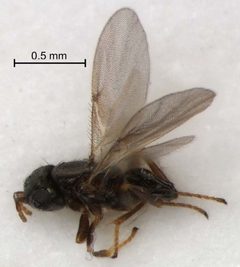
Ixodiphagus is a of minute chalcidoid wasps in the Encyrtidae, comprising approximately 10–11 described worldwide. These are obligate of ticks (order Ixodida), with females ovipositing into larval or nymphal . The genus was erected by Leland Ossian Howard in 1907, with I. texanus as the type species. Ixodiphagus has been extensively studied as a potential agent for medically and veterinary important tick species due to its unique host-specific .
Pronunciation
How to pronounce Ixodiphagus: /ɪkˌsɒdɪˈfæɡəs/
These audio files are automatically generated. While they are not always 100% accurate, they are a good starting point.
Identification
Ixodiphagus can be distinguished from other encyrtid by the combination of a 5-segmented maxillary palp and the absence of a malar on the genae. Accurate identification depends on microscopic examination of male genitalia structure, antennal segment counts, and cuticular on the mesosoma and . The genus is most reliably identified through its association with and the distinctive of tick .
Images
Appearance
are minute measuring approximately 1–2 mm in length, with the typical encyrtid body plan characteristic of chalcidoid wasps. Diagnostic morphological characters include a 5-segmented maxillary palp and genae lacking a malar . -level identification requires examination of male genitalia, antennal segmentation, and patterns of the mesosoma and .
Habitat
Ixodiphagus occur in diverse terrestrial wherever their are present, including forested areas, grasslands, agricultural lands, and coastal environments. The have been recorded from seabird colonies, rabbit habitats, and areas with large mammal hosts. Habitat suitability is determined by host tick presence rather than specific environmental conditions.
Distribution
Near-global distribution, with records from North America, Central and South America, Europe, Africa, Asia, and Oceania. Documented occurrences include the United States (Texas, type locality), Canada (Nova Scotia), Brazil, Kenya, Finland, Hungary, the Netherlands, Germany, New Zealand, and India. Distribution mirrors that of , including island systems such as New Zealand where I. taiaroaensis was described from seabird tick colonies.
Seasonality
Multiple per year have been documented; I. texanus in Nova Scotia shows at least two generations annually. Seasonal activity is tied to , with occurring when larval and nymphal ticks are available. In northern Europe, parasitisation of Ixodes ricinus nymphs shows variation between early season (May to mid-July) and late season (mid-July to October), with highest activity influenced by larval densities and July mean temperatures.
Host Associations
- Ixodes - hard ; includes I. ricinus, I. uriae, I. eudyptidis, I. scapularis
- Rhipicephalus - hard ; includes R. sanguineus, R. appendiculatus, R. microplus
- Amblyomma - hard ; includes A. variegatum, A. nodosum, A. sculptum, A. varium
- Dermacentor - hard
- Haemaphysalis - hard ; includes H. leporispalustris, H. concinna
- Hyalomma - hard
- Ornithodoros - (Argasidae)
Life Cycle
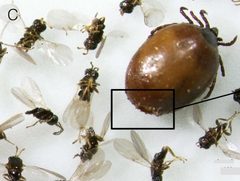
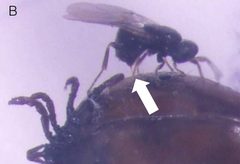
Females oviposit into engorged larvae or unfed/engorged nymphs. deposited in larvae enter developmental arrest until the to the nymphal stage, after which embryogenesis and larval development proceed. Multiple eggs may be laid per individual tick host. emerge 30–60 days after the parasitized nymph feeds and detaches from its vertebrate host. Emerged adults are short-lived, with I. hookeri females beginning immediate oviposition and expiring within seven days.
Behavior
Females locate using volatile chemical cues from host animals rather than direct attraction to ticks. Ixodiphagus hookeri females are attracted to blends of compounds from dog hair, including hexanal, heptanal, and isovaleric acid, with stronger attraction to hair from tick-infested dogs than non-infested dogs. show higher acceptance of live fed and unfed tick nymphs compared to dead or solvent-washed hosts. Host-seeking is mediated by vertebrate-derived , suggesting that is more likely to occur on ticks feeding on large host animals than on ground-questing ticks or those on small hosts.
Ecological Role
Ixodiphagus functions as a natural agent of , acting as a koinobiont endoparasitoid that ultimately kills its tick . rates in natural populations vary geographically, ranging from 0% to 38% in studied Ixodes ricinus populations. The may influence tick-borne dynamics; parasitised ticks show altered pathogen associations, with higher likelihood of spp. carriage and lower likelihood of Borrelia spp. . The presence of in I. hookeri may contribute to incidental detection of Wolbachia in tick , complicating ecological interpretations.
Human Relevance
Investigated extensively as a agent for ticks of medical and veterinary importance, including of , spotted fever, and other -borne . Controlled releases have produced mixed outcomes: a Kenyan trial using approximately 150,000 I. hookeri substantially reduced Amblyomma variegatum but did not affect co-occurring Rhipicephalus appendiculatus, demonstrating specificity limitations. Climate change may enhance populations and rates, potentially increasing biocontrol efficacy in northern regions. The represents a promising but challenging candidate for integrated tick management programs.
Similar Taxa
- HunterellusFormerly considered a separate ; Hunterellus hookeri was transferred to Ixodiphagus hookeri. Historical taxonomic confusion resolved through synonymization.
- AustralzaommaProposed as a separate for - encyrtids but now treated as a junior synonym of Ixodiphagus.
- Other EncyrtidaeDistinguished from non--parasitizing encyrtids by the unique obligate relationship with Ixodida and associated morphological characters (5-segmented maxillary palp, absence of malar ).
More Details
Wolbachia symbiosis
Ixodiphagus hookeri harbors bacterial . Detection of Wolbachia in ticks is strongly associated with I. hookeri , and 87% of I. hookeri-positive ticks carry Wolbachia compared to only 1.6% of unparasitized ticks. This symbiotic relationship may confound molecular screening for Wolbachia in .
Molecular detection
Modern surveys increasingly rely on qPCR and metagenomic screening for Ixodiphagus in ticks rather than direct observation of , enabling detection of in questing nymphs and assessment of geographic distribution patterns.
Taxonomic history
The was erected in 1907 with I. texanus from rabbit ticks in Texas. Additional names proposed for - encyrtids, including Australzaomma (Girault, 1925), have been synonymized under Ixodiphagus. Comprehensive modern reviews recognize 10–11 valid , with I. hookeri being the most extensively studied due to its wide distribution and biocontrol potential.
Sources and further reading
- BugGuide
- Wikipedia
- GBIF taxonomy match
- iNaturalist taxon
- NCBI Taxonomy
- Catalogue of Life
- Encyrtid Holdings | Entomology Research Museum
- Occurrence of Ixodiphagus sp. (Hymenoptera: Encyrtidae) as a parasitoid of
- Pesquisa de parasitoide do gênero Ixodiphagus em carrapatos Amblyomma sculptum e Rhipicephalus sanguineus
- A hidden beneficial: biology of the tick-wasp Ixodiphagus hookeri in Germany
- Host Recognition by the Tick ParasitoidIxodiphagus hookeri(Hymenoptera: Encyrtidae)
- Life history of the tick parasitoid Ixodiphagus hookeri (Hymenoptera: Encyrtidae) in Kenya
- Pesquisa do parasitoide Ixodiphagus hookeri (Howard, 1908), (Hymenoptera: Encyrtidae) nos carrapatos Amblyomma sculptum (Berlese, 1888) e Rhipicephalus sanguineus (Latreille,1806) no município de Salto, SP
- First detection of Ixodiphagus hookeri (Hymenoptera: Encyrtidae) in Ixodes ricinus ticks (Acari: Ixodidae) from multiple locations of Hungary
- Effects of the Feeding Process of Ixodes scapularis (Acari: Ixodidae) on Embryonic Development of its Parasitoid, Ixodiphagus hookeri (Hymenoptera: Encyrtidae)
- First record of the parasitoid wasp Ixodiphagus hookeri (Hymenoptera: Encyrtidae) infesting the tick Amblyomma nodosum (Acari: Ixodidae)
- First report of Amblyomma varium (Ixodida: Ixodidae) as hosts of Ixodiphagus sp. (Hymenoptera: Encyrtidae)
- Parasites of vectors - Ixodiphagus hookeri and its Wolbachia symbionts in ticks in the Netherlands
- Behavioral responses of Ixodiphagus hookeri (Hymenoptera; Encyrtidae) to Rhipicephalus sanguineus nymphs (Ixodida: Ixodidae) and dog hair volatiles
- A new species of Ixodiphagus (Hymenoptera: Chalcidoidea: Encyrtidae) parasitizing seabird ticks in New Zealand
- Ixodiphagus texanus Howard (Hymenoptera: Encyrtidae) a parasite of the rabbit tick in Nova Scotia
- Temporal variation and drivers of Ixodiphagus hookeri parasitisation in Ixodes ricinus ticks in northern Europe
- Long-read sequencing reveals that the mitochondrial genome of an individual Ixodiphagus hookeri is a mixture of structural variants with an invariable core region and heterogeneous repeat regions.
- First Molecular Evidence of Ixodiphagus hookeri (Hymenoptera: Encyrtidae) in Ixodes ricinus and Haemaphysalis concinna (Acari: Ixodida) Ticks from Inland and Coastal Areas of the Balkan Peninsula.