
Macrohomotoma gladiata
Kuwayama, 1908
Curtain Fig Psyllid
Macrohomotoma gladiata is an Asian that has established across the Mediterranean Basin and California, where it infests ornamental Ficus microcarpa. Nymphs feed on young tissues, producing dense white waxy secretions and honeydew that promotes sooty mould growth and causes twig dieback. The has a likely with possible partial third ; young nymphs overwinter under stipules without development, resuming growth in spring. Natural enemies include a Psyllaephagus that can achieve high rates, and the predatory Anthocoris nemoralis.
Pronunciation
How to pronounce Macrohomotoma gladiata: //ˌmækroʊhoʊˈmoʊtoʊmə ˌɡlædiˈeɪtə//
These audio files are automatically generated. While they are not always 100% accurate, they are a good starting point.
Identification
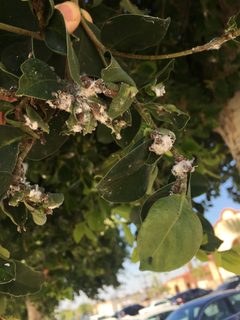
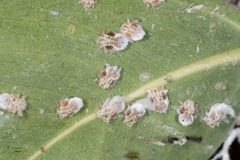
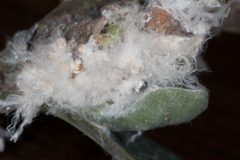
are small psyllids with typical Homotomidae . Nymphs are distinguished by dense white woolly waxy secretions covering twigs and the tendency to aggregate under connected stipules. Infested trees show rolled leaves at shoot tips, blackened twigs from sooty mould, and conspicuous white waxy masses. Differentiation from other Ficus-feeding psyllids such as Trioza brevigenae requires examination of morphological details: T. brevigenae produces tight leaf rolls rather than waxy woolly secretions, and adults have reddish with greenish or brownish bodies at 2.6–2.8 mm length.
Images
Habitat
Urban ornamental settings including gardens, parks, and street plantings on Ficus microcarpa. In studied , occurs on infested twigs 8–10 cm long. Thrives in warm temperate to subtropical climates with sufficient precipitation; high summer temperatures and low autumn precipitation may limit abundance.
Distribution
Native to Eastern Asia (China including Fujian and Shanghai, Hong Kong, India including Maharashtra, Indonesia including Sumatra, Japan including Ryukyu Islands, Taiwan, Turkey). in Mediterranean Basin: Spain including mainland, Balearic and Canary Islands, France, Italy including Sicily, Malta, Portugal including Madeira, Greece, Montenegro, Gibraltar, Cyprus, Algeria, Morocco, Tunisia. Also established in California, USA.
Seasonality
In Greece, recorded in May, August, and October to early January. First and second instar nymphs present year-round except August–September; densities reduced in early May. Middle-aged (third instar) and late instar (fourth and fifth instar) nymphs appear in March–April and June–July. Development slows or arrests in winter; young nymphs overwinter without development under stipules. reduction observed in September, associated with low precipitation.
Diet
Phloem-feeding on plant sap of young and developing tissues of plants.
Host Associations
- Ficus microcarpa L.f. - primary main for
- Ficus benjamina L. -
- Ficus benghalensis L. -
Life Cycle
Likely with possible partial third in autumn. laid under stipules that females connect together; oviposition peaks in May, August, and October–January. First and second instar nymphs present throughout year except August–September, under stipules without development. Third instar nymphs recorded in March–April and June–July. Fourth and fifth instar nymphs recorded in March–April and June–July. Development resumes in spring; young nymphs do not develop further under autumn and winter conditions.
Behavior
Females connect stipules together after oviposition, creating protected shelters for young nymphs. Nymphs produce large quantities of white woolly waxy secretions that cover twigs. Honeydew leads to sooty mould growth and blackened twigs. influenced by precipitation levels and temperature extremes.
Ecological Role
Pest of ornamental Ficus microcarpa causing direct damage through feeding and waxy secretions, and indirect damage via honeydew and sooty mould leading to twig dieback. Prey for native natural enemies including Psyllaephagus sp. and predatory Anthocoris nemoralis. potential noted for urban environments where application is restricted. for Liberibacter bacteria, though to plants unconfirmed.
Human Relevance
Significant pest of widely planted ornamental and landscape tree Ficus microcarpa in urban environments. Causes aesthetic degradation through waxy secretions, sooty mould, and twig dieback. Management complicated by concealed feeding habits under stipules and waxy coverings. Natural by shows promise for urban . International trade in ornamental plants implicated in spread across Mediterranean and to California.
Similar Taxa
- Trioza brevigenaeAlso on Ficus microcarpa in California; distinguished by tight leaf-rolling galls rather than woolly waxy secretions, and color (reddish in T. brevigenae).
- Other Ficus-feeding psyllids in Homotomidae and TriozidaeShare plants and general ; require detailed morphological examination for definitive identification.
Sources and further reading
- BugGuide
- GBIF taxonomy match
- iNaturalist taxon
- NCBI Taxonomy
- Catalogue of Life
- A New Psyllid Pest on Ornamental Trees in California
- Macrohomotoma gladiata . [Distribution map].
- Macrohomotoma gladiata Kuwayama. [Distribution map].
- MACROHOMOTOMA GLADIATA (HEMIPTERA HOMOTOMIDAE) SEASONAL POPULATION FLUCTUATION AND ITS NATURAL ENEMIES ON FICUS MICROCARPA IN GREECE
- Infection Patterns of a Liberibacter Associated with Macrohomotoma gladiata, a Psyllid Feeding on Ficus microcarpa
- First records of Cacopsylla fulguralis (Kuwayama) and Macrohomotoma gladiata Kuwayama in Gibraltar (Hemiptera: Psylloidea)
- Macrohomotoma gladiata Kuwayama, 1908 (Hemiptera: Psylloidea): a new pest of Ficus microcarpa L.f. in Tunisia
- First record of Macrohomotoma gladiata Kuwayama, 1908 (Hemiptera: Psylloidea: Homotomidae), a pest of ornamental Ficus microcarpa L. f., in Morocco
- The psyllid Macrohomotoma gladiata Kuwayama, 1908 (Hemiptera: Psylloidea: Homotomidae): a Ficus pest recently introduced in the EPPO region
- New records of Encyrtid wasps (Hymenoptera: Chalcidoidea) from Greece and Cyprus with the description of a new species associated with Macrohomotoma gladiata Kuwayama (Hemiptera: Psylloidea)
- Preliminary study on the biology, natural enemies and chemical control of the invasive Macrohomotoma gladiata (Kuwayama) on urban Ficus microcarpa L. trees in Valencia (SE Spain)