
Macrohomotoma
Kuwayama, 1908
Species Guides
1- Macrohomotoma gladiata(Curtain Fig Psyllid)
Macrohomotoma is a of psyllids in the Homotomidae, established by Kuwayama in 1908. The genus contains approximately 15 described of plant-parasitic hemipterans. Best-known species include Macrohomotoma gladiata, a significant pest of ornamental Ficus trees that has expanded from its native Asian range to become in the Mediterranean region and elsewhere. The genus is characterized by association with Ficus plants and production of conspicuous waxy secretions.
Pronunciation
How to pronounce Macrohomotoma: /ˌmækroʊhoʊˈmoʊtoʊmə/
These audio files are automatically generated. While they are not always 100% accurate, they are a good starting point.
Images
Habitat
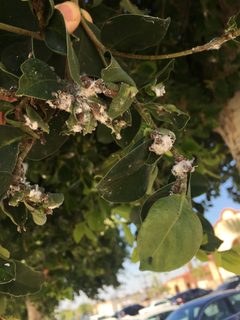
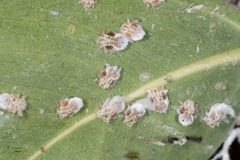
in this are associated with Ficus plants. Macrohomotoma gladiata occurs on Ficus microcarpa in urban environments, with nymphs feeding on inner and outer shoots and on the underside of outer leaves or shoots.
Distribution
Native range includes Taiwan, Japan, Hong Kong, and parts of mainland China. Macrohomotoma gladiata has been introduced and established in Spain, Italy, Greece, Portugal, Gibraltar, Morocco, Algeria, Tunisia, Malta, Cyprus, Montenegro, France, Turkey, and the United States (California).
Seasonality
In the Mediterranean region, occur in May, August, and October through early January. First and second instar nymphs are present year-round except August and September. Middle and late instars appear in March–April and June–July. Winter consist only of young nymphs, which do not develop further under autumn and winter conditions. Likely or partially trivoltine .
Diet
Phloem sap feeder. Macrohomotoma gladiata feeds specifically on Ficus microcarpa; Macrohomotoma sinica has been recorded on Ficus concinna.
Host Associations
- Ficus microcarpa - primary Macrohomotoma gladiata
- Ficus concinna - primary Macrohomotoma sinica
Life Cycle
Macrohomotoma gladiata has five nymphal stages and produces more than one per year, likely with possible partial third generation in autumn.
Behavior
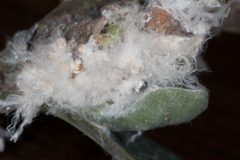
Females lay below stipules of young leaves. Nymphs produce white waxy secretions around shoots that lead to growth. of Macrohomotoma gladiata exhibit abdominal color with orange, brown/grey, and blue/green . Intense feeding can cause shoot death and leaf rolling at twig tips.
Ecological Role
Herbivore on Ficus . of Liberibacter bacteria closely related to Candidatus Liberibacter asiaticus. Serves as for in the Psyllaephagus (Encyrtidae), with rates reaching 81% in some . Preyed upon by Anthocoris nemoralis.
Human Relevance
Significant pest of ornamental Ficus microcarpa in urban landscaping. Causes direct damage through feeding and indirect damage via honeydew and development. Spread through international plant trade has led to establishment across multiple continents. Subject to chemical control and research.
More Details
Liberibacter association
A Liberibacter closely related to Candidatus Liberibacter asiaticus has been detected in Macrohomotoma gladiata in Taiwan with variable frequencies. Infection is associated with gender and abdominal color: males and blue/green abdominal show higher proportions of high-density infections.
Taxonomic note
placement varies in sources between Homotomidae and Carsidaridae; current consensus favors Homotomidae.
Sources and further reading
- BugGuide
- Wikipedia
- GBIF taxonomy match
- iNaturalist taxon
- NCBI Taxonomy
- Catalogue of Life
- Macrohomotoma gladiata Kuwayama. [Distribution map].
- Macrohomotoma gladiata . [Distribution map].
- Infection Patterns of a Liberibacter Associated with Macrohomotoma gladiata, a Psyllid Feeding on Ficus microcarpa
- MACROHOMOTOMA GLADIATA (HEMIPTERA HOMOTOMIDAE) SEASONAL POPULATION FLUCTUATION AND ITS NATURAL ENEMIES ON FICUS MICROCARPA IN GREECE
- A new species of Psyllaephagus (Hymenoptera: Encyrtidae) from China, parasitoid of Macrohomotoma sinica (Hemiptera: Homotomidae) on Ficus concinna
- First records of Cacopsylla fulguralis (Kuwayama) and Macrohomotoma gladiata Kuwayama in Gibraltar (Hemiptera: Psylloidea)
- Macrohomotoma gladiata Kuwayama, 1908 (Hemiptera: Psylloidea): a new pest of Ficus microcarpa L.f. in Tunisia
- First record of Macrohomotoma gladiata Kuwayama, 1908 (Hemiptera: Psylloidea: Homotomidae), a pest of ornamental Ficus microcarpa L. f., in Morocco
- The psyllid Macrohomotoma gladiata Kuwayama, 1908 (Hemiptera: Psylloidea: Homotomidae): a Ficus pest recently introduced in the EPPO region
- New records of Encyrtid wasps (Hymenoptera: Chalcidoidea) from Greece and Cyprus with the description of a new species associated with Macrohomotoma gladiata Kuwayama (Hemiptera: Psylloidea)
- Preliminary study on the biology, natural enemies and chemical control of the invasive Macrohomotoma gladiata (Kuwayama) on urban Ficus microcarpa L. trees in Valencia (SE Spain)
- Figure 2 from: Wu F, Zhen W, Yang Z, Zu G (2021) A new species of Psyllaephagus (Hymenoptera: Encyrtidae) from China, parasitoid of Macrohomotoma sinica (Hemiptera: Homotomidae) on Ficus concinna. Biodiversity Data Journal 9: e63253. https://doi.org/10.3897/BDJ.9.e63253
- Figure 1 from: Wu F, Zhen W, Yang Z, Zu G (2021) A new species of Psyllaephagus (Hymenoptera: Encyrtidae) from China, parasitoid of Macrohomotoma sinica (Hemiptera: Homotomidae) on Ficus concinna. Biodiversity Data Journal 9: e63253. https://doi.org/10.3897/BDJ.9.e63253