
Carsidaridae
Subfamily Guides
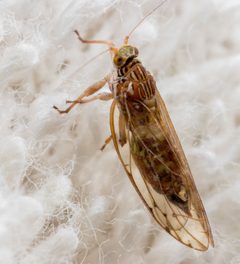
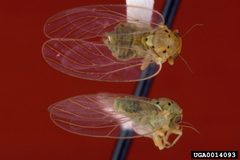
1is a of jumping plant-lice (psyllids) in the superfamily Psylloidea. The family has a worldwide distribution with greater representation in the southern hemisphere. It comprises three : Carsidarinae, Homotominae, and Pachypsyllinae. Several are known agricultural pests, including Allocarsidara species on durian and Mesohomotoma tessmanni on cocoa.
Pronunciation
How to pronounce Carsidaridae: /kɑːr.sɪˈdærɪdiː/
These audio files are automatically generated. While they are not always 100% accurate, they are a good starting point.
Identification
Members of can be distinguished from other by features of wing venation and genitalia; however, family-level diagnostic characters require examination. The Homotominae was previously treated as a separate family (Homotomidae).
Images
Habitat
Associated with plants including Firmiana simplex (Malvaceae), Theobroma cacao (Sterculiaceae), Octolobus spectabilis (Sterculiaceae), and durian (Malvaceae).
Distribution
Worldwide with greater representation in the southern hemisphere; recorded from eastern Asia (type Carsidara), Japan, Korea, and Cameroon.
Diet
Phloem-feeding on plants; specific dietary details at level are not established.
Host Associations
- Firmiana simplex - Immatures free-living on leaves
- Theobroma cacao - Pest Mesohomotoma tessmanni
- Octolobus spectabilis - Pest Mesohomotoma tessmanni
- Durio - Allocarsidara considered pests
Life Cycle
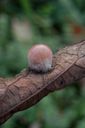
Immatures are free-living on plant leaves. In at least one (Carsidara limbata), older instars secrete large amounts of flocculent wax and honeydew.
Behavior
Older instars of some produce copious flocculent wax secretions and honeydew.
Ecological Role
Some function as pests of cultivated plants. Carsidara limbata has been discussed as a potential agent for Firmiana simplex in North America. Mesohomotoma tessmanni is subject to biological control by (Encyrtidae and Figitidae) in Cameroon.
Human Relevance
Allocarsidara are recognized as pests of durian. Mesohomotoma tessmanni is a pest of cocoa in Cameroon. Carsidara limbata has been investigated for potential use in of an tree species.
Similar Taxa
- PsyllidaeBoth are within Psylloidea; differs in wing venation and genitalia
- TriozidaeBoth are within Psylloidea; includes the former family Homotomidae as Homotominae
More Details
Subfamily classification
A 2021 review recognized three : Carsidarinae (Crawford, 1911), Homotominae (Heslop-Harrison, 1958; previously treated as Homotomidae), and Pachypsyllinae (Crawford, 1914).
Notable genera
Includes type Carsidara Walker, 1869 from eastern Asia; Mesohomotoma Kuwayama, 1908; Tyora Walker, 1869; Homotoma Guérin-Méneville, 1844; and Pachypsylla Riley, 1885.
Sources and further reading
- BugGuide
- Wikipedia
- GBIF taxonomy match
- iNaturalist taxon
- NCBI Taxonomy
- Catalogue of Life
- The identity of the Carsidara species (Hemiptera: Psylloidea: Carsidaridae) associated with Firmiana simplex (Malvaceae) in Japan and Korea
- Parasitism of Mesohomotoma tessmanni Aulmann (Psylloidea, Carsidaridae) Psyllid Pest of Theobroma cacao and Octolobus spectabilis (Sterculiaceae) in Cameroon and Taxonomy of Parasitoids