
Trioza brevigenae
Mathur, 1973
Ficus leaf-rolling psyllid
Trioza brevigenae, known as the ficus leaf-rolling , is an pest of Ficus microcarpa (Chinese banyan or Indian laurel fig) native to India. It was first detected in California in 2016, representing the first known occurrence outside its native range. The causes characteristic leaf-roll galls on foliage, with nymphs developing inside these protected structures. Its invasion and full geographic distribution remain under investigation.
Pronunciation
How to pronounce Trioza brevigenae: /ˈtriː.oʊzə ˌbrɛ.vɪˈdʒiːni/
These audio files are automatically generated. While they are not always 100% accurate, they are a good starting point.
Identification
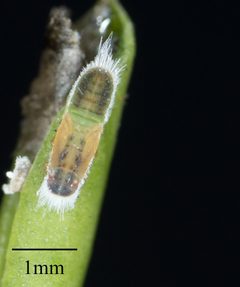
measure 2.6–2.8 mm in length with reddish , greenish to brownish bodies, and transparent wings. Nymphs display distinctive white, waxy filaments. The is recognized by the tight leaf-roll galls it induces on Ficus microcarpa foliage, with multiple nymphal instars visible within these rolls. Formal taxonomic keys distinguishing it from are not provided in available sources.
Images
Habitat
Associated with Ficus microcarpa in urban and landscape settings. Leaf-roll galls provide the microhabitat for nymphal development.
Distribution
Native to India. Introduced and established in southern California (USA), where it has been detected in six counties as of 2016. GBIF records indicate distribution in India and Western Himalaya.
Diet
Phloem-feeding on Ficus microcarpa, with nymphs developing inside leaf-roll galls. Specific plant tissue preferences beyond this are not documented.
Host Associations
- Ficus microcarpa - primary Chinese banyan; Indian laurel fig. The sole confirmed ; causes leaf-roll galls.
Life Cycle
Multiple nymphal instars occur within leaf-roll galls. Complete details including stage, longevity, and time are not documented.
Behavior
Forms characteristic leaf-roll galls on foliage, within which nymphs develop. and nymphs are found in association with these structures.
Human Relevance
Emerging pest of ornamental Ficus microcarpa in urban landscapes. Threatens a popular landscape tree already burdened by multiple other invasive pests including weeping fig thrips, ficus -spot , and others. No economic impact quantification or management protocols are established.
Similar Taxa
- Trioza spp.Congeneric psyllids; T. brevigenae distinguished by specificity to Ficus microcarpa and characteristic leaf-roll gall .
- Other Ficus-associated psyllidsCurtain fig psyllid and other Triozidae on Ficus; T. brevigenae identified by gall type (leaf-roll vs. other gall forms) and confirmed by taxonomic examination.
Sources and further reading
- BugGuide
- GBIF taxonomy match
- iNaturalist taxon
- NCBI Taxonomy
- Catalogue of Life
- Encyrtid Holdings | Entomology Research Museum
- Publications | Entomology Research Museum
- A New Psyllid Pest on Ornamental Trees in California
- Trioza brevigenae Archives - Entomology Today
- Trioza acuminatissima Archives - Entomology Today
- trioza-acuminatissima - Entomology Today