
Gynaikothrips
Zimmermann, 1900
fig thrips, gall thrips, leaf-rolling thrips
Species Guides
1- Gynaikothrips ficorum(Cuban laurel thrips)
Gynaikothrips is a of tube-tailed thrips in the Phlaeothripidae, containing more than 30 described . Members are gall-inducing insects primarily associated with Ficus species (fig trees), causing leaf folding and gall formation. Several species are economically significant pests of ornamental ficus in tropical and subtropical regions, with some having established in North America and other regions. The genus is characterized by its intimate relationship with fig trees and distinctive leaf-gall .
Pronunciation
How to pronounce Gynaikothrips: //ɡaɪˌneɪkoʊˈθrɪps//
These audio files are automatically generated. While they are not always 100% accurate, they are a good starting point.
Identification
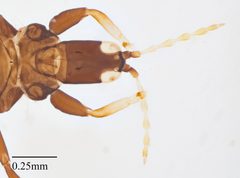
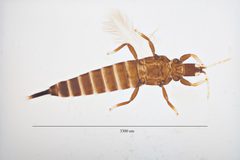
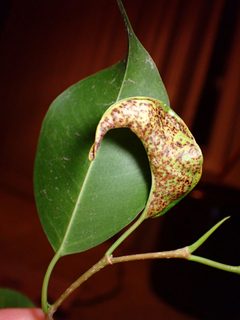
Members of Gynaikothrips can be distinguished from other thrips by their association with folded leaf galls on Ficus . Species-level identification requires examination of morphological characters including antennal segmentation, wing venation, and body setation; published keys exist for regional faunas such as the eleven species recorded from India. The genus belongs to the tube-tailed thrips Phlaeothripidae, distinguished from other thrips families by the tubular terminal abdominal segment (pelta).
Images
Habitat
Associated with Ficus trees in tropical and subtropical environments. In natural settings, occurs on various Ficus ; in urban and horticultural settings, infests ornamental fig trees including Ficus benjamina, Ficus microcarpa, and related cultivated species. Thrips inhabit the interior of folded leaf galls, which provide protected microhabitats for feeding and .
Distribution
Native to tropical regions of Asia including India, Indonesia, Malaysia, Singapore, Sri Lanka, Taiwan, Thailand, and Hong Kong. Established in Mediterranean Europe (Malta, Sicily, Spain), North Africa (Algeria, Canary Islands, Egypt, Libya, Madeira), the Americas (southern United States including Florida, Texas, California, and Hawaii; Mexico; Brazil; Peru; Venezuela), and Pacific Islands (Hawaii). Distribution closely follows the and distribution of Ficus in ornamental horticulture.
Seasonality
Multiple occur annually in suitable climates. Continuous breeding is possible in tropical and subtropical regions where plants remain available year-round. In temperate regions, persist indoors on ornamental plants or in protected outdoor locations.
Diet
Feeding occurs within folded leaf galls on Ficus . Thrips use rasping-sucking mouthparts to puncture leaf and consume plant fluids. Specific feeding damage induces gall formation, with young leaves developing abnormally to create folded . Documented plants include Ficus benjamina, Ficus microcarpa, and other Ficus species.
Host Associations
- Ficus benjamina - primary weeping fig; major ornamental supporting gall induction and complete
- Ficus microcarpa - primary Indian laurel fig; Chinese banyan; significant ornamental and landscape
- Ficus - -level association with multiple Ficus documented as
Life Cycle
completed within leaf galls. are laid in batches within folded leaves. Larvae feed and develop inside galls for several weeks before pupating. occurs within the protected gall environment. Winged emerge to disperse and initiate new galls. For Gynaikothrips cecidii under laboratory conditions (27±2°C, 65±5% RH on Ficus benjamina), egg-to-adult development requires 23-25 days, with time of approximately 28.66 days, of 48 eggs per female, and adult longevity of 16.5 days.
Behavior
Induces gall formation on young Ficus leaves through feeding activity. The feeding stimulus causes leaves to fold and develop abnormally, creating protected where thrips aggregate, feed, and reproduce. and stages remain concealed within galls, with adults occasionally observed at gall openings. occurs by winged adults leaving mature galls to locate new suitable foliage. Heavy can cause premature leaf drop.
Ecological Role
Herbivore and gall inducer on Ficus . Creates structured microhabitats (leaf galls) that may support associated organisms. Serves as prey for predatory insects including anthocorid (documented : Montandoniola confusa). Associated mites (Adactylidium gynaikothripsi) have been recorded from Gynaikothrips ficorum, though the ecological nature of this association requires further study.
Human Relevance
Significant pest of ornamental Ficus trees in horticulture and urban landscaping. cause aesthetic damage through leaf distortion, discoloration, and premature defoliation. Economic impact on nursery production and maintenance of ornamental figs. Control methods include removal and destruction of infested leaves; potential exists through predatory insects. Some reported to bite humans when handled. established in multiple regions outside native range through movement of ornamental plants.
Similar Taxa
- Other PhlaeothripidaeDistinguished by specific gall-inducing habit on Ficus; most other phlaeothripids are fungus-feeders or predatory, not gall-formers on figs
- Other gall-forming thrips on Ficus specificity and gall differ; Gynaikothrips specifically induce folded leaf galls rather than other gall types
More Details
Invasive species status
Multiple Gynaikothrips have established . Gynaikothrips uzeli (weeping fig thrips) and Gynaikothrips ficorum (Cuban laurel thrips) are documented invaders in the United States, with populations in Florida, Texas, California, and Hawaii. These invasions follow the global trade in ornamental Ficus plants.
Population dynamics
Laboratory studies on Gynaikothrips cecidii indicate high reproductive potential with (rc) of 0.135, doubling time of 5.172 days, and 2.55-fold weekly multiplication under favorable conditions.
Sources and further reading
- BugGuide
- Wikipedia
- GBIF taxonomy match
- iNaturalist taxon
- NCBI Taxonomy
- Catalogue of Life
- The hottest bug north of Havana - Cuban laurel thrips, Gynaikothrips ficorum — Bug of the Week
- A New Psyllid Pest on Ornamental Trees in California
- Gynaikothrips ficorum . [Distribution map].
- Biology of <i>Gynaikothrips cecidii</i> Ananthakrishnan (Thysanoptera: Phlaeothripidae) and Key to the Species of <i>Gynaikothrips</i> Karny from India
- Host Specificity Studies onGynaikothrips(Thysanoptera: Phlaeothripidae) Associated with Leaf Galls of CultivatedFicus(Rosales: Moraceae) Trees
- Host Specificity Evaluation forGynaikothrips uzeli(Thysanoptera: Phlaeothripidae) on OrnamentalFicus(Rosales: Moraceae)
- GYNAIKOTHRIPS UZELI (THYSANOPTERA: PHLAEOTHRIPIDAE) IN THE SOUTHEASTERN UNITED STATES: DISTRIBUTION AND REVIEW OF BIOLOGY
- Behavior of Montandoniola confusa Streito & Matocq (Hemiptera: Anthocoridae) preying upon gall-forming thrips Gynaikothrips ficorum Marchal (Thysanoptera: Phlaeothripidae)
- Predicting the Geographical Distribution of The Leaf-Gall Thrips, Gynaikothrips ficorum (Marchal) and Their Interaction with Host Plants in Egypt
- Adactylidium Gynaikothripsin. sp. (Acari: Acarophenacidae) associated withGynaikothrips Ficorum(Marshal) (Thysanoptera: Phlaeothripidae) from Greece