
Gynaikothrips ficorum
(Marchal, 1908)
Cuban laurel thrips, fig leaf-rolling thrips
Gynaikothrips ficorum is a tube-tailed thrips in the Phlaeothripidae, commonly known as the Cuban laurel thrips or fig leaf-rolling thrips. It is a gall-forming pest of Ficus , inducing characteristic curled and folded leaf galls where it feeds, reproduces, and shelters. The species has achieved near- distribution through human transport of its plants. It was first described by Paul Marchal in 1908 as Phloeothrips ficorum.
Pronunciation
How to pronounce Gynaikothrips ficorum: /dʒɪˈneɪkəθrɪps faɪˈkɔːrəm/
These audio files are automatically generated. While they are not always 100% accurate, they are a good starting point.
Identification
Distinguished from similar thrips by its exclusive association with curled, gall-like deformations on Ficus leaves. The leaf-rolling damage is diagnostic: young leaves become gnarled, folded, and discolored (yellow-brown with orange-brown spots) rather than remaining flat and green. and larvae are found sheltering inside these curled leaf . Differs from Gynaikothrips uzeli (weeping fig thrips), which causes similar damage on different Ficus , by association and subtle morphological differences in and wing characters. Montandoniola confusa, an anthocorid , is sometimes found associated with galls but is a beneficial insect with front legs.
Images
Appearance
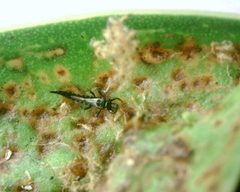
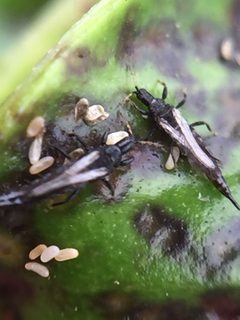
are small, dark-colored thrips with feathery wings typical of the order Thysanoptera. The body is black or dark brown. Wings are narrow with long marginal setae. The possesses a tube-shaped terminal abdominal segment (pelta), characteristic of Phlaeothripidae. Larvae are pale and found within leaf galls.
Habitat
Tropical and subtropical environments where Ficus grow; also established in temperate regions in greenhouses and as indoor plant pest. Associated with urban landscapes, nurseries, and horticultural settings. The microhabitat consists specifically within the curled leaf galls it induces on plants.
Distribution
in distribution. Native to tropical regions of Africa, Asia, and the Americas. Established in North America (Florida, Texas, California, Hawaii), Europe (including Malta, Sicily, Spain), the Middle East, South America (Brazil, Peru, Venezuela), and the Pacific Islands (Hawaii). In Australia, recorded from New South Wales, Northern Territory, Queensland, and Western Australia. Spread has occurred through international trade in ornamental Ficus plants.
Seasonality
Multiple per year in favorable climates. Continuous breeding possible in tropical regions and protected environments. Activity correlated with plant flushing and new leaf production.
Diet
Phloem sap feeder. Uses rasping-sucking mouthparts to puncture leaf and lap up exuded contents. Feeding concentrated on young, developing Ficus leaves within the shelter of curled leaf galls.
Host Associations
- Ficus microcarpa - primary Chinese banyan, Indian laurel fig; major ornamental
- Ficus benjamina - Weeping fig; commonly infested indoors
- Ficus - -level Various Ficus ; specificity at level
Life Cycle
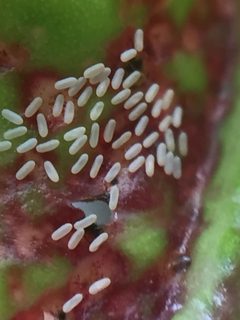
are laid in batches within curled leaf galls. Larvae hatch and feed within the protected gall environment for several weeks. occurs within the leaf roll. Winged emerge and disperse to new growth, repeating the cycle. Multiple overlapping occur annually in suitable climates.
Behavior
Induces leaf curling by feeding on young Ficus leaves, causing abnormal development that creates folded . Aggregates within these galls for feeding, , and shelter. and larvae remain protected inside curled leaves, making them difficult to reach with contact . Adults have been reported to bite humans when handled.
Ecological Role
Herbivore and gall-former on Ficus . Serves as prey for including the anthocorid Montandoniola confusa, which has been observed actively preying upon gall-forming thrips. Associated with the mite Adactylidium gynaikothripsi (Acarophenacidae), which inhabits thrips colonies.
Human Relevance
Significant pest of ornamental Ficus trees in landscapes, nurseries, and interior plantscaping. Causes aesthetic damage through leaf distortion, discoloration, and premature leaf drop. Heavy reduce plant vigor. Control relies on pruning and removal of infested leaves; chemical control is challenging due to sheltered feeding location. can deliver minor bites to humans. International trade in Ficus plants has facilitated global spread.
Similar Taxa
- Gynaikothrips uzeliAlso a gall-forming thrips on Ficus, causing similar leaf-curling damage; distinguished by preferences (Ficus benjamina vs. F. microcarpa) and subtle morphological differences
- Trioza brevigenaeFicus leaf-rolling psyllid causes similar leaf-roll galls on Ficus microcarpa but is a (Hemiptera: Triozidae), not a thrips; are larger (2.6-2.8 mm) with transparent wings and reddish
- Horidiplosis ficifoliiFicus -spot , an pest of Ficus; causes different damage (leaf spots) and is a dipteran, not a thrips
More Details
Taxonomic history
Originally described as Phloeothrips ficorum by Paul Marchal in 1908, later transferred to Gynaikothrips. The name Gynaikothrips references the female-dominated social structure observed in some thrips .
Biological control potential
Montandoniola confusa (Hemiptera: Anthocoridae) has been documented as an effective of G. ficorum, actively hunting within leaf galls. This predator association has been studied for potential applications.
Sources and further reading
- BugGuide
- Wikipedia
- GBIF taxonomy match
- iNaturalist taxon
- NCBI Taxonomy
- Catalogue of Life
- The hottest bug north of Havana - Cuban laurel thrips, Gynaikothrips ficorum — Bug of the Week
- A New Psyllid Pest on Ornamental Trees in California
- Gynaikothrips ficorum . [Distribution map].
- Predicting the Geographical Distribution of The Leaf-Gall Thrips, Gynaikothrips ficorum (Marchal) and Their Interaction with Host Plants in Egypt
- Adactylidium Gynaikothripsin. sp. (Acari: Acarophenacidae) associated withGynaikothrips Ficorum(Marshal) (Thysanoptera: Phlaeothripidae) from Greece
- Behavior of Montandoniola confusa Streito & Matocq (Hemiptera: Anthocoridae) preying upon gall-forming thrips Gynaikothrips ficorum Marchal (Thysanoptera: Phlaeothripidae)