
Trioza
Förster, 1848
psyllids, jumping plant-lice
Species Guides
11- Trioza adventicia(syzygium leaf psyllid)
- Trioza albifrons
- Trioza aylmeriae
- Trioza bakeri
- Trioza brevigenae(Ficus leaf-rolling psyllid)
- Trioza magnoliae(Red Bay Psyllid)
- Trioza mexicana
- Trioza obtusa
- Trioza phoradendri
Trioza is the type of psyllids in the Triozidae, comprising sap-sucking insects with worldwide distribution. in this genus exhibit diverse associations, ranging from agricultural crops to native trees. Several species are economically significant: Trioza erytreae transmits (Huanglongbing), T. apicalis is a major pest of carrot in northern Europe, and T. brevigenae is an pest of ornamental Ficus in California. The genus is characterized by distinct morphological features and complex involving seasonal between summer hosts and sites.
Pronunciation
How to pronounce Trioza: //ˈtraɪ.oʊ.zə//
These audio files are automatically generated. While they are not always 100% accurate, they are a good starting point.
Identification
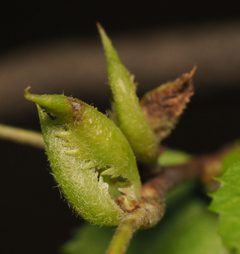
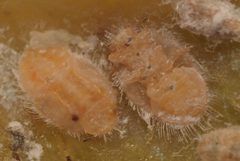
Trioza can be distinguished from other by their wing venation patterns and genitalia structure. typically possess transparent wings with characteristic venation; for example, T. brevigenae adults measure 2.6-2.8 mm with reddish and greenish to brownish bodies. Nymphs often produce distinctive waxy filaments. Specific identification requires examination of male and female genitalia and is best confirmed by taxonomists.
Images
Habitat
varies by : T. apicalis occupies agricultural fields with carrot crops and overwinters on coniferous trees (primarily Norway spruce); T. erytreae occurs in citrus-growing regions with mild temperatures and high precipitation; T. brevigenae infests ornamental Ficus microcarpa in urban landscapes; T. magnoliae inhabits native Persea bay trees in southeastern USA.
Distribution
Worldwide distribution with regional variation: T. apicalis occurs in northern and central Europe (Denmark, Fennoscandia, and other European countries); T. erytreae is native to Africa (Angola, Cameroon, Ethiopia, Kenya, Madagascar, South Africa, and others) and parts of the Middle East (Saudi Arabia, Yemen), in Europe (Spain, Portugal including Madeira and Canary Islands); T. brevigenae reported from India and invasive in southern California; T. magnoliae occurs in southeastern USA.
Seasonality
T. apicalis shows distinct seasonal : overwintered migrate to carrot in spring, oviposition occurs June-July, summer generation develops, and departure from hosts peaks early September before . T. erytreae activity patterns correspond to mild seasonal temperatures in its range.
Diet
Phloem-feeding on plant vascular tissues. T. apicalis feeds on Daucus carota (carrot), Coriandrum sativum (coriander), and Petroselinum hortense (parsley); T. erytreae feeds on Citrus spp. and other Rutaceae; T. brevigenae feeds on Ficus microcarpa; T. magnoliae feeds on Persea spp.
Life Cycle
T. apicalis has a complex with two : overwintered migrate to carrot in spring, live only 2-3 days on carrots, lay during June-July; nymphs develop through multiple instars on carrots; summer generation adults emerge and depart hosts in early September to overwinter on conifers. Other Trioza show variation in generation number and strategies.
Behavior
T. apicalis exhibits precise spring timing synchronized across central and northern Europe, possibly cued by long-day rather than local temperature. of this show very short residence time on summer (2-3 days). T. erytreae transmits Candidatus Liberibacter bacteria causing . Nymphs of some species produce waxy filaments for protection.
Ecological Role
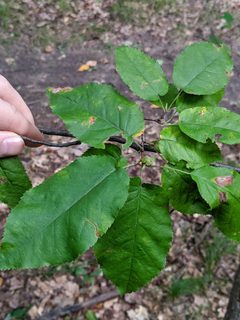
Several are significant agricultural pests and . T. erytreae is a vector of (Huanglongbing) caused by Candidatus Liberibacter africanum and can experimentally transmit Candidatus Liberibacter asiaticum. T. apicalis causes direct damage to carrot crops through phloem feeding that induces leaf curling. Some species appear to have limited impact on native plants.
Human Relevance
High economic impact through agriculture and horticulture. T. erytreae is listed as an A1 pest by EPPO and is a quarantine pest for CPPC and OIRSA; its introduction has prompted prohibitions on citrus plant imports. T. apicalis is a major pest of carrot in northern Europe. T. brevigenae threatens ornamental Ficus plantings in California. T. magnoliae causes aesthetic damage to native bay trees but has limited economic impact.
Similar Taxa
- BactericeraFormerly included now transferred out (e.g., Trioza albiventris moved to Bactericera albiventris); distinguished by genitalia and wing characters
- SchedotriozaFormer Trioza tasmaniensis transferred to Schedotrioza tasmaniensis; differs in associations and morphological details
Sources and further reading
- BugGuide
- Wikipedia
- GBIF taxonomy match
- iNaturalist taxon
- NCBI Taxonomy
- Catalogue of Life
- Encyrtid Holdings | Entomology Research Museum
- Publications | Entomology Research Museum
- Trioza acuminatissima Archives - Entomology Today
- trioza-acuminatissima - Entomology Today
- Trioza brevigenae Archives - Entomology Today
- A New Psyllid Pest on Ornamental Trees in California
- Biology of Trioza apicalis - a review
- Trioza erytreae (African citrus psyllid).
- Ecological models predict narrow potential distribution for Trioza erytreae , vector of the citrus greening disease
- Trioza erytreae . [Distribution map].
- Trioza erytreae . [Distribution map].
- Trioza erytreae . [Distribution map].
- Red Bay Psyllid, Trioza magnoliae (Ashmead) (Insecta: Hemiptera: Sternorrhyncha: Psyllidae)
- New viral sequences and endogenous viral elements (EVE) in world-wide populations of Trioza erytreae, the African citrus psyllid.
- Proteomic analysis may explain differences in Citrus × limon and Citrus × sinensis susceptibility to Trioza erytreae.