
Publilia
Stål, 1866
Species Guides
5Publilia is a of treehoppers (Membracidae) native to North America, with occurring primarily in the eastern and central United States. The genus is notable for forming dense on plants, particularly goldenrods (Solidago spp.), where nymphs and are tended by ants in exchange for honeydew. This mutualistic relationship has made Publilia a model system for studying -hemipteran interactions and their ecological consequences for host plants. The genus is distinguished from related treehoppers by its relatively unadorned pronotum compared to the elaborate projections seen in many Neotropical membracids.
Pronunciation
How to pronounce Publilia: //pʌbˈlɪliə//
These audio files are automatically generated. While they are not always 100% accurate, they are a good starting point.
Identification
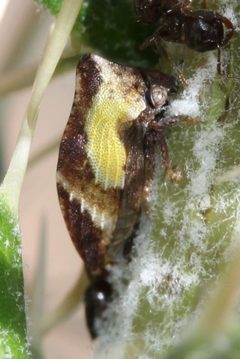
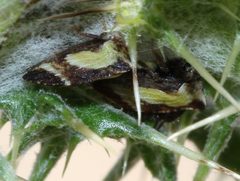
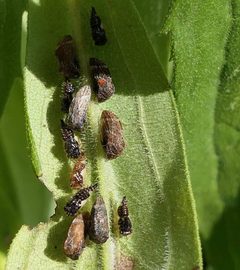
Distinguished from other Nearctic by relatively modest pronotal structure lacking elaborate horns or projections characteristic of many Smiliini and Aconophorini. Nymphs form dense on plant stems, often with visible white waxy secretions. are small, typically under 10 mm, with a rounded or slightly keeled pronotum. -level identification requires examination of genitalia and detailed pronotal ; P. concava has a distinctly concave pronotum, while P. reticulata shows reticulate surface sculpturing.
Images
Habitat
Open fields, meadows, and disturbed dominated by grasses and herbs; specifically associated with plants in the Asteraceae, particularly goldenrods (Solidago spp.) and ironweeds (Vernonia spp.).
Distribution
Eastern and central North America; recorded from Vermont southward and westward through the central United States.
Seasonality
oviposit in early June; nymphs present from late June through mid-September; peak densities occur in mid-July.
Diet
Phloem sap; obtained by piercing leaf midribs and stems of plants with specialized .
Host Associations
- Solidago altissima - primary planttall goldenrod
- Solidago spp. - plantmultiple goldenrod used
- Vernonia noveboracensis - plantNew York ironweed
- Formica subsericea - tending mutualistic association
- Camponotus noveboracensis - tending mutualistic association
- Lasius alienus - tending constructs soil shelters around
- Formica spp. - tending general association on sunflowers
Life Cycle
Females oviposit on plant stems in early June. Nymphs hatch by late June and develop through several instars, forming dense that persist through summer. Aggregations can exceed 500 individuals on a single plant ramet. present from mid-summer; stage not explicitly documented in available sources but presumed to be based on typical membracid .
Behavior
Forms dense, stationary on plant stems; excretes honeydew that attracts tending ants. Multiple may simultaneously tend a single aggregation. Ants provide protection from and ; in return, treehoppers receive nearly continuous defense. Feeding on leaf midribs causes visible damage including drooping and accelerated browning. Some ant species construct fragile soil shelters around aggregations.
Ecological Role
Participant in -hemipteran mutualism; net effect on plants is context-dependent. Ant defense against other herbivores may benefit plants during conditions, but feeding damage may outweigh benefits when other herbivores are scarce. Serves as prey for specialized and when ant protection is absent.
Similar Taxa
- GuayaquilaBoth form -tended on plants, but Guayaquila is Neotropical with long forward-projecting pronotal horns and laterally directed processes; Publilia is Nearctic with relatively unadorned pronotum
- AconophoraBoth in Smiliinae with associations, but Aconophora has long, forward-projecting pronotal horn and is primarily Neotropical
- Aphis vernoniaeBoth occur on New York ironweed and are -tended, but spatially segregated with aphids concentrated in inflorescences and Publilia on middle leaves early in season; aphids are aphids (Aphididae) with cornicles, while Publilia are treehoppers (Membracidae) with enlarged pronotum
Sources and further reading
- BugGuide
- Wikipedia
- GBIF taxonomy match
- iNaturalist taxon
- NCBI Taxonomy
- Catalogue of Life
- Brazil Bugs #15 – Formiga-membracídeos mutualismo | Beetles In The Bush
- Bug Eric: Sunflower Extravaganza
- Preference performance in host choice by an ant protected treehopper Publilia concava
- Potential Consequences of Hosting an Ant-tended Treehopper, Publilia concava, for Tall Goldenrod, Solidago altissima
- Isolation and characterization of nine microsatellite loci in an ant‐tended treehopper Publilia concava
- SPATIAL SEGREGATION BETWEEN APHIS VERNONIAE (APHIDIDAE) AND PUBLILIA RETICULATA (MEMBRACIDAE), TWO SPECIES OF COLONIAL HOMOPTERA ON NEW YORK IRONWEED
- Effects of Host Plant Quality and Ant Tending for Treehopper <I>Publilia concava</I>