
Spilomyia
Meigen, 1803
Hornet Flies
Species Guides
11- Spilomyia alcimus(Broad-banded Hornet Fly)
- Spilomyia citima(Western Hornet Fly)
- Spilomyia crandalli(Crandall's Hornet Fly)
- Spilomyia foxleei(Foxlee's Hornet Fly)
- Spilomyia fusca(Bald-faced Hornet Fly)
- Spilomyia interrupta(Interrupted Hornet Fly)
- Spilomyia kahli(Yellow-tailed Hornet Fly)
- Spilomyia liturata(Rocky Mountain Hornet Fly)
- Spilomyia longicornis(Eastern Hornet Fly)
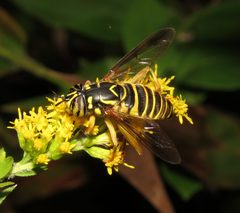
Spilomyia is a of hoverflies (Syrphidae) notable for exceptional of , particularly yellowjackets. visit flowers to feed on nectar and pollen, contributing to pollination. Unlike many other syrphid flies, Spilomyia do not exhibit mating at blossoms. The genus contains approximately 40 described species distributed across the Holarctic region, with about 13 species in North America. Larvae develop in water-filled tree holes, feeding on decaying organic matter.


Pronunciation
How to pronounce Spilomyia: //ˌspaɪl.oʊˈmaɪ.ə//
These audio files are automatically generated. While they are not always 100% accurate, they are a good starting point.
Identification
Distinguished from by single pair of wings (wasps have two pairs), though this requires close inspection. From other syrphid : wasp-mimicry more elaborate than most, including wing darkening and antennal modification. markings and leg-waving are distinctive. From actual yellowjackets (Vespula, Dolichovespula): eyes meet dorsally in flies but are separated in wasps; flies lack constricted wasp waist; structure differs (flies have aristate antennae, wasps have long, thick, non-aristate antennae).
Images
Habitat
associated with flowering vegetation where they visit blossoms. Larval : water-filled tree holes (phytotelmata) containing decaying organic matter. Occurs in wooded and semi-wooded environments where suitable larval microhabitats and adult floral resources coexist.
Distribution
Holarctic distribution. North America: approximately 13 . Europe: multiple species including S. diophthalma, S. saltuum. Asia: records from China, Japan, Pakistan (Swat Valley), Russia, and other regions. Specific species have more restricted ranges; S. longicornis documented in Illinois, USA.
Diet
feed on nectar and pollen obtained from blossoms. Larvae feed on decaying organic matter in water-filled tree holes.
Life Cycle
Complete . Larvae develop in water-filled tree holes, feeding on decaying organic matter. emerge and visit flowers for feeding. Specific details on -laying, , and developmental duration not documented in available sources.
Behavior
visit blossoms solely for feeding, not for mate-finding. Males do not patrol inflorescences or initiate copulation at flowers— absent in this that is present in many other syrphids. Some wave front legs to simulate . Wingbeat frequency in nearly identical to yellowjacket model species, contributing to both visual and auditory mimicry.
Ecological Role
function as through flower visitation. Larvae serve as decomposers and nutrient cyclers in tree hole microhabitats. of may reduce pressure, though specific interactions not documented.
Human Relevance
Potential in natural and agricultural systems. Mimicry may cause misidentification as stinging , leading to unnecessary concern. Historical specimen collections have been used in conservation assessments and range change studies, including identification of of potential conservation concern.
Similar Taxa
- Vespula (yellowjackets)Primary mimicry model; distinguished by two pairs of wings, separated , constricted waist, and non-aristate
- Dolichovespula (aerial yellowjackets)Another mimicry model; same distinguishing features as Vespula
- Other Syrphidae (e.g., Mallota, Microdon, Toxomerus)Co-occurring hoverfly ; Spilomyia distinguished by more elaborate -mimicry including wing darkening, antennal modification, and leg-waving
Misconceptions
Frequently mistaken for yellowjacket due to convergent coloration, body shape, and sound. The ' Flies' reflects this mimicry but may perpetuate confusion with actual hornets (Vespa).
More Details
Mimicry sophistication
Spilomyia represents one of the most elaborate cases of in insects, combining visual (color, patterns, wing darkening, antennal simulation), behavioral (leg-waving), and auditory (wingbeat frequency) components.
Research significance
Specimens of S. longicornis in the Illinois Natural History Survey collection contributed to a 2023 study demonstrating the value of digitized museum collections for tracking range changes and identifying conservation priorities.
Sources and further reading
- BugGuide
- Wikipedia
- GBIF taxonomy match
- iNaturalist taxon
- NCBI Taxonomy
- Catalogue of Life
- Bug Eric: Wasp Wednesday: Not Wasp III
- Hover Flies Identified: Researchers Tackle 20,000 Syrphid Specimens in Illinois Collection
- hover flies - Entomology Today
- First record of the hoverfly genus Spilomyia Meigen (Diptera: Syrphidae) for Pakistan
- Flowers Associations and Mating Behavior or its Absence at Blossoms by <i>Spilomyia</i> Spp. (Diptera, Syrphidae)