
Spilomyia longicornis
Loew, 1872
Eastern Hornet Fly
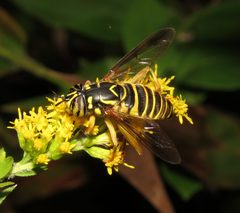
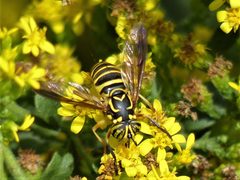
Spilomyia longicornis is a syrphid fly native to eastern North America, notable for its striking mimicry of vespid . are that frequent flowers for pollen and nectar, while larvae develop in rot holes of living trees. The exhibits sophisticated involving visual, behavioral, and auditory components.
Pronunciation
How to pronounce Spilomyia longicornis: /ˌspaɪloʊˈmaɪə ˌlɒŋɪˈkɔːrnɪs/
These audio files are automatically generated. While they are not always 100% accurate, they are a good starting point.
Identification
Distinguished from similar syrphid flies by the combination of: dark wing margin contrasting with clearer remainder; forelegs with black portions moved in -like display; and overall larger size compared to many flower flies. Separated from actual vespid by single pair of wings (Diptera), lack of constricted wasp waist, and typical fly structure with large .
Images
Habitat
occur near flowers producing pollen and nectar. Larval consists of rot holes—damp, rotting cavities in live trees. Almost any tree can develop suitable rot holes, though frequency varies by tree type.
Distribution
Eastern North America, east of the Rocky Mountains. Documented in multiple states including Illinois and Vermont.
Diet
feed exclusively on pollen and nectar from flowers. Females require pollen nitrogenous nutrients for ( deposition and reproductive tissue development). Nectar provides energy for hovering . Larval diet unknown but inferred to involve decomposition products in rot holes.
Life Cycle
Larvae develop in rot holes of living trees, where they find food and protection in damp decomposing wood. emerge and spend majority of time at flowers for feeding and mating. Females require pollen for reproductive development.
Behavior
Exhibits tripartite mimicry of vespid including Vespula vulgaris: (1) Visual—color pattern and dark wing margins; (2) Behavioral—rests on hind four legs while raising and moving forelegs above in -like motions; when threatened, bends in mock-stinging posture and may pulse abdomen up and down mimicking wasp abdomen expansion; (3) Auditory—produces altered buzzing frequency when threatened, similar to some Hymenoptera. Males have been observed mate-seeking near flowers.
Ecological Role
providing services to flowering plants. Larvae contribute to nutrient cycling in forest ecosystems through processing of decaying wood in tree cavities.
Human Relevance
Beneficial with no sting despite -like appearance. Documented in entomological collections including century-old specimens, contributing to understanding of historical ranges and biodiversity patterns.
Similar Taxa
- Vespula vulgaris and other vespid waspsS. longicornis is a Batesian mimic; distinguished by single wing pair, lack of waist, and fly
- Other Spilomyia speciesShare -level mimicry traits but differ in specific leg coloration, wing pattern, and geographic range
- Other syrphid wasp-mimicsDistinguished by combination of dark wing margin, specific foreleg color pattern, and size
More Details
Mimicry Evolution
The multi-modal mimicry (visual, behavioral, auditory) may have evolved because visual and behavioral mimicry alone is not always effective against all .
Collection Significance
Specimens from the Illinois Natural History Survey, some dating back a century, contributed to recent understanding of range dynamics and conservation status for this and other hover flies.
Sources and further reading
- BugGuide
- Wikipedia
- GBIF taxonomy match
- iNaturalist taxon
- NCBI Taxonomy
- Catalogue of Life
- Hover Flies Identified: Researchers Tackle 20,000 Syrphid Specimens in Illinois Collection
- Lab Study Shows Asian Longhorned Tick Can Spread Rocky Mountain Spotted Fever
- Be On the Lookout: There's a New Tick in Town
- Potential Range for Asian Longhorned Tick Covers Much of Eastern U.S.
- Invasive Tick Persists in New Jersey
- Invasive Tick Has Been Present in New York Longer Than Previously Known, Study Shows