
Spilomyia citima
Vockeroth, 1958
Western Hornet Fly
Spilomyia citima, commonly known as the Western Fly, is a rare of syrphid hoverfly first described by Vockeroth in 1958. It belongs to a renowned for exceptional mimicry of yellowjacket , employing visual, behavioral, and acoustic deception. The species has been documented in Canada and the United States, though records remain sparse.
Pronunciation
How to pronounce Spilomyia citima: /ˌspaɪloʊˈmaɪə ˈsɪtɪmə/
These audio files are automatically generated. While they are not always 100% accurate, they are a good starting point.
Identification
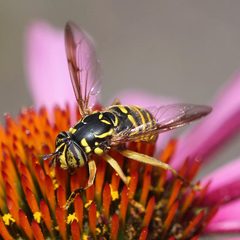
Distinguished from actual yellowjackets by: single pair of wings ( have two); short with (vs. long, thick wasp antennae); large meeting at or near top of . Distinguished from other Spilomyia by geographic distribution and specific pattern details; S. citima is western in distribution compared to eastern .
Images
Appearance
Body length 12–17 mm. Resembles yellowjacket in coloration with bold black and yellow patterning. large with markings that break up their outline, making them appear smaller. Wings with darkened portion mimicking the folded wing appearance of wasps at rest. Short with , though front legs are waved to simulate longer wasp antennae.
Habitat
associated with flowers. Larval inferred from : water-filled tree holes and moist rot holes in trees.
Distribution
Canada and United States. Western North American distribution implied by and distinction from eastern Spilomyia .
Diet
feed on nectar and pollen from flowers. Larval diet unknown for this ; members feed on decaying organic matter in moist tree holes.
Life Cycle
Larval stage described as short-tailed form adapted for moist environments such as tree rot holes. Complete with , larva, pupa, and stages; specific details unknown.
Behavior
Exhibits hovering capable of remaining nearly motionless. Wingbeat frequency nearly identical to yellowjacket , contributing to acoustic mimicry. Waves front legs to simulate wasp .
Ecological Role
serve as . Larvae function as decomposers in tree hole , recycling nutrients from decaying organic matter.
Human Relevance
Contributes to pollination services. Mimicry may cause misidentification as stinging , though flies are harmless. Rare status suggests potential conservation concern.
Similar Taxa
- Dolichovespula arenaria (Aerial Yellowjacket)Visual mimicry target; distinguished by two pairs of wings, long thick , and different structure
- Vespula pensylvanica (Western Yellowjacket)Visual and acoustic mimicry target; distinguished by wing count, structure, and size
- Spilomyia longicornis with similar -mimic appearance; eastern distribution and subtle pattern differences separate the two
Misconceptions
Frequently mistaken for yellowjacket due to convergent coloration, , and sound; this mimicry is defensive and the fly cannot sting.
More Details
Conservation Status
Described as rare in available sources. Recent digitization efforts of museum collections have helped clarify distribution records for this and related .
Mimicry Complexity
Among the most sophisticated known examples of , incorporating visual (coloration, patterning, wing darkening), behavioral (leg-waving, hovering), and acoustic (wingbeat frequency) components.