
Spilomyia liturata
Williston, 1882
Rocky Mountain Hornet Fly
Spilomyia liturata, commonly known as the Rocky Mountain Fly, is an uncommon of hoverfly (Syrphidae) found in western North America. are notable mimics of yellowjacket , exhibiting sophisticated visual and auditory deception. The species is associated with montane along the Rocky Mountains, where larvae develop in water-filled tree holes.


Pronunciation
How to pronounce Spilomyia liturata: //ˌspɪloʊˈmaɪə lɪˈtjʊrətə//
These audio files are automatically generated. While they are not always 100% accurate, they are a good starting point.
Identification
Distinguished from yellowjacket (Vespula, Dolichovespula) by: single pair of wings (wasps have two pairs); short with (vs. long, thick wasp antennae); and large that meet dorsally. Distinguished from other Spilomyia by geographic range and specific pattern details. The wingbeat frequency in closely matches that of yellowjacket models, making auditory distinction difficult. The darkened wing margins and markings are key visual identifiers under close examination.
Images
Appearance
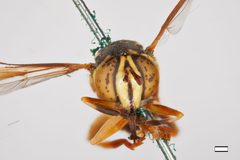
are robust flies, 12–17 mm in body length, with striking yellow and black coloration that closely resembles yellowjacket . The are large and meet at or near the top of the , with black and yellow markings that break up the outline and make them appear smaller. The wings have the portion darkened to mimic the longitudinal wing fold of resting wasps. are short with a hair-like ; the compensates for this wasp-distinguishing feature by waving its front legs in front of the to simulate longer, thicker wasp antennae.
Habitat
Montane environments associated with the Rocky Mountains. Larval is water-filled rot holes in trees. activity occurs in areas with flowering vegetation and access to honeydew sources.
Distribution
Western North America along the Rocky Mountains; United States. Specific documented locations include Colorado.
Diet
feed on nectar and pollen from flowers, and on honeydew. Larval diet consists of decaying organic matter in water-filled tree holes.
Life Cycle
Larvae are described as "short-tailed larvae," a morphological suited for moist environments such as water-filled rot holes in trees. Larval development occurs in these tree holes, feeding on decaying organic matter. emerge and are active during periods when flowers are available and honeydew is accessible.
Behavior
are strong fliers capable of hovering nearly motionless. They exhibit sophisticated mimicry of yellowjacket , including: visual resemblance in color pattern and body shape; behavioral mimicry through front leg waving to simulate wasp ; and auditory mimicry through wingbeat frequency matching that of yellowjacket models. Adults are commonly found on flowers and around colonies where they feed on honeydew.
Ecological Role
serve as through flower visitation. Larvae function as decomposers and nutrient cyclers in forest , processing decaying organic matter in tree holes. The contributes to honeydew-based as adults, and to wood decomposition processes as larvae.
Human Relevance
Contributes to pollination services in natural and potentially agricultural systems. The ' remarkable mimicry may cause misidentification as stinging , though are harmless. May serve as an indicator of healthy montane forest with mature trees providing rot hole .
Similar Taxa
- Spilomyia longicornisCongeneric with similar -mimicking appearance; distinguished by morphological details and geographic distribution
- Vespula pensylvanica (Western Yellowjacket)Visual and auditory mimicry model; distinguished by two pairs of wings, long thick , and smaller that do not meet dorsally
- Dolichovespula arenaria (Aerial Yellowjacket)Visual and auditory mimicry model; distinguished by two pairs of wings, long thick , and different structure
More Details
Taxonomic Note
Authorship year varies between sources: 1882 per Wikipedia, 1887 per Catalogue of Life and GBIF. The epithet 'liturata' refers to markings or spots.
Conservation Status
Described as 'uncommon' in available sources. The 2023 Illinois Natural History Survey digitization project highlighted the value of museum specimens for documenting ranges and identifying conservation concerns, though specific status for S. liturata was not detailed.
Mimicry Complexity
This exhibits one of the most sophisticated known cases of mimicry in hoverflies, combining visual, behavioral, and auditory components. The markings that obscure eye size, the darkened wing margins, the front leg waving , and the matching wingbeat frequency represent multiple convergent traits toward a single deceptive function.