
Spilomyia alcimus
(Walker, 1849)
Broad-banded Hornet Fly
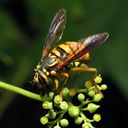
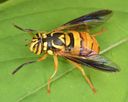
Spilomyia alcimus is a syrphid fly first described by Walker in 1849. It exhibits mimicry, resembling yellowjackets in appearance, sound, and . visit flowers for nectar and pollen. The is uncommon and distributed across Canada and the United States.
Pronunciation
How to pronounce Spilomyia alcimus: //ˌspaɪloʊˈmaɪə ˈælsɪməs//
These audio files are automatically generated. While they are not always 100% accurate, they are a good starting point.
Identification
Distinguished from yellowjacket by short with (wasps have long, thick antennae), single pair of wings (wasps have two pairs), and large that dominate the . Spilomyia alcimus waves its front legs in front of its to simulate wasp antennae. Distinguished from other Spilomyia by specific banding patterns; S. alcimus has broad yellow bands. The darkened wing margins and wingbeat frequency nearly identical to yellowjackets complicate field identification.
Images
Habitat
are found in areas with flowering vegetation. Larvae inhabit water-filled rot holes in trees in moist woodland environments.
Distribution
Canada and the United States. Records include Vermont and other eastern and central North American locations.
Diet
feed on nectar and pollen from flowers. Larvae feed on decaying organic matter in tree rot holes.
Life Cycle
Larval stage occurs in water-filled tree rot holes. emerge and are active during flowering periods.
Behavior
wave front legs to simulate . Wingbeat frequency in matches that of yellowjacket wasps, enhancing acoustic mimicry. Adults are strong fliers capable of hovering motionless.
Ecological Role
serve as . Larvae function as decomposers, recycling nutrients from decaying organic matter in tree cavities.
Human Relevance
Contributes to pollination in natural and potentially agricultural settings. Uncommon and rarely encountered by the general public. May be mistaken for stinging , causing unnecessary concern.
Similar Taxa
- Dolichovespula arenaria (Aerial Yellowjacket)Visual mimic; distinguished by two pairs of wings, long thick , and different structure
- Vespula pensylvanica (Western Yellowjacket)Visual and acoustic mimic; distinguished by wing count, structure, and size
- Spilomyia longicornis with similar mimicry; distinguished by banding pattern and antennal proportions
Misconceptions
Frequently mistaken for yellowjacket due to convergent mimicry in coloration, , and sound. Does not possess a stinger and is harmless to humans.
More Details
Mimicry sophistication
Considered among the most convincing mimics in North American Diptera due to combined visual, behavioral, and acoustic deception