
Spilomyia fusca
Loew, 1864
Bald-faced Hornet Fly
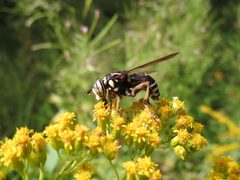
Spilomyia fusca, the Bald-faced Hornet Fly, is a syrphid fly first described by Loew in 1864. This is a notable mimic, resembling yellowjackets in both appearance and sound. are that frequent flowers, while larvae develop in moist tree rot holes where they feed on decaying organic matter. The species is relatively common in eastern North America.
Pronunciation
How to pronounce Spilomyia fusca: //spɪloʊˈmaɪə ˈfʌska//
These audio files are automatically generated. While they are not always 100% accurate, they are a good starting point.
Identification
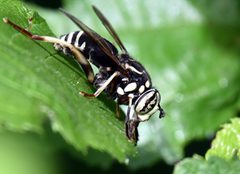
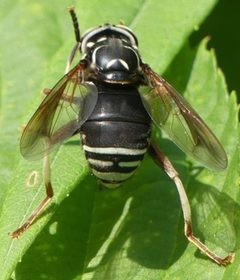
Distinguished from yellowjacket by: short with (vs. long, thick wasp antennae); single pair of wings (vs. two pairs in wasps); and large that meet dorsally. The darkened wing margins and patterning are distinctive. From other Spilomyia : S. fusca has the specific 'bald-faced' pattern with reduced or absent yellow markings on the compared to some .
Images
Appearance
are robust flies with bold black and yellow coloration mimicking yellowjacket . Body length ranges 12–17 mm. The are large and meet at or near the top of the , with black and yellow markings that break up the outline. The front half of each wing is darkened to simulate the longitudinal wing fold of wasps at rest. are short with a hair-like at the tip; the fly compensates by waving its front legs to simulate longer wasp antennae.
Habitat
occur in varied where flowers are present. Larvae inhabit water-filled tree rot holes and moist cavities in decaying wood.
Distribution
Eastern North America, including Canada and the United States. Records from Vermont and broader eastern US and adjacent Canada.
Diet
feed on nectar and pollen from flowers. Larvae feed on decaying organic matter in moist tree holes.
Life Cycle
laid in or near water-filled tree rot holes. Larvae are 'short-tailed' and adapted to moist, decaying wood environments. occurs within the larval . emerge and disperse to flowers.
Behavior
hover motionless in , a characteristic of syrphid flies. They are convincing mimics: in addition to visual resemblance, the wingbeat frequency in flight nearly matches that of yellowjackets. When at rest, waves front legs to simulate wasp . Visits flowers for nectar and pollen.
Ecological Role
serve as . Larvae function as decomposers in forest , processing decaying organic matter in tree cavities.
Human Relevance
Beneficial as and decomposers. The -mimic appearance may cause mistaken identity and unnecessary concern, but the is harmless to humans.
Similar Taxa
- Dolichovespula maculata (Bald-faced Hornet)Similar black and white/yellow pattern and source; distinguished by characters (two wing pairs, long , narrow waist)
- Vespula/Dolichovespula yellowjacketsGeneral appearance and color pattern; distinguished by wing number, structure, and size
- Other Spilomyia species-level mimicry; S. fusca specifically identified by facial patterning with reduced yellow markings
More Details
Taxonomic note
'Bald-faced Hornet Fly' references resemblance to the bald-faced hornet (Dolichovespula maculata), a with similar coloration.
Mimicry sophistication
Among the most elaborate mimics in Syrphidae, combining visual, behavioral, and acoustic mimicry.