
Spilomyia interrupta
Williston, 1882
Interrupted Hornet Fly
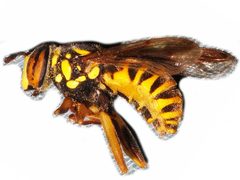
Spilomyia interrupta, commonly known as the Interrupted Fly, is a of hoverfly in the Syrphidae. First described by Williston in 1882, this uncommon species is native to western North America, particularly along the California coast. Like other members of the Spilomyia, it exhibits remarkable mimicry of yellowjacket , including similar coloration, body shape, and even wingbeat frequency. visit flowers for nectar and pollen, while larvae develop in moist tree rot holes.
Pronunciation
How to pronounce Spilomyia interrupta: //ˌspaɪloʊˌmaɪə ɪnˈtɜːrʌptə//
These audio files are automatically generated. While they are not always 100% accurate, they are a good starting point.
Identification
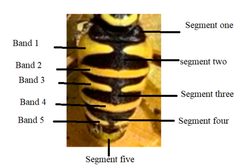
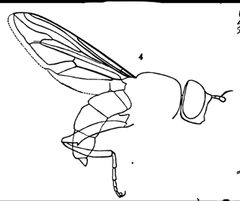
Members of the Spilomyia are distinguished from yellowjacket by their short with a hair-like at the tip, large that meet at or near the top of the , and a single pair of wings (wasps have two pairs). S. interrupta specifically may be differentiated from by details of abdominal patterning; the specific epithet 'interrupta' likely refers to interrupted banding patterns. The waves its front legs to simulate the longer antennae of wasps, and has darkened wing bases that mimic the folded-wing appearance of resting yellowjackets.
Images
Habitat
are found in areas where their models occur, often near flowering plants. Larvae inhabit moist rot holes in trees, requiring decaying wood with accumulated water and organic matter.
Distribution
Western North America, primarily along the California coast. Records extend from Canada through the United States in the Pacific coastal region.
Diet
feed on nectar and pollen from flowers. Larval diet consists of decaying organic matter in water-filled tree holes.
Life Cycle
Complete with , larva, pupa, and stages. Larvae are described as 'short-tailed' and adapted for aquatic or semi-aquatic conditions in tree rot holes.
Behavior
exhibit hovering and -mimicking , including leg-waving to simulate wasp . The wingbeat frequency closely matches that of yellowjacket wasps, enhancing the mimicry. Adults are and frequently observed on flowers.
Ecological Role
serve as when visiting flowers. Larvae function as decomposers in tree rot holes, recycling nutrients from decaying organic matter. The mimicry provides protection from .
Human Relevance
Like other hoverflies, contribute to pollination of wild and cultivated plants. The has no known negative impacts on humans.
Similar Taxa
- Spilomyia longicornisAnother North American Spilomyia with similar yellowjacket mimicry; distinguished by antennal proportions and abdominal pattern details.
- Vespula pensylvanica (Western Yellowjacket)The primary model for mimicry; distinguished by two pairs of wings, longer without , and different wing venation.
- Dolichovespula arenaria (Aerial Yellowjacket)Another model; distinguished by nest-building , social colony structure, and morphological differences in and wing structure.
Sources and further reading
- BugGuide
- Wikipedia
- GBIF taxonomy match
- iNaturalist taxon
- NCBI Taxonomy
- Catalogue of Life
- Bug Eric: July 2011
- Hover Flies Identified: Researchers Tackle 20,000 Syrphid Specimens in Illinois Collection
- Bug Eric: Last Night to Blacklight?
- Arkansas | Beetles In The Bush | Page 2
- Asilidae | Beetles In The Bush | Page 2