
Eucelatoria
Townsend, 1909
Species Guides
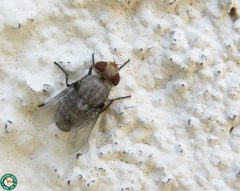
1Eucelatoria is a of tachinid flies (Diptera: Tachinidae) comprising approximately 70 distributed throughout the Western Hemisphere from southern Canada to northern Argentina. The genus is characterized by distinctive reproductive in females of certain species groups, notably the sword-like piercer found in the E. ferox species group. Species within this genus are of Lepidoptera larvae, with documented associations including Noctuidae (Helicoverpa zea, Heliothis virescens, Heliothis armigera) and Crambidae caterpillars. Several species, particularly E. bryani, have been extensively studied for their potential as agents of agricultural pests.
Pronunciation
How to pronounce Eucelatoria: /juː.sɛ.ləˈtoʊ.ri.ə/
These audio files are automatically generated. While they are not always 100% accurate, they are a good starting point.
Identification
The E. ferox group is distinguished by females bearing a distinctive sword-like piercer used for oviposition. Within this group, three subgroups are recognized based on thoracic vittae patterns: the E. ferox subgroup with two thoracic vittae on both presutural and postsutural areas; the E. gladiatrix subgroup with four dorsal thoracic vittae on both areas; and the E. kopis subgroup with a single large dorsal thoracic vitta on the postsutural area and usually two vittae on the presutural area. These morphological differences correlate with specialization patterns and geographic distribution.
Images
Habitat
occur in diverse across the Western Hemisphere, with highest diversity in Central and South American tropical regions. Agricultural have been documented in cultivated fields including tomato, redgram (Cajanus cajan), and Lablab purpureus. The E. gladiatrix subgroup appears specialized on with leaf-rolling habits, suggesting association with vegetation where such hosts occur.
Distribution
Western Hemisphere from southern Canada to northern Argentina. Highest and likely center of origin in the Central and South American tropics. The E. ferox group is distributed throughout this range.
Seasonality
Field studies of E. bryani in agricultural settings indicate effective from December to April, with seasonal activity patterns likely varying by and latitude.
Host Associations
- Helicoverpa zea - gregarious endoparasitoid; successfully parasitizes 2nd through 5th instars and
- Heliothis virescens - gregarious endoparasitoid; primary clutch size adjusted in response to size
- Heliothis armigera - field at ~20% rate; higher rates on tomato than redgram or Lab-lab
- Crambidae caterpillars - E. gladiatrix subgroup specialized on this
Life Cycle
E. bryani is a gregarious endoparasitoid. Maggots emerge from larvae and pupate; occurs from . Development time and survival vary with host developmental stage: successful increases from 30% in 2nd instar hosts to 95% in 5th instars, declining to 63% in . Mean production reaches 14.5 puparia and 10.6 adults per successfully parasitized prepupa. rearing on artificial media has been achieved, with highest adult yields (46.3%) using 200 μl agar-based diet per maggot.
Behavior
E. bryani regulates larval : parasitized third, fourth, and fifth instars of Helicoverpa zea burrow into soil 0.7–3.4 days earlier than unparasitized larvae, and parasitized third instars once then burrow as fourth instars. This behavioral manipulation ensures pupariation in soil, improving protection against natural enemies and lethal temperatures; survival to adulthood is 49.2% for hosts that burrowed versus 0% for those remaining on the surface. Females adjust primary clutch size in response to host size, depositing more in larger hosts without overexploitation. Naïve females do not discriminate between unparasitized and heterospecifically parasitized hosts. with E. rubentis favors E. bryani, which reduces E. rubentis survival when 24 hours older and tends to produce smaller E. rubentis competitors.
Ecological Role
of Lepidoptera larvae, contributing to of noctuid and crambid caterpillars. E. bryani functions as a superior competitor among sympatric tachinid parasitoids. The behavioral manipulation of enhances parasitoid survival by ensuring pupariation in protected soil environments.
Human Relevance
Several , particularly E. bryani, have been evaluated as agents for agricultural pests including Helicoverpa zea, Heliothis virescens, and Heliothis armigera. Field studies demonstrate practical utility for mass multiplication and augmentative release in , with regression analysis indicating 5.63% increase in per parasitized larva. rearing methods have been developed to improve and economy of mass production, including use of absorbent cotton to replace agar in artificial media.
Similar Taxa
- ProrogluteaSynonymized under Eucelatoria by Burington 2022; previously recognized as distinct
- Eucelatoria rubentisSympatric of Helicoverpa zea; inferior competitor to E. bryani, with reduced survival when competing and smaller size when E. bryani present
Sources and further reading
- BugGuide
- Wikipedia
- GBIF taxonomy match
- iNaturalist taxon
- NCBI Taxonomy
- Catalogue of Life
- FIELD RECOVERY OF Eucelatoria brvani ON Heliothis armigera (Hubner)
- A taxonomic revision of the Eucelatoria ferox species group (Diptera: Tachinidae)
- Eucelatoria bryani (Diptera: Tachinidae): Effect on Fecundity of Feeding on Hosts
- Contact stimulants fromHeliothis virescens that influence the behavior of females of the tachinid,Eucelatoria bryani
- Reproductive Biology of Eucelatoria rubentis (Diptera: Tachinidae) Reared on Larvae of Helicoverpa zea (Lepidoptera: Noctuidae)
- Courtship and Mating Behavior of Eucelatoria bryani (Diptera: Tachinidae), a Larval Parasitoid of Heliothis Species (Lepidoptera: Noctuidae)
- The Larval Development of Eucelatoria sp.1 in the Host, Heliothis virescens2, 3
- Asparagine: A host chemical essential for the growth and development of Eucelatoria bryani, a tachinid parasitoid of Heliothis SPP
- In vitro rearing of Eucelatoria bryani: improvements and evaluation of factors affecting efficiency
- Interspecific competition between two parasitoids of Helicoverpa zea: Eucelatoria bryani and E. rubentis
- The Effects of the Number of Maggots per Host on Length of Development, Puparial Weight, and Adult Emergence of Eucelatoria sp.1
- Regulation of Helicoverpa zea larval behavior by the parasitoid Eucelatoria bryani
- Fecundity and oviposition of Eucelatoria bryani, a gregarious parasitoid of Helicoverpa zea and Heliothis virescens
- Influence of host developmental state on host suitability and reproductive biology of the parasitoid Eucelatoria bryani