
Heterosilpha ramosa
(Say, 1823)
Garden Carrion Beetle
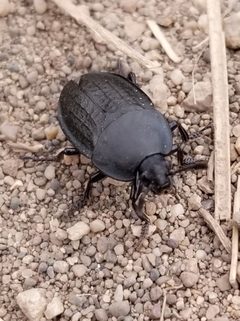
Heterosilpha ramosa, commonly known as the Garden Carrion Beetle, is a of carrion beetle in the Silphidae. Despite its , this species exhibits unusual dietary habits for a carrion beetle, functioning primarily as a feeder rather than a strict carrion . It is widely distributed across western and central North America, from Canada through Mexico, and occupies diverse including shortgrass prairie and coniferous forest. The species has been documented as active from March through October, with .
Pronunciation
How to pronounce Heterosilpha ramosa: //ˌhɛt.ə.roʊˈsɪl.fə rəˈmoʊ.sə//
These audio files are automatically generated. While they are not always 100% accurate, they are a good starting point.
Identification
Distinguished from superficially similar darkling beetles by the presence of five tarsal segments on all legs (darkling beetles have only four tarsal segments on the hind leg) and clubbed . Separated from ground beetles by the combination of clubbed antennae and tarsal segmentation. Among Silphidae, H. ramosa can be recognized by its dull black, unpatterned and associations, in contrast to the more specialized carrion-feeding relatives in such as Nicrophorus.
Images
Appearance
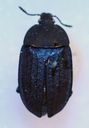
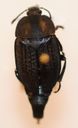
are 11–17 mm in length with a dull black coloration. The body is robust and somewhat flattened. are distinctly clubbed, a key diagnostic feature of the Silphidae. Each leg possesses five tarsal segments. The overall form resembles darkling beetles (Tenebrionidae) or ground beetles (Carabidae) at first glance. Larvae are jet black, highly mobile, and tapered, with relatively short legs positioned anteriorly on the body.
Habitat
Occupies diverse terrestrial environments including shortgrass prairie, coniferous forest, and urban lawns. Frequently encountered crossing sidewalks and other open ground. Has been observed in both natural and anthropogenically modified settings.
Distribution
North America: occurs from British Columbia and Ontario, Canada, south through the western United States (west of the Rocky Mountains primarily, but ranging east to Iowa, Minnesota, and Michigan) to Mexico including Baja California. Records from Canadian provinces include Alberta, British Columbia, Manitoba, Northwest Territories, Ontario, and Saskatchewan. United States records include Arizona, California, Colorado, Idaho, Michigan, Minnesota, Montana, Nebraska, Nevada, New Mexico, North Dakota, Oregon, South Dakota, Utah, Washington, Wisconsin, and Wyoming.
Seasonality
active March through October. Overwinters as adults, becoming active the following spring. laid in soil around carcasses or rotting vegetable matter; hatch in approximately five days. Larval stage lasts approximately two to three weeks. Pupal stage lasts 8–9 days.
Diet
feeder. and larvae consume decaying vegetable matter, soft-bodied insects (living or dead), and maggots associated with decaying organic matter in soil. Has been observed feeding on leaves of plants at night. Documented feeding on dead Devastating Grasshoppers (Melanoplus devastator) and Brown Garden Snails (Helix aspersa). Historical references describe occasional feeding on garden and field crops, grasses, and weeds.
Life Cycle
Complete . laid in soil in proximity to carcasses or rotting vegetable matter. Larvae are highly mobile and capable of rapid movement. Development includes egg (~5 days), larval (2–3 weeks), and pupal (8–9 days) stages before . Adults overwinter.
Behavior
and larvae are highly mobile. Larvae use their tapered bodies to move efficiently into cracks and crevices and to escape . Adults frequently observed crossing open ground including sidewalks. plant feeding has been reported.
Ecological Role
decomposer and scavenger. Functions as a competitor to burying beetles (Nicrophorus spp.) at carcass resources, potentially reducing reproductive success of specialists. Contributes to nutrient cycling through consumption of decaying organic matter and insect remains. May provide incidental through consumption of pest including grasshoppers and snails.
Human Relevance
Occasionally considered a minor agricultural pest in historical literature due to feeding on crops and grasses, though contemporary understanding emphasizes its scavenging . Frequently encountered by observers due to habit of crossing sidewalks in residential areas. Subject of ecological research regarding competition dynamics with carrion beetles.
Similar Taxa
- Nicrophorus spp. burying beetles in the same ; distinguished by more robust form, often patterned or colored , and obligate carrion-burying . Heterosilpha ramosa is more slender, uniformly dull black, and does not bury carcasses.
- Tenebrionidae (darkling beetles)Superficially similar body form and dull coloration; distinguished by four tarsal segments on the hind leg (versus five in H. ramosa) and non-clubbed .
- Carabidae (ground beetles)Similar ground-dwelling habit and dark coloration; distinguished by thread-like or slightly clubbed but not distinctly , and different and structure.
Misconceptions
Despite the 'Garden Carrion Beetle' and placement in Silphidae, this is not a strict carrion . Historical and contemporary sources consistently describe feeding habits, with limited direct consumption of vertebrate carcasses. The species has been misidentified as a crop pest and as a darkling beetle due to its appearance and habits.
More Details
Taxonomic History
Originally described under the Silpha; subsequently transferred to Heterosilpha. The genus Silpha is now restricted to Old World .
Research Significance
Used as a model competitor in studies of resource competition with burying beetles (Nicrophorus guttula). Research by Tracie Hayes at UC Davis demonstrated that competition from H. ramosa reduces reproductive output of specialist burying beetles, highlighting the importance of interactions in ephemeral resource patches.