
Nicrophorus guttula
(Motschulsky, 1845)
Yellow-bellied Burying Beetle
Nicrophorus guttula is a burying in the Staphylinidae, described by Russian entomologist Victor Motschulsky in 1845. The is commonly known as the Yellow-bellied Burying Beetle and is found across western North America from Alaska to Mexico. It exhibits elaborate parental care , including burying small carcasses and cooperatively feeding larvae. Research at the Bodega Marine Reserve has examined how carcass moisture and competition affect its reproductive success.
Pronunciation
How to pronounce Nicrophorus guttula: //nɪˈkrɒfərəs ˈɡʌtjʊlə//
These audio files are automatically generated. While they are not always 100% accurate, they are a good starting point.
Identification
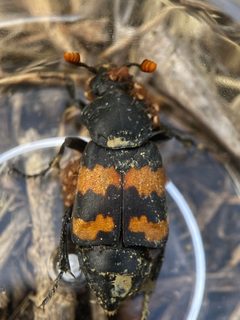
Nicrophorus guttula can be distinguished from other Nicrophorus by its yellowish coloration, which gives rise to its . Like other burying beetles, it has shiny black with orange or yellow markings, though specific pattern details for this species are not well documented in available sources. It is smaller than the endangered Nicrophorus americanus, which has a distinctive orange pronotal patch. Accurate identification to species level typically requires examination of genitalic structures and comparison with .
Images
Habitat
The has been studied at the Bodega Marine Reserve in coastal California, where it occupies a landscape with patchy distribution of small vertebrate carcasses. It appears to favor environments where fresh carrion is available, with reproductive success dependent on carcass moisture conditions. The species has been observed in both coastal and interior western North American .
Distribution
Western North America, including Canada (Alberta, British Columbia, Saskatchewan), the United States (Alaska, Arizona, California, Colorado, Idaho, Kansas, Minnesota, Montana, North Dakota, Nebraska, New Mexico, Nevada, Oregon, South Dakota, Utah, Washington, Wyoming), and Mexico (Baja California). Pleistocene records exist from California.
Diet
Specialized feeder on small vertebrate carcasses, including mice, birds, and squirrels. and larvae consume carrion. Parents feed larvae regurgitated, liquefied carrion material.
Life Cycle
locate fresh carcasses using chemosensory . Males attract females via . The pair buries the carcass (12-18 hours), removes fur or feathers, and shapes the remains into a ball. are laid in a chamber near the carcass. Larvae hatch in approximately four days, move to the carcass, and are fed by both parents via regurgitation. Larvae mature in eight to nine days, then pupate in soil surrounding the nest. Adults may cull excess larvae if carrion is insufficient. time from egg to adult is approximately 48-60 days.
Behavior
Exhibits biparental care, a rarity among non-eusocial . Both sexes cooperate in burying carcasses, preparing nurseries, and feeding offspring. stridulate to communicate during pair formation. Parents defend carcasses and against intruders; males primarily serve a guarding function. Reproductive success is moisture-dependent, with pairs requiring fresh rather than desiccated carcasses to breed successfully. Competition from carrion beetles (Heterosilpha) reduces offspring numbers.
Ecological Role
Functions as a scavenger and nutrient cycler, burying and consuming small vertebrate carcasses. This accelerates decomposition and reduces associated with exposed carrion. As a on ephemeral resource patches, the serves as a model organism for studying organismal responses to spatially and temporally variable resources.
Human Relevance
Subject of ecological research, particularly regarding parental care evolution and resource specialization. Studied as an for responses to environmental change, including shifting moisture conditions and interactions under climate change. Featured in public science communication through the Bohart Museum of Entomology.
Similar Taxa
- Nicrophorus americanusLarger size, orange pronotal patch, and endangered status distinguish it from N. guttula.
- Nicrophorus orbicollisOverlapping range but lacks yellowish coloration characteristic of N. guttula.
- Heterosilpha ramosa carrion beetle competitor that reduces N. guttula reproductive output through resource competition; does not bury carcasses or provide parental care.
More Details
Research significance
Nicrophorus guttula has been the focus of doctoral research by Tracie Hayes at UC Davis examining how moisture and competition modulate ephemeral resource patch quality. This work demonstrated that carcass freshness is a critical factor for reproductive success, with implications for understanding how climate change may affect on transient resources.
Taxonomic note
placement has varied in literature; some sources list Silphidae while modern classifications place the Silphinae within Staphylinidae. The GBIF and iNaturalist records reflect this updated classification.
Sources and further reading
- BugGuide
- Wikipedia
- GBIF taxonomy match
- iNaturalist taxon
- NCBI Taxonomy
- Bohart Museum Spotlight on Yellow-Bellied Burying Beetles | Bug Squad
- Congratulations, UC Davis Linnaean Games Team: National Champs! | Bug Squad
- They eat dead things - Part I - Burying beetles Silphidae — Bug of the Week
- Oklahoma is More than OK for Burying Beetles
- Burying Beetles Are Part of Nature's Clean-up Crew
- Year of the Horse 2026: A selection of equine-related species to celebrate the Lunar New Year | Blog