
Nicrophorus orbicollis
(Say, 1825)
Roundneck Sexton Beetle, Round-necked Burying Beetle
Nicrophorus orbicollis is a Nearctic burying in the Silphidae, first described by Thomas Say in 1825. It is one of the most frequently collected silphid in the eastern United States. The species exhibits elaborate biparental care, with both males and females cooperating to locate, bury, and prepare small vertebrate carcasses as food for their offspring. are and active primarily from late spring through summer, with a multivoltine .
Pronunciation
How to pronounce Nicrophorus orbicollis: //ˈnɪkrəˌfɔːrəs ɔːrˈbɪkəlɪs//
These audio files are automatically generated. While they are not always 100% accurate, they are a good starting point.
Identification
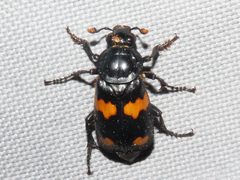
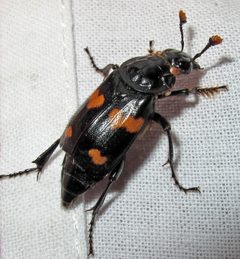
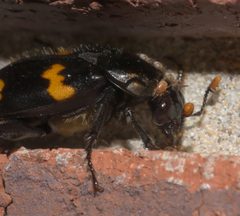
Distinguished from other Nicrophorus by the spherical pronotum with wide lateral and basal margins, and the distinctive orange-marked with long lateral setae giving a hairy appearance. The three-segmented orange antennal club with black base is diagnostic. Can be separated from the endangered Nicrophorus americanus by the absence of an orange patch on the pronotum (N. americanus has a prominent orange pronotal patch).
Images
Appearance
are moderately sized beetles, 15–22 mm in length. The surface of the is covered in long, fine setae, especially laterally, giving a distinctly hairy appearance. The elytra display bright orange markings. The pronotum is spherical with wide lateral and basal margins. The most distinctive feature is the clubbed with three orange segments and a black base. The lobe of the metepimeron bears a few brown hairs, and the hind tibia is straight.
Habitat
Occurs in both open and forested , with highest abundance in mesic forests. Frequently collected on human and , rotten fruit, and carrion. Overwinters as in protected locations.
Distribution
Nearctic distribution ranging from southeastern Canada (Ontario, Quebec, New Brunswick, Nova Scotia, Manitoba, Saskatchewan) through the eastern United States, from Maine south to Florida, west to East Texas, Nebraska, and North Dakota. The most frequently collected silphid in the eastern United States.
Seasonality
active from February to October, with peak activity during summer months (June to August). First adults emerge in late May. occurs from June to August. adults appear from late July to early August. The is multivoltine. Adults are .
Diet
Saprophagous, feeding on protein from small decomposing vertebrate carcasses (mice, chipmunks, rabbits, toads, birds). also consume fly larvae and other carrion-associated . Larvae are fed regurgitated carrion by parents.
Life Cycle
Complete with , larval, pupal, and stages. Eggs hatch approximately 56 hours after oviposition. Larvae complete development and pupate in soil within 6–8 days after hatching. Development from egg burial to larval varies with carcass size, being shorter on smaller carcasses. The is multivoltine with overlapping .
Behavior
are . Males locate small vertebrate carcasses and emit to attract females; males without carcasses may emit pheromones but are less successful. Pairs cooperate to bury carcasses, removing fur or feathers and shaping the carcass into a ball. Both parents provide extensive care, including defense of the nest, carcass preservation through antimicrobial secretions, and regurgitative feeding of larvae. If one parent is removed, the surviving parent compensates by increasing care effort. Males typically abandon the before females, usually when larvae reach the final instar. Nest intrusions by conspecifics occur, with intruders sometimes killing resident parents and offspring to usurp the carcass. Adults engage in aggressive combat with conspecifics and over carcass resources, with larger individuals generally .
Ecological Role
Key decomposer and nutrient recycler, converting small vertebrate carcasses into soil nutrients. Competitive interactions with flies and other carrion insects; consumption of fly larvae can reduce dipteran on carcasses. Serves as transport for phoretic mites of the Poecilochirus, which feed on fly and larvae at carcasses.
Human Relevance
Forensically significant: arrival at carcasses typically occurs after flies, and the ' predictable developmental timeline can aid in estimating postmortem intervals. However, consumption of fly larvae by beetles can complicate forensic analysis. Used in scientific research on parental care, behavioral , and social evolution. No direct economic impact.
Similar Taxa
- Nicrophorus americanusSimilar size and color pattern, but distinguished by prominent orange pronotal patch and larger body size (up to 35 mm); federally endangered with restricted range
- Nicrophorus tomentosusOverlaps in range and seasonality but breeds later (late summer to fall); typically smaller and less in competitive interactions; has distinct golden tomentose on pronotum
- Nicrophorus pustulatusOverlaps in and seasonality but specializes on snake in addition to carrion; -dwelling habit differs from ground-foraging N. orbicollis
- Nicrophorus defodiensDirect competitor for carcass resources; similar size and general appearance but with subtle differences in pronotal shape and elytral markings
More Details
Parental Care
Nicrophorus orbicollis exhibits one of the most elaborate forms of parental care among non-eusocial insects. Larvae are completely dependent on parental feeding and will die before reaching the second instar without care. Offspring mass is positively correlated with duration of maternal care. Parents adjust size through filial when carcass resources are insufficient.
Phoretic Mite Associations
commonly carry mites of the Poecilochirus on their . This commensal relationship benefits the mites, which use beetles for transport between carcasses where they feed on fly . The beetles do not compete with these mites for resources.
Juvenile Hormone and Reproduction
titers elevate rapidly upon carcass discovery and show a second peak during early parental care, particularly in females. Experimental removal of the female leads to increased juvenile hormone in males and elevated paternal care .
Sources and further reading
- BugGuide
- Wikipedia
- GBIF taxonomy match
- iNaturalist taxon
- NCBI Taxonomy
- Congratulations, UC Davis Linnaean Games Team: National Champs! | Bug Squad
- Bohart Museum Spotlight on Yellow-Bellied Burying Beetles | Bug Squad
- Oklahoma is More than OK for Burying Beetles
- They eat dead things - Part I - Burying beetles Silphidae — Bug of the Week
- Burying Beetles Are Part of Nature's Clean-up Crew
- Silphidae | Beetles In The Bush
- Behavioural compensation for mate loss in the burying beetle Nicrophorus orbicollis
- Peer Review #1 of "Behavioral dominance interactions between two species of burying beetles (Nicrophorus orbicollis and Nicrophorus pustulatus) (v0.1)"
- Peer Review #1 of "Behavioral dominance interactions between two species of burying beetles (Nicrophorus orbicollis and Nicrophorus pustulatus) (v0.2)"
- Behavioral dominance interactions between two species of burying beetles ( Nicrophorus orbicollis and Nicrophorus pustulatus )
- Peer Review #2 of "Behavioral dominance interactions between two species of burying beetles (Nicrophorus orbicollis and Nicrophorus pustulatus) (v0.1)"
- Biparental behavior in the burying beetleNicrophorus orbicollis: a role for dopamine?
- Peer Review #1 of "Behavioral dominance interactions between Nicrophorus orbicollis and N. tomentosus burying beetles (Coleoptera: Silphidae) (v0.2)"
- Peer Review #3 of "Behavioral dominance interactions between Nicrophorus orbicollis and N. tomentosus burying beetles (Coleoptera: Silphidae) (v0.1)"
- Peer Review #2 of "Behavioral dominance interactions between Nicrophorus orbicollis and N. tomentosus burying beetles (Coleoptera: Silphidae) (v0.1)"
- Peer Review #1 of "Behavioral dominance interactions between Nicrophorus orbicollis and N. tomentosus burying beetles (Coleoptera: Silphidae) (v0.1)"
- Identification of Splicing Variation Associated with Parental Behavior in the Burying Beetles ( Nicrophorus orbicollis )
- Nest intrusions, infanticide, and parental care in the burying beetle, Nicrophorus orbicollis (Coleoptera: Silphidae)
- Rapid elevation of juvenile hormone titer during behavioral assessment of the breeding resource by the burying beetle, Nicrophorus orbicollis
- From constructing nests to nutritional provisioning: the impact of direct and indirect parental care in the burying beetle, Nicrophorus orbicollis
- Behavioral dominance interactions between Nicrophorus orbicollis and N. tomentosus burying beetles (Coleoptera: Silphidae)