
Nicrophorus americanus
Olivier, 1790
American burying beetle, giant carrion beetle
Nicrophorus americanus is a federally threatened burying to North America and the largest member of its . are , strong fliers capable of traveling up to one kilometer per night while searching for carrion. The exhibits elaborate biparental care, with both sexes cooperating to locate, bury, and prepare vertebrate carcasses for their offspring. Once abundant across 35 U.S. states and parts of Canada, it now occupies less than 10% of its historic range due to loss, carrion scarcity, and other factors.
Pronunciation
How to pronounce Nicrophorus americanus: /nɪˈkrɒfərəs əˌmɛrɪˈkeɪnəs/
These audio files are automatically generated. While they are not always 100% accurate, they are a good starting point.
Identification
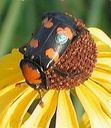
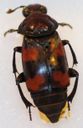
The orange-red pronotal marking distinguishes N. americanus from all other North American Nicrophorus , which lack this feature. Its large size (25–45 mm) separates it from smaller such as N. orbicollis. The combination of black body with orange-red elytral spots, pronotal patch, and orange antennal clubs is diagnostic. activity and strong capability may aid in field recognition.
Images
Habitat
Current evidence indicates N. americanus functions as a when foraging, using diverse habitats including grasslands, open understory oak-hickory forests, and forest edges. However, forested habitats appear preferred for breeding in some regions. The requires suitable soils for carcass burial and depends on habitat openness for detecting airborne carrion odors. Carrion availability rather than vegetation type appears to be the primary habitat determinant.
Distribution
Historically distributed across 35 U.S. states, the District of Columbia, and the Canadian provinces of Ontario and Quebec. Current natural are restricted to ten states: Rhode Island (Block Island), Oklahoma, Arkansas, Texas, Kansas, South Dakota, and Nebraska. Reintroduced populations occur in Ohio, Massachusetts, and Missouri. The northernmost confirmed populations are in South Dakota.
Seasonality
emerge from soil when temperatures exceed 15°C (60°F) to begin mating and . Adults overwinter buried in soil when temperatures drop below this threshold. The is nocturnally active during warmer months. time from carcass burial to adult is 45–60 days.
Diet
Obligate carrion feeder. and larvae consume vertebrate carcasses, specifically requiring carcasses the size of doves or chipmunks for successful . Adults may also feed on insects associated with carrion.
Life Cycle
Complete with biparental care. locate and bury suitable carcasses, remove fur or feathers, roll the carcass into a ball, and coat it with antimicrobial secretions from oral and anal glands. Females lay in an adjacent tunnel; larvae hatch in approximately four days and are fed regurgitated carrion by both parents. Larvae mature in 8–9 days, then burrow into surrounding soil to pupate. Adults emerge 45–60 days after initial burial. Adult lifespan is approximately 12 months.
Behavior
and a strong flier, capable of traveling up to one kilometer in one night. Both sexes cooperate in parental care, an unusual trait among beetles. locate carrion using chemosensors on the . Males often locate carcasses first and emit to attract mates. Same-sex and for carcasses occurs, with larger individuals typically prevailing. Adults exhibit death-feigning () as an anti- defense. Marking by elytral clipping alters stridulatory characteristics and reduces reproductive success.
Ecological Role
Specialized carrion decomposer that accelerates nutrient cycling through burial and consumption of vertebrate carcasses. Antimicrobial secretions applied to buried carcasses suppress competing microbes and other scavengers. The may serve as an indicator of health regarding vertebrate composition, connectivity, and carrion availability. Competition with smaller for carrion resources influences local community structure.
Human Relevance
Listed as federally threatened under the U.S. Act (reclassified from endangered in 2020); IUCN lists the as critically endangered. Subject to intensive conservation efforts including captive breeding, reintroduction programs on Penikese Island and Nantucket (Massachusetts), and monitoring. ongoing threats from loss, climate change, and neonicotinoid exposure, which causes behavioral impairment and delayed mortality even at sublethal doses. Conservation conflicts have arisen with oil and gas development interests in Oklahoma.
Similar Taxa
- Nicrophorus orbicollisOverlapping range in Oklahoma and elsewhere; distinguished by absence of orange pronotal marking and smaller size (typically under 25 mm)
- Nicrophorus marginatusCo-occurs in South Dakota and other regions; pitfall trap studies indicate competitive exclusion where N. marginatus is abundant, reducing N. americanus captures
- Necrophila americanaSimilar (American carrion beetle) causes confusion; belongs to different (Necrophila), lacks pronotal orange patch, and does not exhibit parental carcass burial
More Details
Conservation History
Listed as endangered in 1989; reclassified as threatened in 2020. The has been the subject of repeated petitions for delisting by energy industry interests, despite ongoing vulnerabilities and incomplete understanding of historical decline causes. The extinction of the passenger pigeon has been hypothesized as a contributing factor to carrion scarcity.
Research Significance
Extensively studied as a model organism for parental care evolution, function in reproductive , and aging in insects. Laboratory colonies are maintained on raw chicken liver, facilitating physiological and behavioral research.
Sources and further reading
- BugGuide
- Wikipedia
- GBIF taxonomy match
- iNaturalist taxon
- NCBI Taxonomy
- Catalogue of Life
- Congratulations, UC Davis Linnaean Games Team: National Champs! | Bug Squad
- A Force Awakened and to Be Reckoned With | Bug Squad
- Oklahoma is More than OK for Burying Beetles
- Burying Beetles Are Part of Nature's Clean-up Crew
- Silphidae | Beetles In The Bush
- Bug Eric: Insects in the News
- Habitat Preference of the Endangered American Burying Beetle (Nicrophorus americanus) in Oklahoma
- Ecology and Conservation of the Endangered American Burying Beetle ( Nicrophorus americanus )
- Habitat selection, breeding success and conservation of the endangered American burying beetle Nicrophorus americanus
- Marking by elytral clip changes stridulatory characteristics and reduces reproduction in the American burying beetle, Nicrophorus americanus
- Using species distribution models to guide conservation at the state level: the endangered American burying beetle (Nicrophorus americanus) in Oklahoma
- Population trends and flight behavior of the American burying beetle, Nicrophorus americanus (Coleoptera: Silphidae), on Block Island, RI
- Neonicotinoid exposure causes behavioral impairment and delayed mortality of the federally threatened American burying beetle, Nicrophorus americanus
- The Occurrence of the American Burying Beetle (Nicrophorus americanus) and Associated Silphid Beetle Community in South Dakota: Implications for Managed Relocation
- Identifying priority conservation areas for the American burying beetle,Nicrophorus americanus(Coleoptera: Silphidae), a habitat generalist
- Establishing Age-Based Color Changes for the American Burying Beetle, Nicrophorus americanus Olivier, with Implications for Conservation Efforts.