
Nicrophorus marginatus
Fabricius, 1801
margined sexton beetle, margined burying beetle, red and black burying beetle
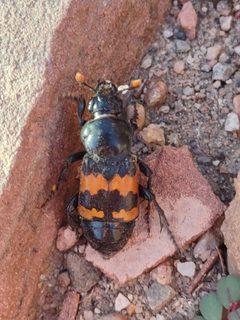
Nicrophorus marginatus is a burying in the Silphidae, described by Fabricius in 1801. are medium-sized beetles, 12–28 mm in length, with distinctive shiny black bodies and red-orange elytral bands. The exhibits extreme physiological sensitivity to desiccation, losing 1–5% body mass per hour in low humidity conditions, yet maintains activity patterns and extends into arid through behavioral . Like other Nicrophorus species, it engages in complex biparental care, burying small vertebrate carcasses and provisioning larvae with regurgitated, pre-digested food.
Pronunciation
How to pronounce Nicrophorus marginatus: /nɪˈkrɒfərəs mɑːrˈdʒɪneɪtəs/
These audio files are automatically generated. While they are not always 100% accurate, they are a good starting point.
Identification
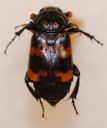
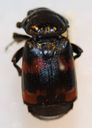
Distinguished from by the combination of shiny black body with red-orange elytral bands and orange-red antennal clubs. The specific epithet 'marginatus' refers to the marginal banding pattern on the . Distinguished from the similar Nicrophorus tomentosus by specific elytral pattern details; N. tomentosus has more extensive orange coloration and different pronotal markings. Distinguished from Nicrophorus americanus by the absence of the large orange pronotal patch characteristic of that .
Images
Appearance
are 12–28 mm in length with shiny black . The feature distinct red-orange bands. Antennal clubs are orange-red. Overall coloration is black with contrasting orange-red markings on the wing cases and tips.
Habitat
Found in diverse terrestrial including forests, grasslands, and open areas where small vertebrate carcasses occur. Despite high physiological water-loss rates, the occupies habitats ranging from mesic to relatively arid conditions, suggesting behavioral rather than physiological to dry environments.
Distribution
North America: Canada (Alberta, British Columbia, Ontario, Quebec), United States (widespread across 40+ states including AR, AZ, CA, CO, CT, FL, IA, ID, IL, IN, KS, KY, LA, MA, MD, ME, MI, MN, MO, MT, NC, ND, NE, NJ, NM, NY, OK, OR, PA, RI, SD, TN, TX, UT, VA, WA, WI, WY), and Mexico. Pleistocene records from California.
Seasonality
Active during warmer months; exhibits bimodal activity pattern with peaks avoiding hottest midday hours. Summer activity is constrained by desiccation risk, with high mortality in pitfall traps containing dry soil during summer months.
Diet
on small vertebrate carrion (mice, birds, squirrels). liquefy carcass tissue through pre-oral digestion using secreted including phospholipase A2, then consume the liquefied material. Larvae are fed regurgitated, pre-digested carrion by both parents.
Life Cycle
Holometabolous. locate and bury small vertebrate carcasses, prepare them by removing fur or feathers and shaping into compact balls, and coat with antimicrobial secretions. are laid in soil near the carcass. Larvae hatch in approximately four days, are fed regurgitated food by both parents, and mature in 8–9 days. Larvae then burrow into surrounding soil to pupate, emerging as adults after 48–60 days. Adults may become inactive in winter.
Behavior
with strong bimodal activity pattern avoiding peak heat hours—a behavioral to mitigate high water-loss rates. of both sexes cooperate to locate, bury, and prepare carcasses. Males emit to attract females. for carcasses occurs, with larger individuals typically winning breeding rights. Both parents provide extended care including carcass preparation, nest defense, and larval provisioning through regurgitation. Adults may cull excess larvae if carcass resources are insufficient. Produces oral and anal defensive secretions when disturbed.
Ecological Role
Primary consumer of small vertebrate carrion; facilitates nutrient cycling through rapid carcass decomposition. Parental application of antimicrobial secretions to buried carcasses suppresses microbial competitors, potentially altering soil microbiome dynamics around carcass sites. Serves as prey for various and competitors at carcass resources.
Human Relevance
Subject of physiological research on and thermal due to its unusual combination of high desiccation sensitivity and occupation of arid . Used in studies of parental care evolution and carrion decomposition ecology. Not a pest ; contributes to natural by removing small carcasses.
Similar Taxa
- Nicrophorus tomentosusSimilar size and coloration with orange-red markings; distinguished by more extensive orange coloration and different pronotal pattern. Historically confused due to Gistel's 1857 misidentification.
- Nicrophorus americanusLarger size and prominent orange pronotal patch; federally endangered and restricted to fewer states. N. marginatus lacks the distinctive pronotal marking.
- Nicrophorus orbicollisOverlapping range and similar burying ; distinguished by specific elytral pattern details and geographic distribution nuances.
More Details
Physiological Water Balance
N. marginatus exhibits exceptionally high water-loss rates (1–5% body mass per hour at 25–30% relative humidity), resulting in 50% mortality within 7–16 hours at 16–28°C. This rate exceeds comparably sized mesic beetles by 26–79%. The defies typical predictions linking water-loss rates to type, occupying dry habitats through behavioral rather than physiological .
Thermal Sensitivity of Reproduction
Reproductive success declines significantly at temperatures only 1.5°C above baseline (27.5°C vs. 26°C), with reduced success rates, extended carcass handling times, and increased activity levels. size is reduced at 26.5°C. These findings suggest vulnerability to projected climate warming even within current temperature ranges.
Digestive Biochemistry
Oral secretions contain phospholipase A2, an optimally active at pH 7.0–8.0 and 35–40°C, with specificity for phosphatidylcholine. This enzyme facilitates external digestion of carcass lipids, contributing to the liquefaction process essential for feeding and larval provisioning.
Multigenerational Effects
Research has found no evidence that parental body size or natal carcass size confer advantages to offspring. Lifetime offspring number and first- size are unrelated to parental traits, though current carcass size remains a significant predictor of reproductive output.
Sources and further reading
- BugGuide
- Wikipedia
- GBIF taxonomy match
- iNaturalist taxon
- NCBI Taxonomy
- Congratulations, UC Davis Linnaean Games Team: National Champs! | Bug Squad
- Bohart Museum Spotlight on Yellow-Bellied Burying Beetles | Bug Squad
- They eat dead things - Part I - Burying beetles Silphidae — Bug of the Week
- Pixelated Entomology: Analyzing Beetles' Flower Use Through Digital Samples
- Oklahoma is More than OK for Burying Beetles
- Burying Beetles Are Part of Nature's Clean-up Crew
- High water‐loss rates and rapid dehydration in the burying beetle, Nicrophorus marginatus
- Pre-Oral Digestion: A Phospholipase A2 Associated with Oral Secretions in Adult Burying Beetles, Nicrophorus marginatus
- The thermal ecology of burying beetles: temperature influences reproduction and daily activity in Nicrophorus marginatus
- No evidence for increased fitness of offspring from multigenerational effects of parental size or natal carcass size in the burying beetle Nicrophorus marginatus