
Nicrophorus tomentosus
Weber, 1801
Gold-necked carrion beetle, Tomentose burying beetle
Nicrophorus tomentosus is a burying ( Silphidae) distinguished by a dense patch of golden-yellow setae on the pronotum. Unlike most , it does not completely bury carcasses; instead, it excavates shallow pits beneath small vertebrate remains and covers them with leaf litter. exhibit biparental care, feeding larvae regurgitated carrion. The is active from May through October, peaking in July and August, and overwinters as —a trait unique among sympatric Nicrophorus species. Behavioral dominance in competitive interactions is determined primarily by body size rather than species identity.
Pronunciation
How to pronounce Nicrophorus tomentosus: /nɪˈkrɒfərəs təʊmɛnˈtoʊsəs/
These audio files are automatically generated. While they are not always 100% accurate, they are a good starting point.
Identification
Distinguished from by the thick golden-yellow hair patch on the pronotum; N. orbicollis and N. marginatus lack this dense tomentum. entirely black (some congeners have orange-tipped antennae). Shallow burial with leaf litter cover differs from complete burial typical of most Nicrophorus. Smaller average body size than N. orbicollis, with which it frequently co-occurs. activity when searching for carrion contrasts with habits of N. orbicollis.
Images
Appearance
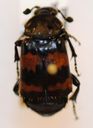
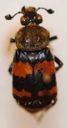
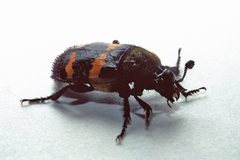
Medium-sized 11.2–19.0 mm in length. Body predominantly black with symmetrical orange markings on . Pronotum densely covered with golden-yellow tomentose setae, creating a distinct "gold-necked" appearance. entirely black, clubbed at tips with olfactory organs. Fifth abdominal bears paired striations. Scutellum large, sometimes as wide as the . Elytral epipleuron black with orange splotches. pattern resembles that of a .
Habitat
Forests, woodlands, shrublands, and sandy prairies. Requires presence of small vertebrate carcasses for . Frequently captured in baited traps in wooded . In southeastern Ontario, breeds in both terrestrial and forest environments.
Distribution
North America: United States (widespread except southeastern region), southern Canada east of the Rocky Mountains (Manitoba, New Brunswick, Nova Scotia, Ontario, Quebec, Saskatchewan). GBIF records confirm presence in 38 US states and 6 Canadian provinces.
Seasonality
active May through October; peak abundance July and August. Breeding period extends from late summer into fall, approximately 3–4 weeks versus 10 weeks for sympatric N. orbicollis. Unique among local Nicrophorus in as , enabling later-season breeding.
Diet
Small vertebrate carcasses including rodents (rats, moles, voles), birds, and other small mammals. and larvae consume carrion; parents feed larvae regurgitated, liquefied carrion. Adults have been observed to consume fly larvae (maggots) competing for carcass resources.
Life Cycle
deposited in soil near carcass at least 12 hours after carcass discovery; hatch after approximately 4 days. Larvae move to feeding hole prepared by parents, fed regurgitated food by both parents for 6–8 days until fully developed. Larvae then burrow into surrounding soil to pupate. emerge after 48–60 days. Overwinters as , unlike that overwinter as adults.
Behavior
when searching for carrion; becomes active day and night once carcass is secured. Does not fully bury carcasses; excavates shallow pit beneath carcass and covers with leaf litter. Both parents cooperate in carcass preparation: removing hair or feathers, rolling carcass into ball, applying oral and anal secretions to retard decay and mask odor. Biparental care includes defending from and heterospecific competitors; if female dies, male assumes full care. may cull excess larvae if carcass size is insufficient. Engages in aggressive interference competition; contest outcomes determined by body size rather than identity or arrival order.
Ecological Role
Carrion consumer and nutrient cycler; facilitates decomposition of small vertebrate remains. Competes for limited carcass resources with other Nicrophorus and flies. Parental antimicrobial secretions and larval may suppress microbial competitors. Serves as prey or for various and .
Human Relevance
Subject of ecological research on parental care, behavioral dominance, and resource competition. Occasionally captured in Japanese beetle traps baited with carrion. No documented agricultural or medical significance. trends unknown; not listed under conservation legislation.
Similar Taxa
- Nicrophorus orbicollisOverlaps in distribution and ; distinguished by larger size, activity, complete carcass burial, and lack of dense golden pronotal setae. N. orbicollis typically behaviorally due to larger size.
- Nicrophorus marginatusSympatric burying ; lacks golden pronotal tomentum and has different seasonal activity pattern.
- Nicrophorus americanusFederally endangered with orange pronotal patch (not golden setae); larger and restricted to specific states.
More Details
Behavioral Dominance
In experimental contests with N. orbicollis, N. tomentosus was typically subordinate due to smaller body size, but could outcompete smaller N. orbicollis individuals when size advantage reversed. This demonstrates that body size, not identity, determines competitive outcomes.
Canopy Breeding
One of at least two Nicrophorus documented breeding in forest , expanding use beyond ground-level carrion resources.
Ovarian Development
Research indicates behavioral cues associated with carcass discovery and burial trigger ovarian development in females, suggesting reproductive physiology is condition-dependent rather than automatic.
Sources and further reading
- BugGuide
- Wikipedia
- GBIF taxonomy match
- iNaturalist taxon
- NCBI Taxonomy
- Congratulations, UC Davis Linnaean Games Team: National Champs! | Bug Squad
- Bohart Museum Spotlight on Yellow-Bellied Burying Beetles | Bug Squad
- They eat dead things - Part I - Burying beetles Silphidae — Bug of the Week
- Burying Beetles Are Part of Nature's Clean-up Crew
- Oklahoma is More than OK for Burying Beetles
- Silphidae | Beetles In The Bush
- Behavioural cues trigger ovarian development in the burying beetle, Nicrophorus tomentosus
- Behavioral dominance interactions between Nicrophorus orbicollis and N. tomentosus burying beetles (Coleoptera: Silphidae)
- Peer Review #1 of "Behavioral dominance interactions between Nicrophorus orbicollis and N. tomentosus burying beetles (Coleoptera: Silphidae) (v0.2)"
- Peer Review #2 of "Behavioral dominance interactions between Nicrophorus orbicollis and N. tomentosus burying beetles (Coleoptera: Silphidae) (v0.1)"
- Peer Review #3 of "Behavioral dominance interactions between Nicrophorus orbicollis and N. tomentosus burying beetles (Coleoptera: Silphidae) (v0.1)"
- Peer Review #1 of "Behavioral dominance interactions between Nicrophorus orbicollis and N. tomentosus burying beetles (Coleoptera: Silphidae) (v0.1)"