
Necrophila
Kirby & Spence, 1828
carrion beetles
Species Guides
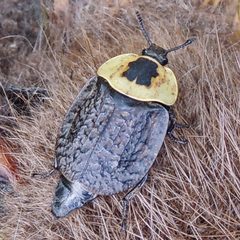
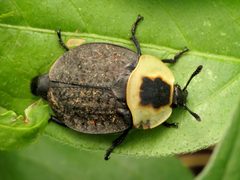
1- Necrophila americana(American Carrion Beetle)
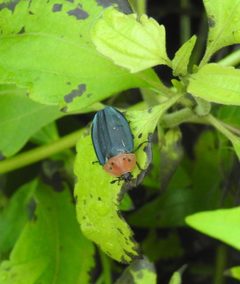
Necrophila is a of carrion beetles in the Silphidae, comprising approximately 20 distributed primarily across Asia and India, with a single North American species, N. americana. The genus name derives from Greek roots meaning 'attracted to corpses,' reflecting their ecological association with decomposing animal matter. These beetles are significant forensic indicators and play important roles in carrion decomposition and nutrient cycling.
Pronunciation
How to pronounce Necrophila: //ˌnɛ.krəˈfaɪ.lə//
These audio files are automatically generated. While they are not always 100% accurate, they are a good starting point.
Identification
Members of Necrophila can be distinguished from the closely related burying beetles (Nicrophorus) by their lack of parental care and their tendency to feed on carrion without burying it. N. americana specifically lacks the orange and black color pattern typical of Nicrophorus , instead showing more uniform dark coloration. possess clubbed and may be found in at carcasses or, occasionally, at sap flows on trees.
Images
Habitat
Carrion including animal carcasses in various stages of decomposition; forested and open environments where vertebrate mortality occurs. N. americana has been documented at sap flows on oak trees, suggesting broader feeding than strict carrion association. N. japonica occupies diverse habitats from disturbed riparian zones to stable forests.
Distribution
Predominantly Asian distribution with recorded across East Asia including Japan, China, and surrounding regions. N. americana is the sole North American representative, occurring in the eastern and central United States. Specific distribution records include Vermont and other eastern US localities for N. americana; Japanese archipelago (Hokkaido, Honshu, Shikoku, Kyushu) for N. japonica.
Diet
Necrophagous, feeding primarily on decomposing animal flesh. N. brunnicollis has been demonstrated to be preferentially necrophagous while also consuming dipteran larvae as a minor dietary component. and larvae feed on carrion; adults may also prey on fly larvae (maggots) at carcasses, reducing competition for their own offspring.
Life Cycle
Complete with , larval, pupal, and stages. N. brunnicollis development has been characterized with thermal summation parameters established for forensic applications, including lower developmental thresholds and requirements for all life stages. N. americana larvae develop within and beneath carcasses without parental care, then pupate in soil. N. japonica exhibits muscle dimorphism with no seasonal change in proportions; individuals with flight muscles produce more eggs.
Behavior
N. americana exhibit distinctive courtship where males grasp females' with their , releasing them only briefly during mating while stroking the female's pronotum with their own antennae; this antennal grasping continues until and larvae are present at a carcass, suggesting mate guarding. N. japonica demonstrates aggressive interference competition at carcasses, including direct attacks on conspecifics and heterospecifics and prevention of competitor burial. When threatened, N. americana emits defensive compounds from rectal glands.
Ecological Role
Carrion decomposers contributing to nutrient cycling and carcass removal. N. japonica often achieves numerical dominance in ground . Through on fly larvae, reduce competition for their own larvae and influence community on carcasses. Facilitate later by other through carcass processing, though succession mechanisms may follow processing chain models rather than strict facilitation.
Human Relevance
Forensically important ; N. brunnicollis and N. americana serve as indicators for postmortem interval estimation in forensic investigations. N. americana is frequently encountered in casework and research. Thermal development models have been established for N. brunnicollis to improve PMI calculations. Must be distinguished from the endangered American burying beetle (Nicrophorus americanus) in conservation and forensic contexts.
Similar Taxa
- NicrophorusBurying beetles in the same Silphidae; distinguished by parental care (Nicrophorus buries carcasses and feeds larvae regurgitated food, Necrophila does not), coloration (Nicrophorus typically orange and black patterned, Necrophila more uniformly dark), and carcass utilization strategy.
- OiceoptomaAnother silphid with overlapping carrion use; N. japonica and O. noveboracense have been documented co-occurring at carcasses, with Necrophila arriving earlier and exhibiting superior competitive ability through aggressive interference.
Sources and further reading
- BugGuide
- Wikipedia
- GBIF taxonomy match
- iNaturalist taxon
- NCBI Taxonomy
- Catalogue of Life
- Deerly departed: food for flesh-recycling carrion beetles - Margined carrion beetle, Oiceoptoma noveboracense, and American carrion beetle, Necrophila americana — Bug of the Week
- Silphidae | Beetles In The Bush
- They eat dead things - Part I - Burying beetles Silphidae — Bug of the Week
- They eat dead things, Part II - Blow flies, Calliphoridae — Bug of the Week
- The Flies and Beetles That Turn Death Into Dinner
- Developmental Biology of Forensically Important Beetle, Necrophila (Calosilpha) brunnicollis (Coleoptera: Silphidae)
- Macroscale evolutionary patterns of flight muscle dimorphism in the carrion beetle Necrophila japonica
- Mechanisms of succession between two Silphidae, Necrophila japonica and Nicrophorus concolor on small vertebrate carcasses
- Standardized Laboratory Methodology for the Evaluation of Foraging Strategies in Necrophilous Beetles: A Case Study of Necrophila (Calosilpha) brunnicollis (Coleoptera: Silphidae)