
Oiceoptoma
Leach, 1815
Species Guides
3- Oiceoptoma inaequale(Ridged Carrion Beetle)
- Oiceoptoma noveboracense(Margined Carrion Beetle)
- Oiceoptoma rugulosum(Carrion Beetle)
Oiceoptoma is a of carrion beetles in the Silphidae, comprising approximately ten described distributed across the Holarctic region. These beetles are necrophagous, specializing in the consumption of vertebrate carcasses. The genus includes species of forensic importance due to their predictable associations and seasonal activity patterns. Oiceoptoma noveboracense, the margined carrion beetle, is among the most studied species and serves as a model for understanding carrion beetle in North America.
Pronunciation
How to pronounce Oiceoptoma: /oɪsiˈɒptəmə/
These audio files are automatically generated. While they are not always 100% accurate, they are a good starting point.
Identification
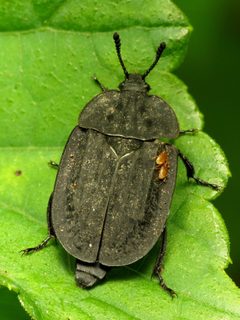
Oiceoptoma are distinguished from other Silphidae by combinations of elytral coloration, punctation patterns, and body proportions. Oiceoptoma noveboracense has distinctive orange-yellow margins on the dark . Oiceoptoma thoracicum exhibits pronotal and elytral characteristics that separate it from . Species-level identification requires examination of genitalic structures and detailed punctation patterns. The can be separated from the similar Necrophila by differences in antennal club structure and elytral microsculpture.
Images
Habitat
Forest are strongly preferred; Oiceoptoma thoracicum shows significantly higher abundance in woods compared to meadows or forest-meadow . The actively avoids habitat edges despite these zones being general biodiversity hotspots. This habitat fidelity has direct forensic applications for detecting post-mortem relocation of corpses.
Distribution
Holarctic distribution with regional variation among . Oiceoptoma noveboracense occurs in eastern North America with western range extensions documented to Colorado. Oiceoptoma thoracicum is present in Central Europe. Oiceoptoma tangi is to Zhejiang Province, China. Oiceoptoma subrufum occurs in Central and North-eastern China, the Korean Peninsula, Russian Far East, and Japan. Oiceoptoma nigropunctatum is endemic to Japan. Records exist from Denmark, Norway, Sweden, and the United States.
Seasonality
activity coincides with availability of carrion resources; of fresh adults occurs in summer following larval development and soil .
Diet
Necrophagous; and larvae consume vertebrate carcass flesh and internal organs. Adults have been observed feeding on fly maggots at carcasses.
Life Cycle
are deposited in soil near carcasses. Larvae hatch and feed on carrion, molting several times before moving to soil to pupate. emerge from and await subsequent carrion availability.
Behavior
arrive at carcasses after initial by blow flies. Both adults and larvae feed on carrion and associated dipteran larvae. Strong fidelity to forest interiors; avoidance of and open meadows.
Ecological Role
Necrophagous decomposer facilitating nutrient recycling from vertebrate carcasses. Serves as or competitor of dipteran larvae at carcass sites. Forensically important for estimating post-mortem interval and detecting corpse relocation due to predictable associations.
Human Relevance
applications include post-mortem interval estimation and detection of post-mortem body manipulation. The presence or absence of Oiceoptoma at a corpse discovery site can indicate whether a body was moved from its original location, given their strong preferences.
Similar Taxa
- NecrophilaSimilar size and carrion association; distinguished by antennal club structure and elytral microsculpture
- SilphaShared Silphidae and general carrion beetle ; separated by body shape and punctation patterns
More Details
Forensic Applications
Oiceoptoma are valuable in forensic investigations due to their strong preferences. The absence of forest-preferring species like O. thoracicum at a corpse found in open habitat, or conversely their presence at a corpse found in forest, can provide evidence regarding whether a body was moved post-mortem.
Taxonomic Note
Catalogue of Life and GBIF classify Oiceoptoma within Staphylinidae, while NCBI and primary silphid literature place it in Silphidae. The latter placement reflects modern consensus; Silphidae is treated here as the correct .
Sources and further reading
- BugGuide
- Wikipedia
- GBIF taxonomy match
- iNaturalist taxon
- NCBI Taxonomy
- Catalogue of Life
- Deerly departed: food for flesh-recycling carrion beetles - Margined carrion beetle, Oiceoptoma noveboracense, and American carrion beetle, Necrophila americana — Bug of the Week
- BIOTOPE PREFERENCES OF OICEOPTOMA THORACICUM (COLEOPTERA: SILPHIDAE)
- Oiceoptoma tangi (Coleoptera: Silphidae: Silphinae), a new species of carrion beetle from eastern China
- Distribution of the Carrion BeetleOiceoptoma noveboracense(Förster) (Coleoptera: Silphidae) in Colorado, U.S.A.