
Poecilochirus
G. Canestrini & R. Canestrini, 1882
Carrion Beetle Mites
Poecilochirus is a Holarctic of relatively large mites (0.5–1 mm) in the Parasitidae. They are phoretic of burying beetles (Silphidae: Nicrophorus), using beetles for transport to vertebrate carcasses where they feed and reproduce. The genus exhibits extensive cryptic diversity, with molecular studies identifying 24 genetic clusters potentially representing distinct . Their interaction with is context-dependent, ranging from antagonistic ( , competition) to potentially mutualistic (preying on fly eggs and ).
Pronunciation
How to pronounce Poecilochirus: /ˌpɛsɪloʊˈkaɪrəs/
These audio files are automatically generated. While they are not always 100% accurate, they are a good starting point.
Identification
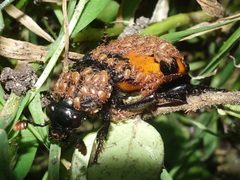
Deutonymphs are distinguished by two orange shields and, in many , a transverse band on the sternal shield. Identification keys rely on the extent of the dark band across the sternal shield, size of dorsal shields, dorsal chaetotaxy (particularly seta length), and appendices of the fixed digit of the . Females are smaller than males. The shows extensive cryptic diversity; morphological similarity masks numerous genetically distinct lineages, particularly within the P. carabi complex.
Images
Habitat
Vertebrate carcasses (carrion); transported phoretically on burying beetles. The entire mite occurs on carcasses, with deutonymphs dispersing by mounting beetles.
Distribution
Holarctic distribution. Documented from Europe (including Germany, UK, Turkey), North America (including Vermont), and Asia. Records from 43 locations worldwide based on molecular sampling.
Diet
Feed on vertebrate carrion; prey on and larvae of burying beetles (documented oophagy on Nicrophorus vespilloides and N. nepalensis); consume fly eggs and larvae; prey on .
Host Associations
- Nicrophorus vespilloides - phoretic and food sourcepreferred for P. carabi
- Nicrophorus vespillo - phoretic and food sourcepreferred for P. necrophori
- Nicrophorus nepalensis - phoretic and food sourceno detected effect on
- Silphidae (multiple genera) - phoretic transportat least eight Poecilochirus use silphid beetles for
Life Cycle
Development includes larva (three pairs of legs), , and deuteronymph; no tritonymph stage. Males guard female deutonymphs shortly before mating. Pairs mate venter-to-venter. Deutonymphs are the phoretic stage, mounting beetles between or under . Development time is synchronized with parental care duration (8–11 days for next deutonymphs to emerge). Young mites depart with parental beetles after .
Behavior
Phoretic specialization: deutonymphs actively select and mount specific , with demonstrated ability to discriminate between Nicrophorus species. Host fidelity is maintained through behavioral preferences and consequences on non-preferred hosts. Mite offspring mount parental beetles before departure. Interaction with hosts is context-dependent: under some conditions mites prey on competitors of beetles (fly , ); under others they reduce beetle fitness through egg and competition.
Ecological Role
Competitors and of burying beetles; reduces reproductive success. Potential mutualistic role through predation on carrion-feeding flies and that compete with beetles. regulator of Nicrophorus through egg mortality. participant linking carrion resources to beetle populations.
Human Relevance
Forensic significance: presence on carcasses and synchronized with makes them potential indicators for post-mortem interval estimation. Increasingly recognized as forensic markers in and acarology.
Similar Taxa
- ParasitusClosely related within Parasitidae; phylogenetic analyses suggest Poecilochirus and Parasitus may belong to same genus. Both are mesostigmatid mites associated with decomposing organic matter and .
- EuryparasitusFormerly included now placed in Poecilochirus (e.g., P. emarginatus as synonym); historical taxonomic confusion between these .
Sources and further reading
- BugGuide
- Wikipedia
- GBIF taxonomy match
- iNaturalist taxon
- NCBI Taxonomy
- Catalogue of Life
- Phoretic Poecilochirus mites specialize on their burying beetle hosts
- Complete mitochondrial genomes of two Phoretic mites (Parasitidae: Poecilochirus) on burying beetle: Genome characterization and phylogenetic analysis
- Egg Predation by Poecilochirus carabi (Mesostigmata: Parasitidae) and its Effect on Reproduction of Nicrophorus vespilloides (Coleoptera: Silphidae)
- First record of Poecilochirus necrophori (Acari: Mesostigmata: Parasitidae) from Turkey and its importance in forensic acarology
- Experimental evidence that the mite Poecilochirus davydovae (Mesostigmata: Parasitidae) eats the eggs of its beetle host
- Poecilochirus carabi: Behavioral and Life-History Adaptations to Different Hosts and the Consequences of Geographical Shifts in Host Communities
- Host range and behavioral preferences in German sibling species of the Poecilochirus carabi complex (Acari: Mesostigmata: Parasitidae)
- Morphological differences between sympatric populations of the Poecilochirus carabi complex (Acari: Mesostigmata: Parasitidae) associated with burying beetles (Silphidae: Nicrophorus)
- Competition among host-specific lineages of Poecilochirus carabi mites influences the extent of co-adaptation with their Nicrophorus vespilloides burying beetle hosts
- The dispersal behaviour of the phoretic mite Poecilochirus carabi (Mesostigmata, Parasitidae): adaptation to the breeding biology of its carrier Necrophorus vespilloides (Coleoptera, Silphidae)
- Cryptic diversity within the Poecilochirus carabi mite species complex phoretic on Nicrophorus burying beetles: phylogeny, biogeography, and host specificity
- Pairing, oviposition and development in two sibling species of phoretic mites (Acari: Mesostigmata: Parasitidae:Poecilochirusspp.) associated with burying beetles (Coleoptera: Silphidae:Nicrophorusspp.)
- Observations on a mite (Poecilochirus davydovae) predatory on the eggs of burying beetles (Nicrophorus vespilloides) with a review of its taxonomic status
- Cryptic diversity within the Poecilochirus carabi mite species complex phoretic on Nicrophorus burying beetles: Phylogeny, biogeography, and host specificity
- No Evidence That the Phoretic Mite Poecilochirus carabi Influences Mate Choice or Fitness in the Host Burying Beetle Nicrophorus nepalensis
- Competition among host-specific lineages of Poecilochirus carabi mites influences the extent of co-adaptation with their Nicrophorus vespilloides burying beetle hosts.