Nicrophorus vespilloides
Herbst, 1783
Lesser Vespillo Burying Beetle
Nicrophorus vespilloides is a burying in the Silphidae, characterized by its distinctive orange-yellow elytral bands and black . The exhibits facultative biparental care, with both parents cooperating to locate, bury, and prepare small vertebrate carcasses as food resources for their larvae. This species serves as a prominent model organism for studying social , parental care, and the evolution of complex social in insects. It has a Holarctic distribution spanning northern Eurasia and North America, with documented associations with phoretic mites and that influence its and .
Pronunciation
How to pronounce Nicrophorus vespilloides: //nɪˈkrɒfərəs vɛspɪˈlɔɪdiːz//
These audio files are automatically generated. While they are not always 100% accurate, they are a good starting point.
Identification
Distinguished from by completely black (lacking the orange club found in some related ). The squarish that are shorter than the create a distinctive profile. The two orange-yellow elytral bands are consistent but not unique to this species; antenna coloration provides more reliable separation from Nicrophorus orbicollis and other similar burying beetles. Males can be recognized by proportionally wider relative to body size. In North America, previously confused with the sister species Nicrophorus hebes, which is restricted to Sphagnum bogs and has different preferences.
Images
Appearance
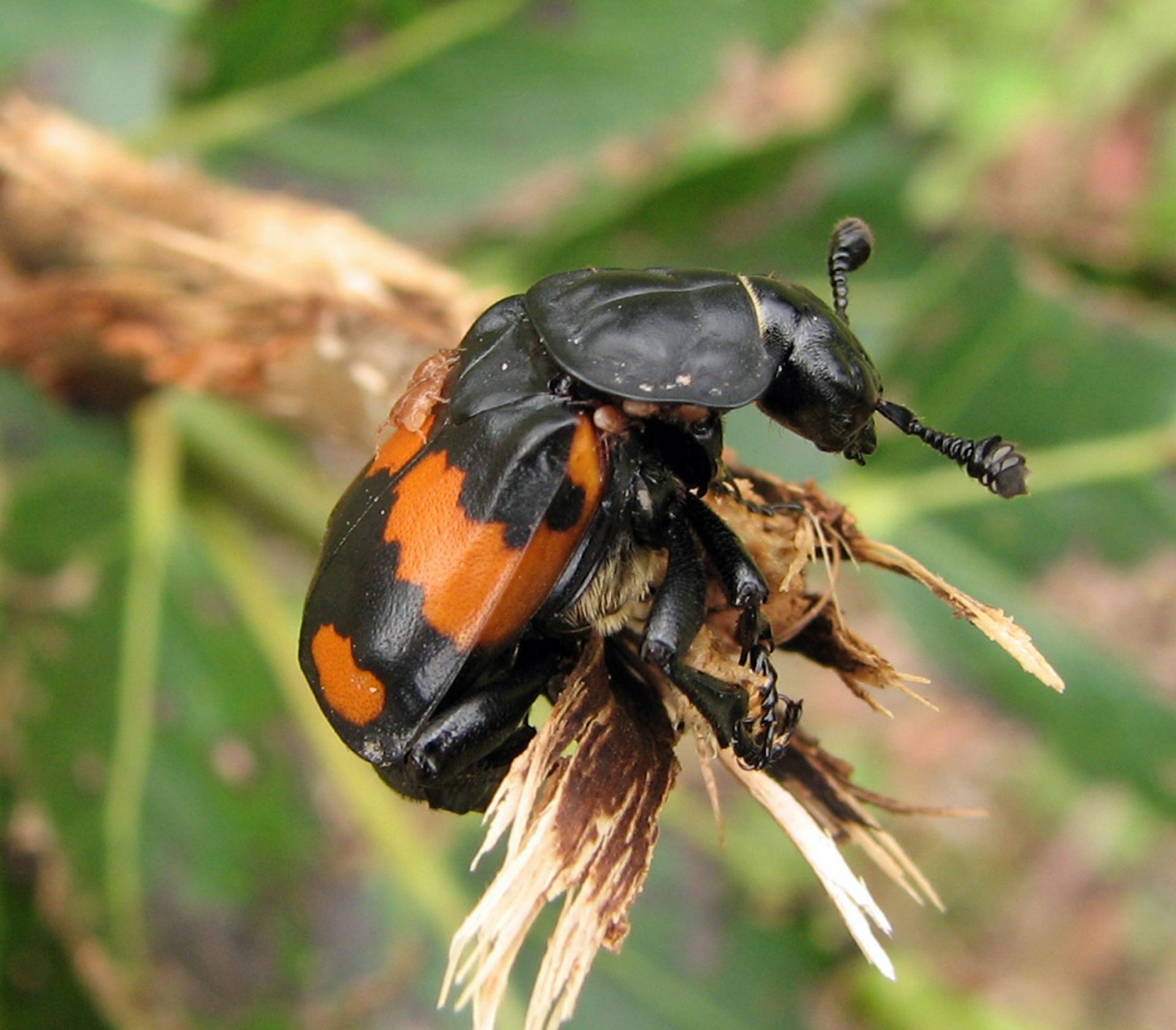
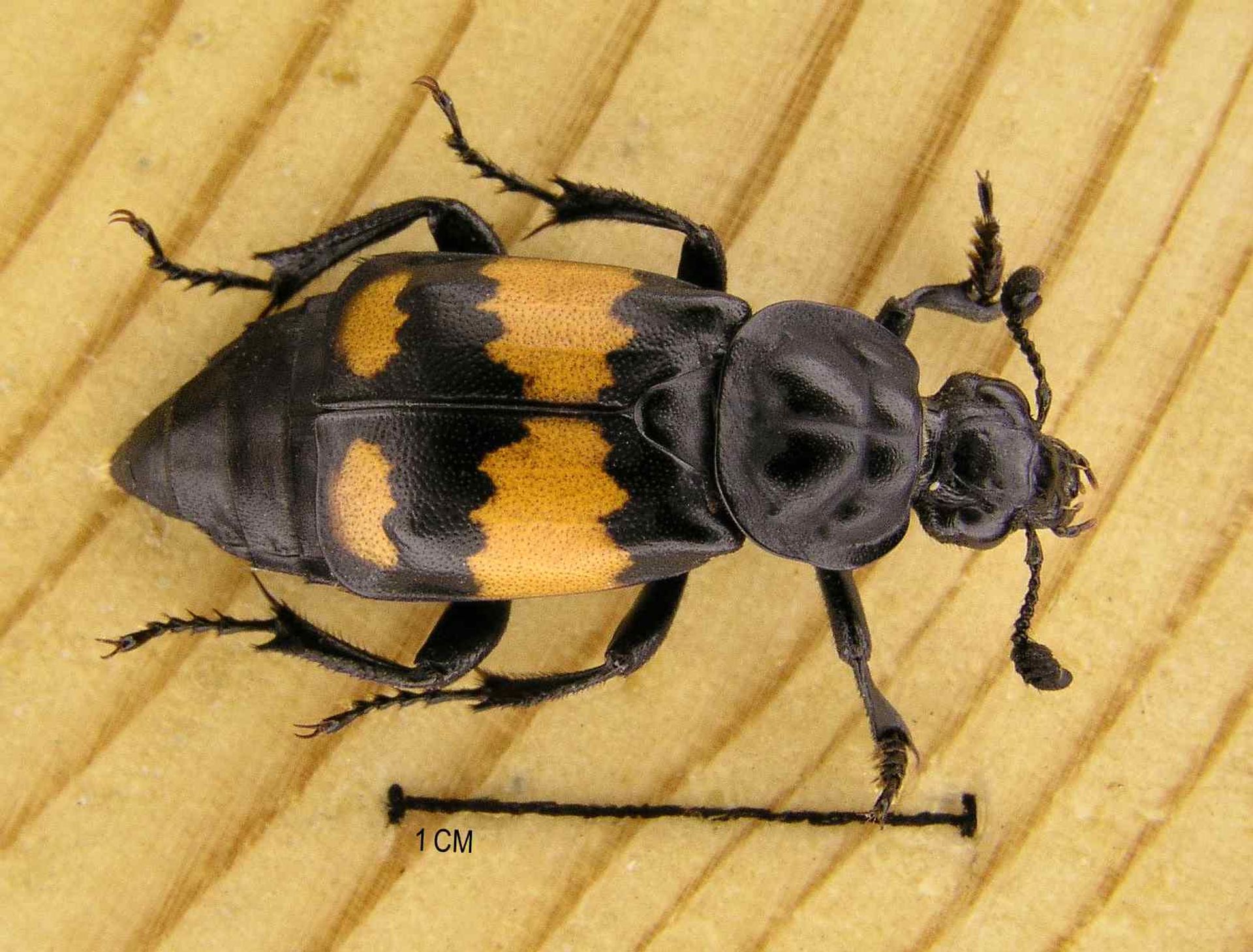
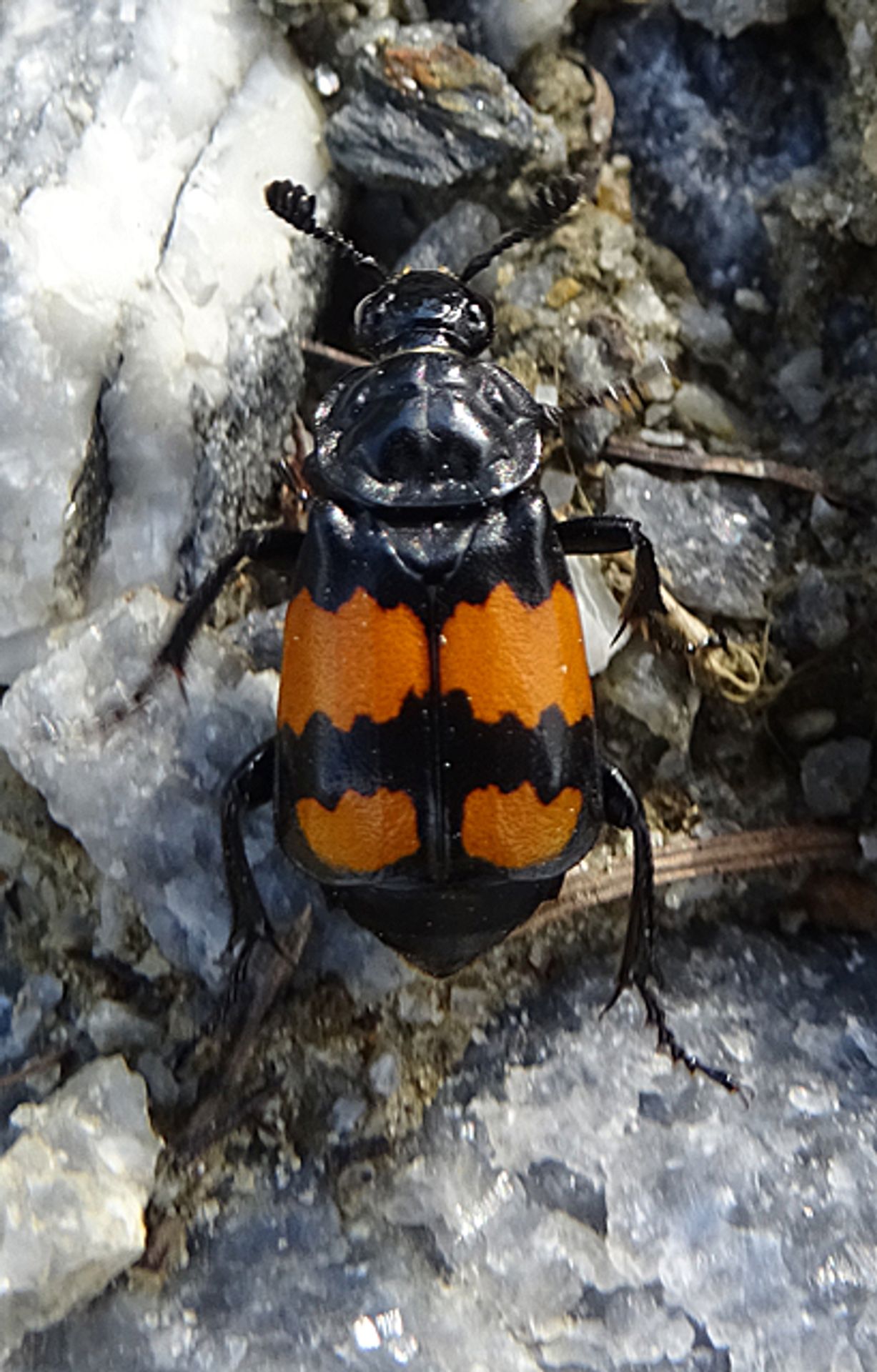
Medium-sized ranging from 12–20 mm in body length. Black body with two conspicuous orange-yellow transverse bands on the . entirely black, a key distinguishing feature from similar . Wing cases (elytra) squarish in shape and notably shorter than the , leaving abdominal segments partially exposed. in width: males exhibit wider heads than females for any given body size, with hyperallometric scaling in males versus isometric scaling in females. Overall coloration functions as aposematic warning signals to avian .
Habitat
Occupies diverse across its range. In the Palearctic: found in dense woodlands, open heathlands, parklands, gardens, lowland plains, and alpine regions up to high elevations. In the Nearctic region: more selective, primarily occurring in open forest habitats in Alaska and northwestern Canada. Shows habitat partitioning from the sister N. hebes, which is restricted to Sphagnum bogs and marshes in eastern North America. Requires access to soil suitable for burrowing to bury carcasses.
Distribution
Holarctic distribution. Palearctic: northern and central Europe including Scandinavia, across Russia (European Russia, Siberia, Far East, Kuril Islands), Turkey, Caucasus region (Georgia, Armenia, Azerbaijan), Israel, Iran, Kazakhstan, Mongolia, Japan, Korea (North and South), and China (including Sichuan). Nearctic: Alaska, northern Canada (Northwest Territories, Yukon), with records in northern United States; some historical records from other US states now attributed to the sister N. hebes.
Seasonality
activity follows a bimodal pattern with peaks in May and late summer. Active period extends from early spring (April–May) through late autumn. Activity closely tied to temperature and availability of carrion resources. activity occurs during late spring and summer, primarily for locating ephemeral carrion resources.
Diet
Specialized carrion feeder. and larvae consume small vertebrate carcasses (mice, birds, squirrels, and other small mammals). Adults locate carrion using highly sensitive olfactory detection. Larvae are fed regurgitated, liquefied meat by both parents; can also self-feed directly on the prepared carcass. Adults may practice partial filial , consuming excess offspring when carrion resources are insufficient to support the entire .
Life Cycle
laid on or near prepared, buried carcasses. Larvae hatch after a few days and navigate to the carcass, which serves as both food source and nursery. Larvae fed by parental regurgitation or self-feed on carcass tissue. Larval development completed on the carcass; from nest occurs 8–9 days after parental pairing. and approximately 16±2 days after dispersal. Sexual maturity reached 2–3 weeks post-eclosion. Adults may produce multiple per season if carrion resources permit.
Behavior
Exhibits complex biparental care including cooperative carcass location, burial, preparation (removing fur/feathers, rolling flesh into compact ball), and direct provisioning of larvae. Parents apply antimicrobial secretions and exudates to carcasses to slow decomposition and suppress competitors. Defends breeding resource against intraspecific and interspecific competitors; however, relatively weak competitor compared to larger . Communal breeding with multiple pairs occasionally tolerated on single large carcasses, though this reduces per-pair . Produces defensive anal fluid when threatened. Stridulation used in intrapair communication during carcass preparation. essential for locating unpredictable, ephemeral carrion resources.
Ecological Role
Functions as an obligate carrion that accelerates decomposition and nutrient cycling through carcass burial and consumption. Carcass preparation alters bacterial composition, reducing Proteobacteria and increasing Flavobacteriales and Clostridiales. Serves as for phoretic mites (Poecilochirus carabi, Macrocheles merderius, Pelzneria nr. crenulata, Uroobovella nr. novasimilis) and (Rhabditoides regina), forming complex symbiotic and parasitic relationships. Mite associations vary geographically and influence reproductive success. The ' reliance on small vertebrate carcasses creates localized hotspots of nutrient cycling and supports diverse microbial and communities.
Human Relevance
Used extensively as a model organism in behavioral , evolutionary , and immunology research, with over 1,000 scientific citations. Studies focus on social , parental care evolution, mating conflict, sibling competition, and genetic architecture of social . Subject of conservation concern only indirectly through preservation. No significant agricultural or economic impact; occasionally encountered by the public when attracted to carrion or rotting organic matter.
Similar Taxa
- Nicrophorus hebesSister previously confused with N. vespilloides in eastern North America; distinguished by restriction to Sphagnum bog and geographic separation, confirmed as distinct species by Sikes et al. 2016
- Nicrophorus orbicollisCo-occurs in some areas; distinguished by antennal coloration (N. orbicollis has orange antennal clubs versus entirely black in N. vespilloides)
- Nicrophorus nepalensisSister sharing similar burying and biparental care; distinguished by geographic range (Asia) and differences
- Nicrophorus americanusLarger endangered ; distinguished by larger body size, orange pronotal patch, and different geographic range
Sources and further reading
- BugGuide
- Wikipedia
- GBIF taxonomy match
- iNaturalist taxon
- NCBI Taxonomy
- Catalogue of Life
- Congratulations, UC Davis Linnaean Games Team: National Champs! | Bug Squad
- Bohart Museum Spotlight on Yellow-Bellied Burying Beetles | Bug Squad
- Research Showcases Best and Brightest Fathers of the Insect World
- literature | Beetles In The Bush | Page 5
- They eat dead things - Part I - Burying beetles Silphidae — Bug of the Week
- Oklahoma is More than OK for Burying Beetles
- Egg size, begging behaviour and offspring fitness in Nicrophorus vespilloides
- Parental effects and flight behaviour in the burying beetle, Nicrophorus vespilloides
- Biparental age effects in the burying beetle Nicrophorus vespilloides
- Cobreeding in the Burying Beetle, Nicrophorus vespilloides: Tolerance Rather Than Cooperation
- Fitness effects and transmission of phoretic nematodes of the burying beetle, Nicrophorus vespilloides
- Previous breeding success and carrion substrate together influence subsequent carrion choice by adult Nicrophorus vespilloides
- Sexual dimorphism in head size in wild burying beetles ( Nicrophorus vespilloides )
- Privatization of a breeding resource by the burying beetle Nicrophorus vespilloides is associated with shifts in bacterial communities
- Olfactory Choice for Decomposition Stage in the Burying Beetle Nicrophorus vespilloides: Preference or Aversion?
- Competition among host-specific lineages of Poecilochirus carabi mites influences the extent of co-adaptation with their Nicrophorus vespilloides burying beetle hosts
- Egg Predation by Poecilochirus carabi (Mesostigmata: Parasitidae) and its Effect on Reproduction of Nicrophorus vespilloides (Coleoptera: Silphidae)
- Fitness costs of phoretic nematodes in the burying beetle, Nicrophorus vespilloides
- Phoretic Association Between the Dauerjuveniles of Rhabditis Stammeri (Rhabditidae) and Life History Stages of the Burying Beetle Nicrophorus Vespilloides (Coleoptera: Silphidae)
- Surface Chemicals Inform about Sex and Breeding Status in the Biparental Burying Beetle Nicrophorus vespilloides