
Nicrophorus defodiens
(Mannerheim, 1846)
Boreal Burying Beetle
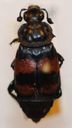
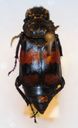
Nicrophorus defodiens is a burying first described by Mannerheim in 1846. It is one of at least two burying beetle species known to breed in the forest . The species exhibits communal breeding , where multiple male-female associations share parental care duties on larger vertebrate carcasses. It produces approximately twice as many as the related N. orbicollis, with clutch sizes averaging around 24 eggs.

Pronunciation
How to pronounce Nicrophorus defodiens: /nɪˈkrɒfərəs dɪˈfoʊdi.ɛnz/
These audio files are automatically generated. While they are not always 100% accurate, they are a good starting point.
Identification
Nicrophorus defodiens can be distinguished from the similar N. orbicollis by its larger clutch size, producing roughly twice as many (approximately 23.9 versus 12 in N. orbicollis). As with other Nicrophorus , it likely displays the characteristic black body with orange or red markings on the , though specific diagnostic color patterns for this species are not documented in the provided sources.
Images
Habitat
Found in the Mer Bleue Bog area and other forest . Has been observed breeding in the forest , one of at least two burying with this capability.
Distribution
North America: Canada (Alberta, British Columbia, Manitoba, New Brunswick, Newfoundland and Labrador, Nova Scotia, Northwest Territories, Ontario, Prince Edward Island, Quebec, Saskatchewan, Yukon Territory) and United States (Alaska, California, Colorado, Idaho, Massachusetts, Maine, Michigan, Minnesota, Montana, North Carolina, New Hampshire, New Jersey, Nevada, New York, Oregon, South Dakota, Tennessee, Vermont, Washington, Wisconsin, West Virginia, Wyoming).
Diet
Small vertebrate carcasses serve as the primary food source for larvae. feed on carrion and regurgitate liquefied food to feed their young.
Life Cycle
Breeds on small vertebrate carcasses. Females lay approximately 24 in a chamber excavated near the buried carcass. Larvae hatch and feed on the preserved carcass, receiving parental care from both male and female . Developmental timing details are not specifically documented for this .
Behavior
Males emit pheromonal signals to attract mates. During mating, females frequently bite males. After copulation, males resume emission, but females actively obstruct males from attracting additional females, effectively imposing monogamy. Exhibits communal breeding on larger carcasses, forming multiple male-female associations. In communal groups, and subordinate female hierarchies form, with subordinate females rarely observed on the carcass. Both sexes cooperate in burying carcasses, removing fur or feathers, and forming the carcass into a compact ball. apply secretions containing antimicrobial compounds and immune molecules to preserve the carcass and suppress fungal and bacterial growth.
Ecological Role
Functions as a carrion decomposer and nutrient recycler. Burying activity accelerates decomposition and returns nutrients to soil. Parental care includes investment in social through antimicrobial secretions that preserve carcasses for offspring.
Similar Taxa
- Nicrophorus orbicollisSimilar burying ; N. defodiens produces approximately twice as many (roughly 24 versus 12), providing a key reproductive distinction.
- Nicrophorus vespilloidesSympatric burying found in similar bog ; specific distinguishing features not documented in provided sources.
More Details
Taxonomic Note
placement varies across sources: GBIF and iNaturalist list Staphylinidae, while NCBI and most literature sources place it in Silphidae ( Nicrophorinae).
Social Immunity Research
Experimental studies show that communal breeding in N. defodiens does not increase per-capita social immune investment as hypothesized. While combined immune activity is higher in groups, females show lower individual investment than singly breeding females, and subordinate females contribute minimally. This suggests that communal breeding may actually decrease individual investment in carcass preservation .
Canopy Breeding
In 2012, N. defodiens was identified as one of at least two burying capable of breeding in the forest , expanding the known vertical distribution of burying beetle reproductive .
Data Quality
Many aspects of basic (detailed appearance, precise requirements, complete timing, seasonality) remain undocumented or inferred from congeneric . The 1989 master's thesis on this species appears not to have yielded accessible detailed findings in the provided abstract.
Sources and further reading
- BugGuide
- Wikipedia
- GBIF taxonomy match
- iNaturalist taxon
- NCBI Taxonomy
- Congratulations, UC Davis Linnaean Games Team: National Champs! | Bug Squad
- Bohart Museum Spotlight on Yellow-Bellied Burying Beetles | Bug Squad
- They eat dead things - Part I - Burying beetles Silphidae — Bug of the Week
- Oklahoma is More than OK for Burying Beetles
- Burying Beetles Are Part of Nature's Clean-up Crew
- Silphidae | Beetles In The Bush
- Does Communal Breeding Promote an Increase in Social Immunity in Burying Beetles? A Test Case with Nicrophorus Defodiens
- A study of the ecology and reproductive biology of the carrion beetle assemblage in the Mer Bleue Bog area with specific reference to the habitat associations of Nicrophorus Vespilloides Herbst and N. Defodiens Mannerheim (Coleoptera: Silphidae).