
Nicrophorus pustulatus
(Herschel, 1807)
Pustulated Carrion Beetle, Blistered Burying Beetle
Nicrophorus pustulatus is a North American burying beetle distinguished by its unique among . Unlike typical carrion beetles that bury small vertebrate carcasses underground, this is a that has undergone a remarkable shift to exploit snake as a primary breeding resource. It is the only described Nicrophorus species demonstrated to function as a true of vertebrates, attacking live reptile eggs. are medium-sized (14.0–22.2 mm), predominantly black with distinctive orange elytral spots, and lack the long setae characteristic of related species. The species exhibits flexible social mating systems and facultative parental care.
Pronunciation
How to pronounce Nicrophorus pustulatus: /nɪˈkrɒfərəs ˌpʌstjʊˈleɪtəs/
These audio files are automatically generated. While they are not always 100% accurate, they are a good starting point.
Identification
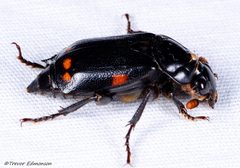
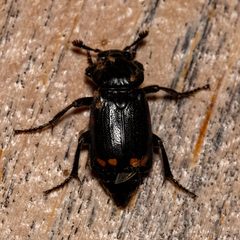
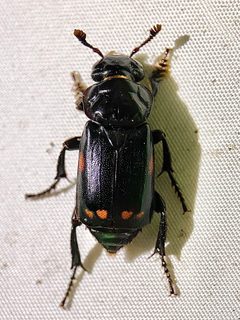
Distinguished from other Nicrophorus by: (1) absence of long setae on ; (2) oval rather than circular pronotum; (3) specific orange spot pattern on elytra (one lateral, two per elytron); (4) entirely black epipleuron; (5) sparse pattern. trapping methods are more effective than ground pitfall traps for detection.
Images
Habitat
Temperate forest in mature deciduous and mixed forests; occurs in urban, suburban, and rural forest settings. Ground-level carrion traps are largely ineffective; are captured primarily in above-ground canopy traps baited with raw chicken or fish.
Distribution
Native to North America east of the Rocky Mountains. Canada: Alberta, Saskatchewan, Manitoba, Ontario, Quebec, New Brunswick, Nova Scotia, Prince Edward Island, and Nunavut (Akimiski Island). Northernmost records from Marten Falls, Ontario. United States: from North Dakota south to Florida and eastern Texas. Not known to occur outside North America.
Seasonality
Reproductively active from late April to May or June in Ontario. emerge in late July or early August. Highest adult abundance coincides with breeding periods of small birds and mammals in the .
Diet
and larvae are necrophagous. Adults consume carrion, Diptera larvae, competitor larvae, , and decaying fungi. Larvae feed on pre-digested carrion or other food provided by parents. Uniquely among Nicrophorus, wild have been observed breeding primarily on snake (Pantherophis spiloides, Diadophis punctatus edwardsii, P. vulpinus) and occasionally turtle eggs; laboratory studies confirm successful on mouse carcasses, rat carcasses, and fish.
Host Associations
- Pantherophis spiloides - Primary in wild; gray ratsnake targeted in communal nests
- Diadophis punctatus edwardsii - Northern ringneck snake ; individual observations
- Pantherophis vulpinus - Foxsnake ; individual observations
- Tachycineta bicolor - Observed burying live nestlings in nest box; aberrant
- Aegolius acadicus - commensalFound in failed owl nests; potential food or breeding site association
- Nicrophorus orbicollis - competitorSubordinate in ; subject to by N. pustulatus
- Poecilochirus - phoretic Monospecific mite ; mutualistic/commensal
Life Cycle
Holometabolous with six stages: , three larval instars, pupa, . Female oviposits 36–72 hours after locating food; eggs hatch in approximately 3 days. First instar feeds ~12 hours, to second instar (~24 hours), then third instar (5–15 days). Third instars disperse, wander several days, then pupate for 3–4 weeks. Adults emerge sexually mature within 1 month. Overwinters as adult.
Behavior
; frequently observed at lights. Exhibits highly developed facultative bi-parental or uni-parental care including pre-hatching resource preparation and post-hatching regurgitative feeding. Parents manage size through control or larval culling. Capable of facultative brood on . Stridulates using abdominal ridge against for intraspecific communication. Competitive dominance determined primarily by body size; subordinate to larger N. orbicollis in direct contests. Does not bury snake eggs when utilizing them, unlike carrion-burying observed in laboratory settings.
Ecological Role
Decomposer contributing to nutrient cycling through carrion consumption. Unique of reptiles, potentially impacting snake (documented destruction of up to 100% of in targeted nests). Facultative of other Nicrophorus . to mutualistic phoretic mites that reduce competitor larvae. Spatial partitioning as may reduce .
Human Relevance
Subject of extensive research on behavioral , parental care evolution, and shifts. Potential forensic indicator for post-mortem interval estimation on large vertebrate carcasses. Not an agricultural pest or . Conservation concern as threat to endangered/threatened snake (particularly Pantherophis spiloides in Canada).
Similar Taxa
- Nicrophorus orbicollisOverlapping range and ; larger body size; behaviorally in competitive interactions; circular pronotum; has long elytral setae
- Nicrophorus tomentosusSimilar elytral coloration pattern; ground-dwelling ; not ; does not parasitize reptile
- Nicrophorus americanusLarger size (up to 35 mm); critically endangered; distinct orange pronotal patch; ground
- Nicrophorus hispaniolaSister in molecular ; restricted to Caribbean (Hispaniola); distribution
More Details
Antimicrobial Secretions
Unlike other Nicrophorus , N. pustulatus oral and anal secretions lack antimicrobial properties. This may correlate with evolution of and snake , as grave-soil microbes associated with buried carcasses are absent from reptile egg nests.
Genetic Resources
barcodes available on BOLD System (COI 5' locus); nuclear and mitochondrial sequences on GenBank (COI, COII, CAD, 28S rRNA). No reference available; related N. vespilloides, N. orbicollis, and N. investigator have sequenced genomes (192–202 Mb).
Conservation Status
Globally ranked Secure by NatureServe; no IUCN Red List status. Not federally listed in USA or Canada. Relevant to conservation as biological threat to COSEWIC-listed Threatened/Endangered snake .
Sources and further reading
- BugGuide
- Wikipedia
- GBIF taxonomy match
- iNaturalist taxon
- NCBI Taxonomy
- Congratulations, UC Davis Linnaean Games Team: National Champs! | Bug Squad
- Bohart Museum Spotlight on Yellow-Bellied Burying Beetles | Bug Squad
- Burying Beetles Are Part of Nature's Clean-up Crew
- They eat dead things - Part I - Burying beetles Silphidae — Bug of the Week
- Oklahoma is More than OK for Burying Beetles
- Silphidae | Beetles In The Bush
- Peer Review #1 of "Behavioral dominance interactions between two species of burying beetles (Nicrophorus orbicollis and Nicrophorus pustulatus) (v0.2)"
- Peer Review #1 of "Behavioral dominance interactions between two species of burying beetles (Nicrophorus orbicollis and Nicrophorus pustulatus) (v0.1)"
- Peer Review #2 of "Behavioral dominance interactions between two species of burying beetles (Nicrophorus orbicollis and Nicrophorus pustulatus) (v0.1)"
- Behavioral dominance interactions between two species of burying beetles ( Nicrophorus orbicollis and Nicrophorus pustulatus )
- Host shift by the burying beetle,Nicrophorus pustulatus, a parasitoid of snake eggs
- Effect of food source availability in the salivary gland transcriptome of the unique burying beetle Nicrophorus pustulatus (Coleoptera: Silphidae)
- Relative Abundance of Nicrophorus Pustulatus (Coleoptera: Silphidae) in a Burying Beetle Community, With Notes on its Reproductive Behavior
- A case of a Pustulated Carrion Beetle (<i>Nicrophorus pustulatus</i>, Coleoptera: Silphidae) burying live Tree Swallow (<i>Tachycineta bicolor</i>, Passeriformes: Hirundinidae) nestlings under the nest