
Eleodes gigantea
Mannerheim, 1843
desert stink beetle, darkling beetle
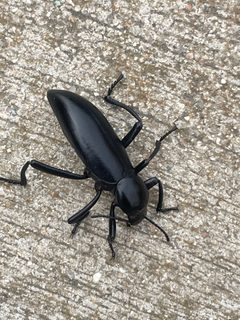
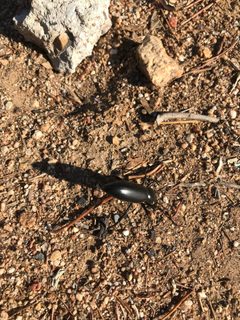
Eleodes gigantea is a large darkling in the Tenebrionidae, commonly known as the desert stink beetle. It is distributed along the Pacific coast of North America from central California to Baja California, Mexico. When threatened, it exhibits the characteristic defensive of the Eleodes: raising its body and secreting benzoquinone compounds from abdominal glands. The E. gigantea meridionalis has been documented in Pleistocene deposits at the La Brea Tar Pits.
Pronunciation
How to pronounce Eleodes gigantea: //ɛˈliːədiːz dʒaɪˈɡæntiə//
These audio files are automatically generated. While they are not always 100% accurate, they are a good starting point.
Identification
Distinguished from other Eleodes by its large size and smooth black . The geographic range along the California coast provides additional context for identification. The defensive posture—raising the and secreting orange benzoquinone—is characteristic of the but not unique to this species. May be confused with other large black Eleodes, but the combination of smooth elytra and coastal California distribution helps differentiate it.
Images
Appearance
Large-bodied with smooth, shiny black . The body is robust and elongated, consistent with the Eleodes. Some individuals may show subtle surface sculpturing. The overall size is notably large relative to other Eleodes in the same region.
Habitat
Coastal and inland desert environments of California and Baja California. Associated with arid and semi-arid conditions typical of the region. Specific microhabitat preferences within these zones are not documented.
Distribution
Pacific coastal region from San Francisco, California south to Tijuana, Mexico. More frequently encountered in the southern half of California from Santa Cruz to San Diego. Records from Mexico (MX) confirmed in distribution databases.
Seasonality
Most active during sundown, indicating or activity patterns.
Life Cycle
E. gigantea meridionalis has been found in La Brea Tar Pits deposits, indicating long-term presence in the region extending back to the Pleistocene. Specific developmental stages and duration not documented.
Behavior
When frightened, raises its body in a headstand posture and secretes benzoquinone from abdominal glands. The orange secretion has a strong odor and causes irritation in humans. This defensive is shared with other Eleodes .
Human Relevance
The defensive secretion causes watering and has a strong odor, serving as a deterrent to handling. No other documented human interactions.
Similar Taxa
- Eleodes suturalisSimilar large size and black coloration with possible reddish markings; distinguished by sharply carinate and explanate pronotum in E. suturalis, which has a Great Plains distribution rather than coastal California
- Eleodes hispilabrisSimilar size and coloration; distinguished by subtle morphological differences and different geographic range
- Eleodes acutaSimilar appearance including possible reddish sutural stripe; distinguished by rounded lateral pronotal borders versus upturned borders in E. suturalis, and larger average size
More Details
Fossil record
The E. gigantea meridionalis has been recovered from the La Brea Tar Pits, with some of the earliest reports of the dating to 1918.