
Eleodes acuta
(Say, 1824)
desert stink beetle
Eleodes acuta is a large desert stink beetle in the Tenebrionidae. It is closely related to and frequently confused with E. suturalis, with which it shares similar size, coloration, and preferences. The occurs in the Great Plains and southwestern United States, including areas of South Dakota and New Mexico. It is primarily and exhibits the defensive -stand characteristic of the Eleodes.
Pronunciation
How to pronounce Eleodes acuta: //ɪˈloʊ.diːz əˈkjuː.tə//
These audio files are automatically generated. While they are not always 100% accurate, they are a good starting point.
Identification
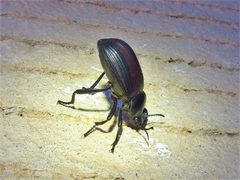
Distinguished from the similar E. suturalis by the rounded (not upturned) lateral borders of the pronotum. Averages larger in size than E. suturalis. Both share the reddish-brown sutural stripe and occur sympatrically, requiring close examination of pronotal margin shape for accurate identification. The flattened and broadly explanate pronotum are key structural features.
Images
Appearance
Large darkling beetle, averaging approximately 30 mm in length. Body predominantly black with a distinct reddish-brown sutural stripe running along the elytral . Pronotum broadly explanate (spread outward flatly) with rounded lateral borders. sharply laterally carinate (keeled along the sides) and distinctly flattened. Similar in general coloration to E. suturalis but separable by pronotal shape.
Habitat
Mixed-grass prairie and desert grassland environments. Found in sandy substrates including the White Sands region of New Mexico. Nocturnally active in open terrain.
Distribution
Great Plains region of North America, including southwestern South Dakota and New Mexico. Distribution largely overlaps with that of E. suturalis.
Behavior
Nocturnally active. Exhibits defensive -stand posture characteristic of Eleodes, in which the raises its and releases defensive secretions when disturbed.
Similar Taxa
- Eleodes suturalisNearly identical in coloration including the reddish-brown sutural stripe, size, and preference. Separated by rounded vs. upturned pronotal lateral borders and slightly larger average size in E. acuta. Both occur sympatrically in the Great Plains.
- Eleodes hispilabrisSimilar size, shape, and coloration with potential for reddish-brown sutural stripe. Distinguished by structural details of pronotum and ; historically confused due to superficial similarity.
More Details
Taxonomic confusion
E. acuta has been frequently misidentified or overlooked due to its close similarity to E. suturalis. Accurate identification requires examination of pronotal margin shape rather than reliance on color pattern alone.
Mimetic associations
The Eleodes, including E. acuta and E. suturalis, has been suggested to exhibit mimetic associations with tiger beetles such as Amblycheila cylindriformis due to shared size, shape, and coloration patterns.