
Eleodes hispilabris
(Say, 1824)
Rough-lipped Darkling Beetle, desert stink beetle
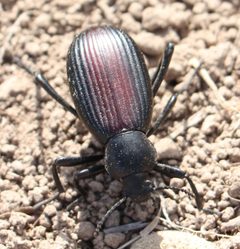
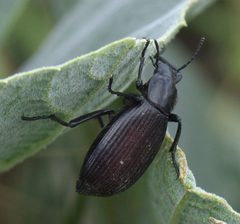
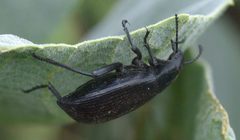
Eleodes hispilabris is a darkling beetle (Tenebrionidae) native to North America, where it occurs in arid and semi-arid regions including the Great Plains. It is closely related to and frequently confused with Eleodes suturalis, sharing similar size, coloration, and a reddish-brown sutural stripe on the . The exhibits -dependent selection and performs the characteristic defensive ' stand' typical of the Eleodes.
Pronunciation
How to pronounce Eleodes hispilabris: /ɛˈliːoʊdiːz hɪˌspɪˈlæbrɪs/
These audio files are automatically generated. While they are not always 100% accurate, they are a good starting point.
Identification
Eleodes hispilabris can be distinguished from the similar and sympatric Eleodes suturalis by its flattened that lack sharp lateral carinae, and by its pronotum which is not broadly explanate. Both may display a reddish-brown sutural stripe, making this trait unreliable for separation. E. suturalis has distinctly laterally carinate elytra and a broadly explanate pronotum. E. acuta, which also occurs in the same region and shares the reddish sutural stripe, averages larger (around 30 mm vs. under 26 mm for E. suturalis) and has rounded rather than upturned lateral pronotal borders.
Images
Habitat
Arid and semi-arid environments including mixed-grass prairie and desert regions. Exhibits -dependent selection: at fine scales, selects microhabitats based on vegetation structure and soil characteristics; at larger scales, responds to broader landscape features. Distribution in the Rattlesnake Hills has been documented in relation to elevation and temperature gradients.
Distribution
North America: occurs in the Great Plains region including Oklahoma, Kansas, South Dakota, and extends into New Mexico. Also recorded from Mexico.
Seasonality
have been observed active in July; specific seasonal patterns otherwise not documented.
Behavior
Performs the defensive ' stand' characteristic of Eleodes, in which the raises its and supports itself on its head when disturbed. Exhibits -dependent selection, responding to vegetation and soil characteristics at fine spatial scales and to broader landscape features at larger scales.
Human Relevance
Subject of ecological research on selection and elevational distribution. Occasionally collected by entomologists; can be confused with other Eleodes of interest such as E. suturalis.
Similar Taxa
- Eleodes suturalisShares similar size, black coloration with reddish-brown sutural stripe, and occurs sympatrically in the Great Plains. Distinguished by sharply laterally carinate and broadly explanate pronotum.
- Eleodes acutaAlso shares reddish sutural stripe and similar distribution. Distinguished by larger average size (around 30 mm vs. smaller E. suturalis and E. hispilabris) and rounded (not upturned) lateral pronotal borders.
- Amblycheila cylindriformisA tiger that may exhibit mimetic association with Eleodes suturalis due to similarity in size, shape, and coloration; E. hispilabris has been mistaken for E. suturalis in this context.
More Details
Taxonomic confusion
This has been frequently misidentified as E. suturalis due to shared coloration including the reddish-brown sutural stripe. Reliable identification requires examination of elytral carination and pronotal shape rather than color pattern alone.
Research significance
Has been studied for -dependent selection and for distributional patterns in relation to elevation and temperature, making it a model organism for understanding responses to environmental gradients.
Sources and further reading
- BugGuide
- Wikipedia
- GBIF taxonomy match
- iNaturalist taxon
- NCBI Taxonomy
- The real Eleodes suturalis… | Beetles In The Bush
- Scale-dependent Habitat Selection by the Darkling Beetle Eleodes hispilabris (Coleoptera: Tenebrionidae)
- Observations on the Distribution of Eleodes hispilabris (Say) (Coleoptera: Tenebrionidae) in Relation to Elevation and Temperature in the Rattlesnake Hills