
Amblycheila cylindriformis
(Say, 1823)
Great Plains Giant Tiger Beetle
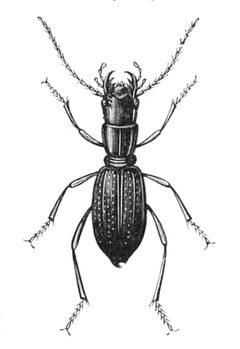
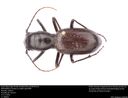
Amblycheila cylindriformis is a flightless tiger native to the Great Plains of North America. It is the largest tiger beetle in North America, with reaching 25–38 mm in length. The species is strictly and inhabits grassland environments, where adults walk on bare ground and larvae construct deep burrows in specific soil types.
Pronunciation
How to pronounce Amblycheila cylindriformis: //ˌæm.blɪˈkaɪ.lə ˌsɪ.lɪnˈdrɪ.fɔːr.mɪs//
These audio files are automatically generated. While they are not always 100% accurate, they are a good starting point.
Identification
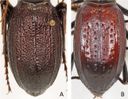
are distinguished from all other North American tiger beetles by their combination of enormous size (25–38 mm), cylindrical body shape, somber black coloration, small , and strictly activity. Flightlessness separates them from most other tiger beetles. Larvae are identified by their exceptional size (up to 62 mm), two pairs of eyes with the pair larger, and the diagnostic hook arrangement on the 5th abdominal segment: simple thorn-like hooks with middle and inner hooks distinctly separated at the base, surrounded by stout setae. Burrows are large (6–8 mm diameter), almost perfectly round with clean beveled edges, slightly D-shaped to match the larval profile, and often clustered in proximity.
Images
Habitat
Native mixed-grass prairie and grassland areas of the Great Plains. are found on bare ground, particularly on red clay/gypsum exposures on lower talus slopes. Larvae construct burrows in specific soil types including Colby silt loam, with preference for areas with particular slope profiles. Suitable microhabitats include barren soil patches amongst vegetation, clay banks near streams, ravines, and vertical clay bluff .
Distribution
Great Plains of central North America. Documented from Texas north to far-southwestern South Dakota (the northernmost limit), including Oklahoma, Kansas, and Nebraska.
Seasonality
are active during summer months, with peak activity in June and July. The is strictly , with adults emerging after dark (observed activity beginning around 9 pm).
Life Cycle
Development includes , larval (three instars), pupal, and stages. Larval development is prolonged; one individual collected as a 2nd instar larva took over 3 years to reach adulthood, with the pupal stage occurring in a plugged burrow. Larval burrows extend to depths of a meter or more. Adults construct burrows in clay soil with ragged openings, unlike the perfectly-shaped larval burrows, and spend much time in these burrows.
Behavior
Strictly ; walk with a lumbering, deliberate gait distinct from the rapid, jerky movement of most tiger beetles, lifting each foot relatively high. Adults are not fast runners and do not pause frequently, making them difficult to photograph in the field. Larvae are sit-and-wait that anchor themselves in burrows using abdominal hooks. Adults can be collected in pitfall traps.
Ecological Role
Larvae function as subterranean in grassland soil . Their deep burrowing activity likely contributes to soil aeration and nutrient cycling in prairie .
Human Relevance
Collected by entomologists for study and curation; the represents a notable target for collectors due to its size and restricted distribution. are reportedly easy to handle but possess large capable of delivering a painful bite.
Similar Taxa
- Amblycheila hoversoniAlso a giant flightless tiger of the same ; slightly larger, making it the largest tiger beetle in the Western Hemisphere. Restricted to South Texas, separating it geographically from A. cylindriformis.
- Tetracha speciesLarvae share two pairs of hooks on the 5th abdominal segment, but Tetracha hooks touch at the base rather than being distinctly separated, and lack the cluster of stout setae around the hook base present in Amblycheila.
- Cicindela (sensu lato) speciesMost tiger beetles are , fast-running, and capable of ; of A. cylindriformis are immediately distinguished by habits, flightlessness, enormous size, and lumbering gait.
Sources and further reading
- BugGuide
- Wikipedia
- GBIF taxonomy match
- iNaturalist taxon
- NCBI Taxonomy
- Catalogue of Life
- How to collect larvae of Amblycheila cylindriformis | Beetles In The Bush
- Hunting the Great Plains giant tiger beetle | Beetles In The Bush
- The Power of Impulse | Beetles In The Bush
- Microhabitat Preference of Great Plains Giant Tiger Beetle Larvae,Amblycheila cylindriformisSay (Coleoptera: Carabidae: Cicindelinae), is Influenced by Soil Slope Profile