
Eleodes suturalis
(Say, 1824)
Red-backed Darkling Beetle
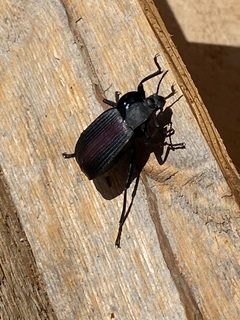
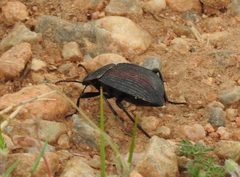
Eleodes suturalis, commonly known as the red-backed darkling beetle, is a large, flightless darkling beetle to the Great Plains of North America. It is distinguished by a prominent reddish-brown stripe running along the of its distinctly flattened . The exhibits the characteristic defensive headstand of the Eleodes, raising its and secreting a foul-smelling liquid when threatened. It is among the most conspicuously abundant darkling beetles in its range and has been proposed as a visual mimic of the Great Plains giant tiger beetle (Amblycheila cylindriformis).
Pronunciation
How to pronounce Eleodes suturalis: /ɛˈlɛ.əˌdiːz suːˈtʊr.əlɪs/
These audio files are automatically generated. While they are not always 100% accurate, they are a good starting point.
Identification
The combination of sharply laterally carinate and broadly explanate pronotum distinguishes E. suturalis from all other Great Plains Eleodes . The reddish-brown sutural stripe on flattened elytra is characteristic but not exclusive—occasionally present in E. hispilabris and other species. E. acuta, which shares the red stripe and similar distribution, has rounded rather than upturned lateral pronotal borders and averages larger (around 30 mm vs. mostly under 26 mm for E. suturalis).
Images
Appearance
Large, robust darkling beetle with a distinctly flattened body profile. are predominantly black with a prominent reddish-brown to orange stripe running longitudinally along the elytral . Males measure 25–36 mm in length; females are slightly smaller at 21.5–33.5 mm. The are sharply laterally carinate (keeled along the sides) and the pronotum is broadly explanate, spreading outward flatly. These features create a somewhat angular, shield-like silhouette when viewed dorsally.
Habitat
Mixed-grass prairie and open grassland . Often encountered crossing roads at night in large numbers. Found in areas with sandy or loamy soils suitable for burrowing.
Distribution
to the Great Plains of North America. Range extends from South Dakota south to Texas, west to southwestern Wyoming, Colorado, New Mexico, and extreme southeastern Arizona. Distribution likely extends into adjacent northern Mexico, though this is less documented. Not known west of the Rocky Mountains.
Diet
Herbivorous. Both larvae and feed on seeds of various plants.
Behavior
Nocturnally active. When threatened, performs a defensive headstand by raising the into the air and secreting a foul-smelling liquid from abdominal glands—a characteristic of the Eleodes. are frequently observed crossing highways in large at night.
Human Relevance
Occasionally a nuisance when large numbers cross roads at night. Has been proposed as a model for , with the Great Plains giant tiger beetle (Amblycheila cylindriformis) potentially mimicking its aposematic coloration.
Similar Taxa
- Eleodes hispilabrisShares reddish-brown sutural stripe and similar size/coloration; distinguished by less sharply carinate and less explanate pronotum
- Eleodes acutaShares red stripe and overlapping distribution; distinguished by rounded (not upturned) lateral pronotal borders and larger average size
- Amblycheila cylindriformisNot a , but convergent in size, shape, and coloration (black with reddish stripe); proposed as a visual mimic of E. suturalis
Misconceptions
The reddish sutural stripe, while distinctive, is not diagnostic for E. suturalis alone—several other Eleodes occasionally exhibit this trait, leading to potential misidentification of E. hispilabris and others as E. suturalis.
More Details
Mimicry association
Wrigley (2008) proposed a mimetic association between E. suturalis and Amblycheila cylindriformis, suggesting the tiger may gain protection by resembling the chemically defended darkling beetle. This hypothesis remains to be rigorously tested.
Photographic documentation challenges
The ' dark coloration and small make photographic documentation difficult, as capturing true black tones while preserving surface sculpturing and form requires careful lighting technique.