
Nyctoporis carinata
LeConte, 1851
armored night-walker, flightless darkling beetle
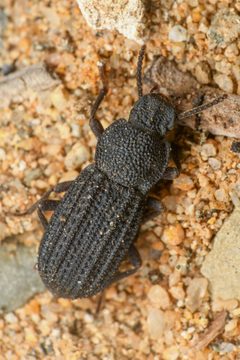
Nyctoporis carinata is a flightless darkling to California, found in leaf litter and rocky debris along the coast and Coast Ranges. measure 12–16 mm and are characterized by , non-functional wing covers () that render them permanently flightless. The exhibits a heavily sculptured with indentations, bumps, and ridges. Preliminary genetic analysis suggests possible conspecificity with Nyctoporis vandykei.
Pronunciation
How to pronounce Nyctoporis carinata: /nɪkˈtoʊpɔːrɪs kɑːrɪˈneɪtə/
These audio files are automatically generated. While they are not always 100% accurate, they are a good starting point.
Identification
Distinguished from other darkling beetles by the combination of: (1) permanently flightless condition due to with no visible wing , (2) heavily carinate (ridged) and punctate surface, and (3) presence of golden hairs on the . Similar to Nyctoporis vandykei, from which it may not be reliably separable without genetic analysis; the two are potentially synonymous.
Images
Appearance
are black, 12–16 mm in length, with a heavily sculptured featuring indentations, bumps, and ridges. Golden hairs are present on the (feet). The are along the midline, completely covering the and preventing any wing exposure. Both sexes lack functional wings.
Habitat
Found in leaf litter and rocky debris in coastal and near-coastal environments. Occupies moist, sheltered microhabitats under cover objects in woodland and scrubland settings.
Distribution
to California, USA. Range extends along the California coast and into the Coast Ranges from central to southern California.
Behavior
activity pattern implied by , though specific behavioral observations are not documented. Flightlessness restricts to .
Ecological Role
Contributes to decomposition as a in leaf litter . Serves as prey for various in forest floor .
Human Relevance
Of no known economic importance. Occasionally encountered by naturalists and entomologists in field surveys. Not a pest .
Similar Taxa
- Nyctoporis vandykeiPreliminary genetic analysis suggests the two may be synonymous ; morphological distinctions, if any, are unclear
- Other TenebrionidaeDistinguished by the combination of , ridged , and California coastal distribution
More Details
Taxonomic Uncertainty
Preliminary genetic analysis suggests Nyctoporis carinata and Nyctoporis vandykei may represent a single , though this remains to be confirmed with comprehensive study.
Flightlessness
The complete fusion of and absence of wings in both sexes represents a derived, irreversible condition that limits and likely influences structure.