
Xylosandrus compactus
Wood & Bright, 1992
black twig borer, black coffee borer, black coffee twig borer, tea stem borer
Xylosandrus compactus is a highly ambrosia beetle (Scolytinae) native to subtropical Asia. Females tunnel into twigs of living woody plants, cultivate symbiotic fungi as larval food, and reproduce through arrhenotokous . The has spread to over 50 countries, becoming a significant agricultural pest of coffee, tea, cocoa, and avocado, and threatening native forest in invaded regions.
Pronunciation
How to pronounce Xylosandrus compactus: //zaɪloʊˈsændrəs kəmˈpæktəs//
These audio files are automatically generated. While they are not always 100% accurate, they are a good starting point.
Identification
Distinguished from other Xylosandrus by the combination of small size (approximately 2 mm), dark coloration, six to eight pronotal serrations in females, and obliquely truncated antennal club. Xylosandrus germanus (black stem borer) is larger and attacks larger diameter branches. Xylosandrus crassiusculus (granulate ambrosia beetle) has granulate elytral declivity. Entry holes on twigs approximately 0.8–1.0 mm diameter, often with associated wilting or dieback of foliage. Molecular identification via COI barcode sequencing confirms species identity.
Images
Appearance
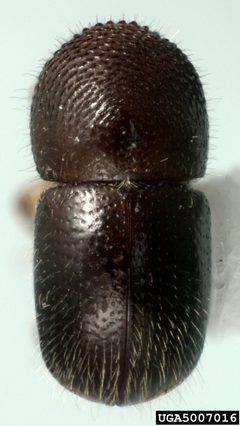
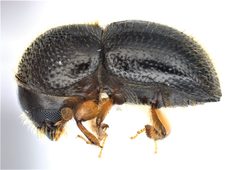
female dark brown to black, approximately 2 mm long and 1 mm wide, with convex bearing indistinct transverse groove above mouthparts. with five-segmented funicle and obliquely truncated club slightly longer than wide. Pronotum rounded with six to eight serrations on margin. convex, grooved, with fine punctations and setae between grooves. Adult male smaller, wingless, with unserrated pronotum. smooth, white, ovoid, approximately 0.5 mm. Larvae creamy white with brownish heads, apodous. Pupae cream-colored, exarate.
Habitat
Tropical and subtropical broad-leaved forests, agricultural plantations, urban parks, and tree nurseries. In natural forests, occurs at low densities without significant damage; becomes problematic in plantations and nurseries. Thrives in shaded environments with high humidity. In invaded temperate regions, established in urban green spaces with suitable plants.
Distribution
Native to subtropical eastern Asia. Established throughout tropical Africa (Madagascar to West Africa), South and Southeast Asia (India, Sri Lanka, Thailand, Vietnam, Malaysia, Indonesia, Philippines, China, Japan), and Pacific islands. Introduced to United States (1941, Florida; 1961, Hawaii), Brazil, Cuba, and Caribbean islands. In Europe, first detected Italy 2011, subsequently France 2015, Spain 2019, Greece 2019, Croatia, and expanding. In Australia, detected Perth 2025.
Seasonality
In Florida, complete in approximately 28 days; continuous breeding with overlapping in tropical climates. Peak activity and in late summer and autumn in Mediterranean regions; minimal activity in winter. In temperate invaded areas, activity constrained by winter temperatures.
Diet
and larvae feed on symbiotic fungi cultivated within xylem tunnels, primarily Ambrosiella xylebori and Fusarium . Fungi colonize xylem tissue and serve as sole nutritional source; beetles do not consume wood directly.
Host Associations
- Coffea spp. - major agricultural coffee
- Camellia sinensis - major agricultural tea
- Theobroma cacao - major agricultural cocoa
- Persea americana - major agricultural avocado
- Laurus nobilis - ornamental and native laurel, common in Mediterranean invasions
- Quercus ilex - native in Europeholm oak
- Swietenia macrophylla - mahogany
- Alectryon macrococcus - endangered native Hawaii
- Colubrina oppositifolia - endangered native Hawaii
- Caesalpinia kavaiensis - endangered native Hawaii
- Flueggea neowawraea - endangered native Hawaii
- Cercis siliquastrum - Judas tree, high levels in Israel
Life Cycle
Female excavates tunnel into twig, introduces fungal , and lays . Larvae develop through feeding on cultivated fungi within gallery system. occurs in tunnels. Newly emerged females remain in natal gallery approximately 8 days, mate with siblings, then disperse to establish new galleries. Males develop from unfertilized eggs (), remain in gallery, and mate with sisters. time approximately 28 days under favorable conditions.
Behavior
Females are the dispersing sex, flying to new and initiating galleries on undersides of branches. and larvae engage in fungus farming: females transport fungal in mycangia (specialized internal structures) and cultivate fungi on gallery walls. Stressed hosts release ethanol, which has been observed to attract beetles. Native European ants have been observed to reduce success and reproductive output through interference.
Ecological Role
As a xylomycetophagous ambrosia beetle, functions as a fungal and facilitator of xylem by symbiotic fungi. In native ranges, likely a minor component of forest dynamics. In invaded regions, acts as a destructive pest causing twig dieback, seedling mortality, and tree death, particularly threatening rare with no coevolutionary history. Disruption of fungal by competing microorganisms has been proposed as a potential regulatory mechanism.
Human Relevance
Major agricultural pest causing economic losses in coffee, tea, cocoa, and avocado production. Threatens ornamental horticulture and urban forestry. concern for international plant trade; spread facilitated by movement of nursery stock and wood products. Management efforts include pruning infested material, applications against symbiotic fungi, and trunk injections, though field efficacy of these methods has shown limited success. using bassiana has been tested with unclear results.
Similar Taxa
- Xylosandrus germanusLarger (2.5–3.5 mm) attacking larger diameter branches and stems; known as black stem borer rather than
- Xylosandrus crassiusculusGranulate ambrosia beetle with distinctly granulate elytral declivity; similar size but different elytral
- Xyleborinus saxeseniiFruit-tree pinhole borer, similar gallery habits but different antennal club and pronotal structure
Misconceptions
Despite suggesting primary wood-boring habit, X. compactus does not consume wood; nutritional dependence on cultivated fungi makes it a fungus-farming rather than a true wood borer. declines observed in some invaded regions (e.g., Israel 2024–2025) are not fully explained by resistance, natural enemies, or , challenging assumptions about predictable invasion dynamics.
More Details
Fungal symbionts
Primary mutualists include Ambrosiella xylebori and Fusarium ; additional associated fungi include Thyridium lauri. Females transport fungal in mycangia and inoculate new galleries. Fungal is obligate for larval development.
Invasion genetics
Molecular studies using COI barcoding confirm identity of invaded ; genetic diversity comparisons between native and introduced ranges ongoing to trace invasion , including origin of Turkish and European populations.
Host susceptibility
Study in Uganda found that tree exuding copious sap upon injury were less susceptible to , suggesting sap flow may deter or interfere with fungal establishment.
Sources and further reading
- BugGuide
- Wikipedia
- GBIF taxonomy match
- iNaturalist taxon
- NCBI Taxonomy
- Catalogue of Life
- Bembicid Holdings | Entomology Research Museum
- Xylosandrus germanus - Entomology Today
- Xylosandrus crassiusculus Archives - Entomology Today
- What Role, If Any, Do Ambrosia Beetles Play in Rapid Apple Decline?
- The Best Look Yet at the Tiny Fungus Storage Units Inside Ambrosia Beetles
- Beetle Fossil Nearly Doubles the Age of Known Parasites of Social Insects
- Xylosandrus compactus (Eichhoff)
- Xylosandrus compactus . [Distribution map].
- Xylosandrus compactus . [Distribution map].
- Biology of an Introduced Ambrosia Beetle, Xylosandrus compactus,1 in Florida2
- First Record of Xylosandrus Compactus (Eichhoff) 1875 (Curculionidae: Scolytinae) in Guatemala
- İstilacı egzotik böcek türü Xylosandrus compactus (Eichhoff)’un İstanbul - Türkiye’deki konukçu bitki türleri Host plant species of invasive exotic insect species Xylosandrus compactus (Eichhoff) in Istanbul - Türkiye
- First Record of the Ambrosia Beetle Xylosandrus compactus (Coleoptera, Curculionidae) in Croatia
- First records of Xylosandrus compactus (Coleoptera: Curculionidae, Scolytinae) in the Iberian Peninsula: an expanding alien species?
- First record of the black twig borer Xylosandrus compactus (Eichhoff) (Coleoptera: Curculionidae, Scolytinae) from Europe
- Ecology, Biology, and Management of Xylosandrus compactus (Coleoptera: Curculionidae: Scolytinae) with Emphasis on Coffee in Hawaii
- Molecular and morphological identification of the invading Xylosandrus compactus (Coleoptera: Curculionidae: Scolytinae) and novel host plant records for Türkiye
- Invasiveness, seasonal dynamics, and impacts of Xylosandrus compactus on natural and cultivated vegetation in Israel, with notes on the implications of its management
- Native European ants can discourage host colonization and reduce reproductive success of the invasive ambrosia beetle Xylosandrus compactus
- XYLOSANDRUS COMPACTUS AND LIPARTHRUM COLCHICUM (COLEOP- TERA SCOLYTINAE) IN TUSCANY: A PRELIMINARY SCREENING OF ASSOCIATED FUNGI
- Survey of Xylosandrus compactus (Coleoptera: Curculionidae) Attack Levels in Malang: Influence of Land Management and Habitat Conditions
- Exploring the potential of synthetic and biological fungicides for managing the fungus-farming ambrosia beetle Xylosandrus compactus.